

Overview
AWS Bedrock supports multiple model families (Claude, Nova, Mistral, Llama, Cohere, Titan) with significant structural differences from OpenAI’s format. Bifrost performs extensive conversion including:- Model family detection - Automatic routing based on model ID to handle family-specific parameters
- Parameter renaming - e.g.,
max_completion_tokens→maxTokens,stop→stopSequences - Reasoning transformation -
reasoningparameters mapped to model-specific thinking/reasoning structures (Anthropic, Nova) - Tool restructuring - Function definitions converted to Bedrock’s ToolConfig format
- Message conversion - System message extraction, tool message grouping, image format adaptation (base64 only)
- AWS authentication - Automatic SigV4 request signing with credential chain support
- Structured output -
response_formatconverted to specialized tool definitions - Service tier & guardrails - Support for Bedrock-specific performance and safety configurations
Model Family Support
Supported Operations
Unsupported Operations (❌): Speech (TTS) and Transcriptions (STT) are not supported by the upstream AWS Bedrock API. These return
UnsupportedOperationError.Limitations: Images must be in base64 or data URI format (remote URLs not supported). Text completion streaming is not supported.Setup & Configuration
Bedrock supports both SigV4-based authentication and direct API-key authentication. Four authentication flows are supported - choose the one that matches your deployment environment.The
aliases field (mapping model names to inference profile IDs, ARNs, or
deployment identifiers) requires v1.5.0-prerelease2 or later. On v1.4.x,
use deployments inside bedrock_key_config instead - see the v1.5.0
Migration
Guide
for details.1. Explicit Credentials
Provideaccess_key and secret_key directly. Optionally include session_token for temporary credentials.
- Web UI
- API
- config.json
- Go SDK
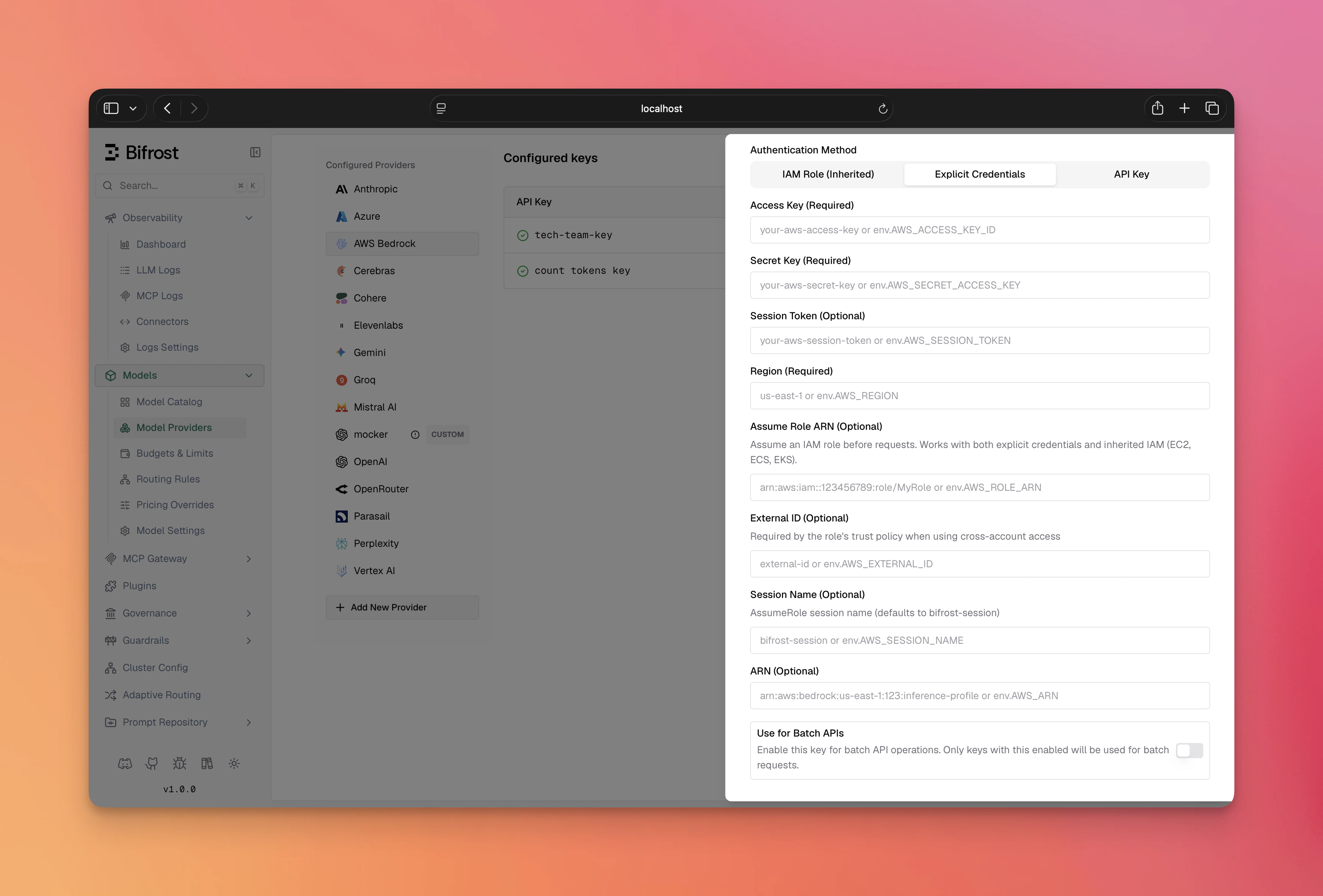
- Navigate to “Model Providers” → “Configurations” → “AWS Bedrock”
- Click “Add Key” (or edit an existing key)
- Under Authentication Method, select “Explicit Credentials”
- Set Access Key: Your AWS access key ID
- Set Secret Key: Your AWS secret access key
- Set Session Token (Optional): For temporary/assumed credentials
- Set Region: e.g.,
us-east-1 - Configure Aliases: Map model names to inference profile IDs - see Inference Profiles & ARN Configuration when using inference profiles
- Save
2. Inherited AWS Credentials / IAM Role
Uses AWS’s default credential chain when static credentials are not configured. That includes IAM roles (IRSA in EKS, ECS task role, EC2 instance profile), environment variables (AWS_ACCESS_KEY_ID/AWS_SECRET_ACCESS_KEY), and shared credential files.
- Web UI
- API
- config.json
- Go SDK
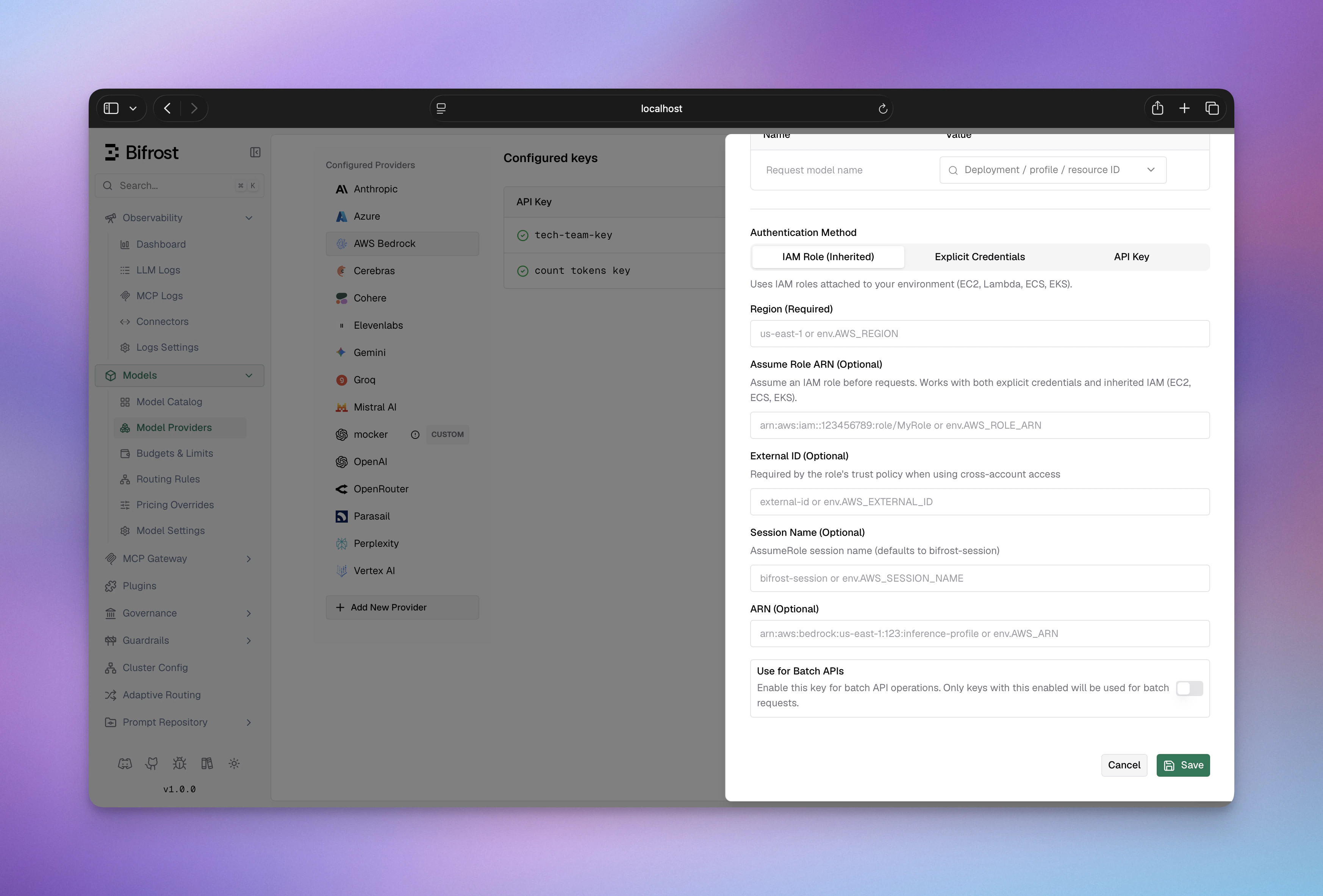
- Navigate to “Model Providers” → “Configurations” → “AWS Bedrock”
- Click “Add Key” (or edit an existing key)
- Under Authentication Method, select “IAM Role (Inherited)”
- Set Region: e.g.,
us-east-1 - Configure Aliases if needed - see Inference Profiles & ARN Configuration when using inference profiles
- (Optional) Set Assume Role ARN: to assume an IAM role before signing (e.g.,
arn:aws:iam::123456789012:role/BedrockRole) - (Optional) Set External ID: required when the role’s trust policy demands it
- (Optional) Set Session Name: identifies the session in CloudTrail (default:
bifrost-session) - Save
AWS_ACCESS_KEY_ID/AWS_SECRET_ACCESS_KEY are set in the environment.3. API Key
Setvalue to a Bearer token for direct API key authentication. This method uses a Bearer token instead of SigV4 signing and does not support STS AssumeRole.
- Web UI
- API
- config.json
- Go SDK
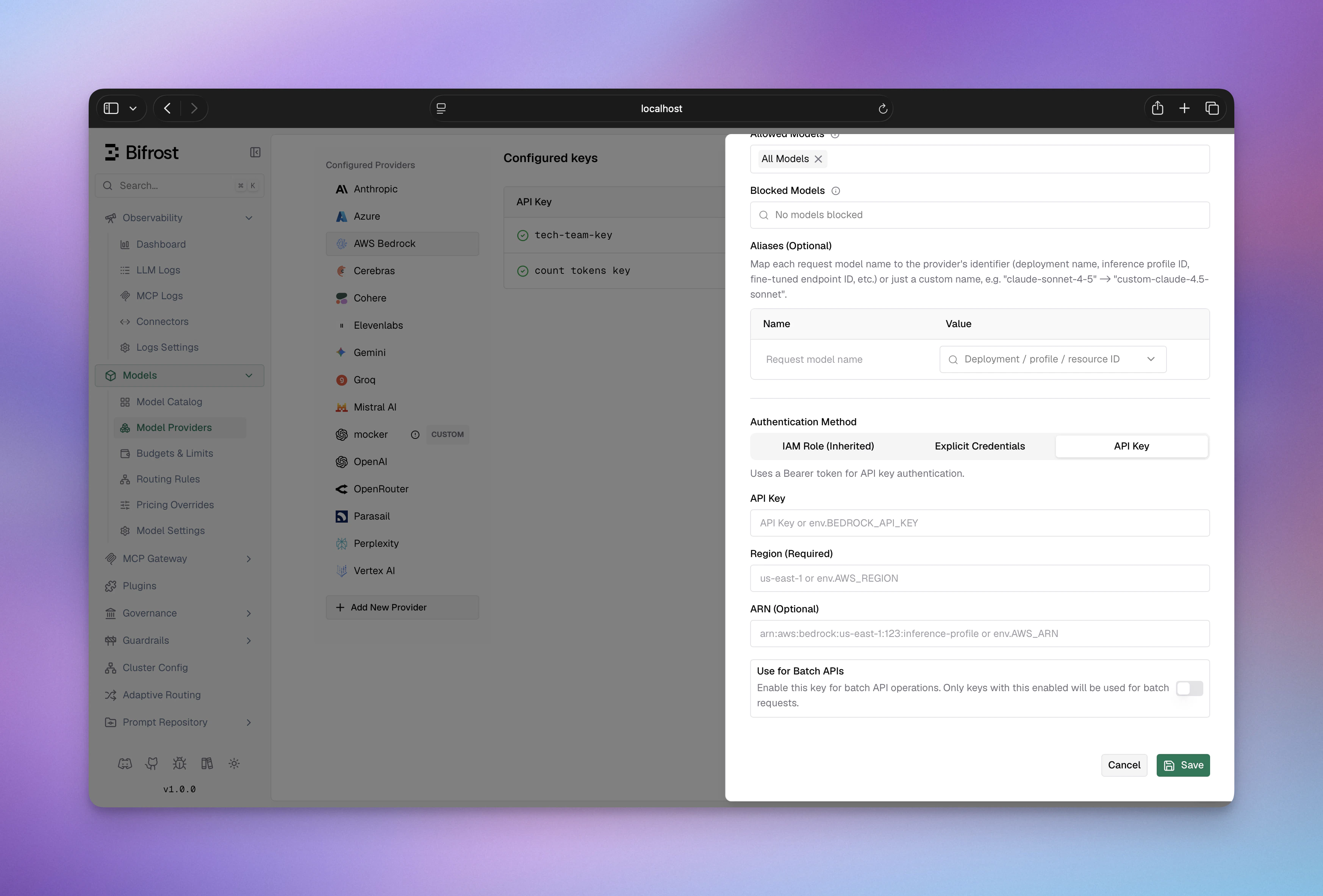
- Navigate to “Model Providers” → “Configurations” → “AWS Bedrock”
- Click “Add Key” (or edit an existing key)
- Under Authentication Method, select “API Key”
- Set API Key: Your Bedrock API key (Bearer token)
- Set Region: e.g.,
us-east-1 - Configure Aliases if needed - see Inference Profiles & ARN Configuration when using inference profiles
- Save
bedrock_key_config fields:
Key-level fields:
Beta Headers
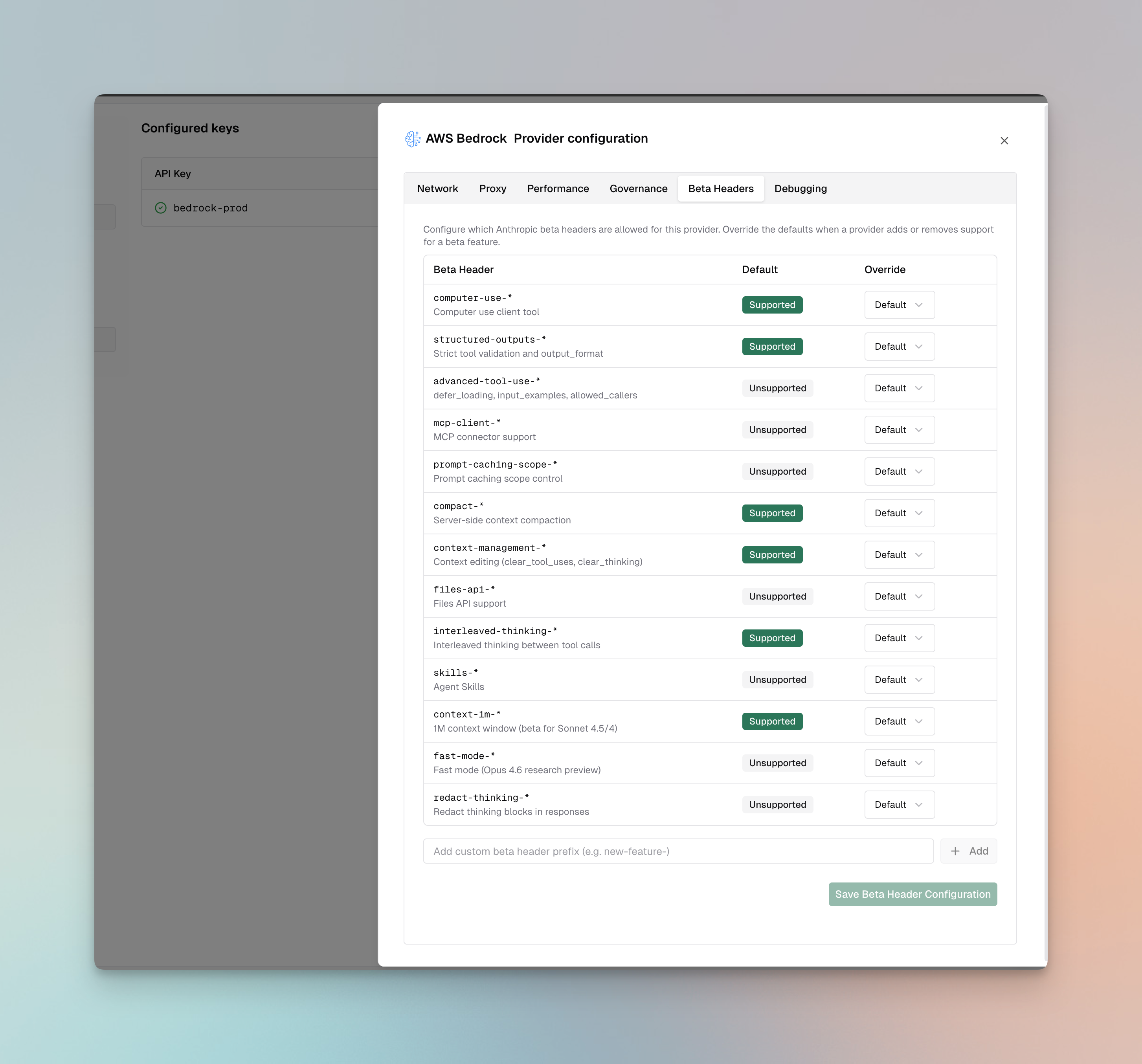
For Claude models on Bedrock, Bifrost validatesanthropic-beta headers and drops unsupported headers from the request.
Supported: computer-use-*, structured-outputs-*, compact-*, context-management-*, interleaved-thinking-*, context-1m-*
Not supported: advanced-tool-use-*, mcp-client-*, prompt-caching-scope-*, files-api-*, skills-*, fast-mode-*, redact-thinking-*
You can override these defaults per provider via the Beta Headers tab in provider configuration or via beta_header_overrides. See the full support matrix in the Anthropic provider docs.
1. Chat Completions
Request Parameters
Parameter Mapping
Dropped Parameters
The following parameters are silently ignored:frequency_penalty, presence_penalty, logit_bias, logprobs, top_logprobs, seed, parallel_tool_calls
Extra Parameters
Useextra_params (SDK) or pass directly in request body (Gateway) for Bedrock-specific fields:
- Gateway
- Go SDK
guardrailConfig- Bedrock guardrail configuration withguardrailIdentifier,guardrailVersion,traceperformanceConfig- Performance optimization withlatency(“optimized” or “standard”)additionalModelRequestFieldPaths- Pass-through for model-specific fields not in standard schemapromptVariables- Variables for prompt templates (if using prompt caching)requestMetadata- Custom metadata for request tracking
Cache Control
Bifrost can also add the marker for clients that send none. Setprompt_cache.auto_inject on the provider and the first cacheable block is marked
automatically, which Bedrock receives as a cachePoint. See
Prompt caching.
Prompt caching is supported via cache control directives:
- Gateway
- Go SDK
Reasoning / Thinking
Documentation: See Bifrost Reasoning Reference Reasoning/thinking support varies by model family:Anthropic Claude Models
Parameter Mapping:reasoning.effort→thinkingConfig.type = "enabled"(always enabled when reasoning present)reasoning.max_tokens→thinkingConfig.budgetTokens(token budget for thinking)
- Minimum budget: 1024 tokens required; requests below this fail with error
- Dynamic budget:
-1is converted to1024automatically
Anthropic Nova Models
Parameter Mapping:reasoning.effort→reasoningConfig.thinkingLevel(“low” →low, “high” →high)reasoning.max_tokens→ Max reasoning tokens (affects inference configuration)
Message Conversion
Critical Caveats
- System message extraction: System messages are removed from messages array and placed in separate
systemfield - Tool message grouping: Consecutive tool messages are merged into single user message with tool result content blocks
- Image format: Only base64/data URI supported; remote image URLs are not supported by Bedrock Converse API
- Document support: Bifrost’s Bedrock conversion path currently supports PDF, CSV, DOC, DOCX, XLS, XLSX, HTML, TXT, MD formats
Supported Chat Content Blocks
The Chat Completions request format is OpenAI-compatible for standard blocks (type: "text", type: "image_url", type: "file"). Bifrost converts these blocks to Bedrock Converse blocks internally. Bedrock-specific extensions (for example, standalone cachePoint) are also accepted when using the Bedrock provider.
Image Conversion
- Request shape (client → Bifrost):
type: "image_url"withimage_url.urlset to a data URI/base64 image - Internal Bedrock shape (Bifrost → Bedrock): Converted to
image: { format, source: { bytes } } - URL images: ❌ Not supported - Will fail if attempted
- Documents: Converted to document content blocks with MIME types
Image Block Example (image_url)
- Gateway
- Go SDK
File Block Example (file → Bedrock document)
- Gateway
- Go SDK
file_data is raw base64-encoded content (no data: URI prefix, unlike image_url).
Formats currently supported by Bifrost’s Bedrock document conversion path: pdf, txt, md, html, csv, doc, docx, xls, xlsx.
Standalone Cache Point Example (Bedrock-specific)
cachePoint block is a Bifrost/Bedrock extension (not OpenAI-standard) and should be used only with the Bedrock provider.
Unsupported Block Notes
input_audioblocks are not supported by Bedrock Converse and return an error.- For chat content conversion, use
file.file_datafor document payloads.file_urlandfile_idare not the documented Bedrock chat-content path here.
Cache Control Locations
Cache directives supported on:- System content blocks (entire system message)
- User message content blocks (specific parts)
- Tool definitions within tool configuration
Tool Conversion
Tool definitions are restructured:function.name→name(preserved)function.parameters→inputSchema(Schema format)function.strict→ Dropped (not supported by Bedrock)
Tool Choice Mapping
Tool Call Handling
Tool calls are converted between formats:- Bifrost → Bedrock: Tool call arguments converted from JSON object to
inputfield - Bedrock → Bifrost: Tool use results with
toolUseId, converted back to Bifrost format - Tool results: Merged consecutive tool messages into single user message
Structured Output
Structured output uses a special tool-based approach:Response Conversion
Field Mapping
stopReason→finish_reason:endTurn/stopSequence→stop,maxTokens→length,toolUse→tool_callsusage.inputTokens + usage.cacheReadInputTokens + usage.cacheWriteInputTokens→prompt_tokens(all cache counts rolled into the total)- Cache token breakdown surfaced in
prompt_tokens_details:usage.cacheReadInputTokens→prompt_tokens_details.cached_read_tokensusage.cacheWriteInputTokens→prompt_tokens_details.cached_write_tokens
usage.outputTokens→completion_tokensreasoning/thinkingblocks →reasoning_detailswith index, type, text, and signature- Tool call
input(object) →arguments(JSON string)
Structured Output Response
When structured output is detected:- Tool call with name
bf_so_*is treated as structured output inputobject is extracted and returned ascontentStr- Removed from
toolCallsarray
Streaming
Chat Completions Streaming
Event sequence from Bedrock Converse Stream API:- Initial message role:
contentBlockIndexand role information - Content block starts:
toolUseblocks withtoolUseId,name - Content block deltas:
- Text delta: Incremental text content
- Tool use delta: Accumulated tool call arguments (JSON)
- Reasoning delta: Reasoning text and optional signature
- Message completion:
stopReasonand final token counts - Usage metrics: Token counts, cached tokens, performance metrics
- Each Bedrock streaming event → Multiple Bifrost chunks as needed
- Tool arguments accumulated across deltas and emitted on block end
- Reasoning content emitted with signature if present
Text Completion Streaming
❌ Not supported - AWS Bedrock’s text completion API does not support streaming.Responses API Streaming
Streaming responses use OpenAI-compatible lifecycle events:response.createdresponse.in_progresscontent_part.startcontent_part.deltacontent_part.donefunction_call_arguments.deltafunction_call_arguments.doneoutput_item.done
- Tool arguments accumulated across deltas
- Content block indices mapped to output indices
- Synthetic events emitted for text/reasoning content
2. Responses API
The Responses API uses the same underlyingconverse endpoint but converts between OpenAI’s Responses format and Bedrock’s Messages format.
Request Parameters
Parameter Mapping
Extra Parameters
Useextra_params (SDK) or pass directly in request body (Gateway):
- Gateway
- Go SDK
Input & Instructions
- Input: String wrapped as user message or array converted to messages
- Instructions: Becomes system message (same extraction as Chat Completions)
- Cache control: Supported on instructions (system) and input messages
Response Conversion
stopReason→status:endTurn/stopSequence→completed,maxTokens→incompleteusage.inputTokensis aggregated intoinput_tokens(same semantics as Chat: Bedrock’sinputTokens+cacheReadInputTokens+cacheWriteInputTokensrolled up intoinput_tokens);usage.outputTokens→output_tokens(preserved as-is)- Cache tokens:
cacheReadInputTokens→input_tokens_details.cached_read_tokens|cacheWriteInputTokens→input_tokens_details.cached_write_tokens - Output items:
text→message|toolUse→function_call|thinking→reasoning
Streaming
Event sequence:response.created → response.in_progress → content_part.start → content_part.delta → content_part.done → output_item.done
3. Text Completions (Legacy)
Request conversion:-
Claude models: Uses Anthropic’s
/v1/completeformat with prompt wrappingpromptauto-wrapped with\n\nHuman: {prompt}\n\nAssistant:max_tokens→max_tokens_to_sampletemperature,top_pdirect pass-throughtop_k,stopviaextra_params
-
Mistral models: Uses standard format
max_tokens→max_tokenstemperature,top_pdirect pass-throughstop→stop
- Claude:
completion→choices[0].text - Mistral:
outputs[].text→choices[](supports multiple) stopReason→finish_reason
4. Embeddings
Supported embedding models: Titan, CohereRequest Parameters
Parameter Mapping
Titan-specific:
- No dimension customization
- Fixed output size per model version
- Reuses Cohere format conversion
- Similar parameter mapping to standard Cohere
Response Conversion
- Titan:
embedding→ single embedding vector - Cohere: Reuses Cohere response format with
embeddingsarray usage.inputTokens→usage.prompt_tokens
5. Image Generation
Supported image generation models: Titan Image Generator v1, Titan Image Generator v2, Nova Canvas v1Request Conversion
Quality Mapping
Thequality parameter is automatically mapped to Bedrock’s expected format:
Response Conversion
Example Request
- Gateway
- Go SDK
Stability AI models
Supported generation models:stability.stable-image-core-v1:1, stability.stable-image-ultra-v1:1
These models use a flat JSON body (not the nested Bedrock taskType structure). Bifrost detects them automatically - any model ID containing "stability." is converted via ToStabilityAIImageGenerationRequest.
Request Parameters
Example Request
- Gateway
- Go SDK
6. Image Edit
Supported image edit models: Titan Image Generator v1, Titan Image Generator v2, Nova Canvas v1 Bedrock supports three image edit task types: INPAINTING, OUTPAINTING, and BACKGROUND_REMOVAL. Thetype field is required and must be one of these values.
Request Parameters
Request Conversion
- Task Type Mapping:
Params.Typeis mapped totaskType:"inpainting"→"INPAINTING""outpainting"→"OUTPAINTING""background_removal"→"BACKGROUND_REMOVAL"- Any other value returns an error:
"unsupported type for Bedrock"
- Image Conversion: First image in
Input.Imagesis converted to base64:image.Image→ base64 string - Task-Specific Parameters:
- INPAINTING: Uses
inPaintingParams:prompt→inPaintingParams.textimage(base64) →inPaintingParams.imagemask(if present) →inPaintingParams.maskImage(base64)negative_text(viaExtraParams) →inPaintingParams.negativeTextmask_prompt(viaExtraParams) →inPaintingParams.maskPromptreturn_mask(viaExtraParams) →inPaintingParams.returnMask
- OUTPAINTING: Uses
outPaintingParams:prompt→outPaintingParams.textimage(base64) →outPaintingParams.imagemask(if present) →outPaintingParams.maskImage(base64)negative_text(viaExtraParams) →outPaintingParams.negativeTextmask_prompt(viaExtraParams) →outPaintingParams.maskPromptreturn_mask(viaExtraParams) →outPaintingParams.returnMaskoutpainting_mode(viaExtraParams, validated to"DEFAULT"or"PRECISE") →outPaintingParams.outPaintingMode
- BACKGROUND_REMOVAL: Uses
backgroundRemovalParams:image(base64) →backgroundRemovalParams.image- No other parameters supported
- INPAINTING: Uses
- Image Generation Config (for INPAINTING and OUTPAINTING only):
n→imageGenerationConfig.numberOfImagessize→imageGenerationConfig.widthandimageGenerationConfig.height(parsed from"WxH"format)quality→imageGenerationConfig.quality(see Quality Mapping)cfgScale(viaExtraParams["cfgScale"]) →imageGenerationConfig.cfgScale
- Uses the same response structure as image generation:
BedrockImageGenerationResponse→BifrostImageGenerationResponse - Response includes:
images[]: Array of base64-encoded imagesmaskImage: Base64-encoded mask image (ifreturn_maskwas true)error: Error message (if present)
invoke endpoint
Streaming: Image edit streaming is not supported by Bedrock.
Stability AI models
Stability AI edit models are automatically detected by their model ID (contains"stability."). The task type is inferred from the model name by default, but you can also set the type field explicitly - useful when using deployment aliases. See Type values for explicit task selection below.
Supported models
Common parameters
Task-specific extra parameters
Pass these viaextra_params (Go SDK) or as top-level form fields (Gateway).
Style-transfer image order matters. The first image (
image[0]) becomes
init_image (the content to transform) and the second (image[1]) becomes
style_image (the artistic reference). Both images must be non-empty.Type values for explicit task selection
You can set thetype field to override model-name inference. This is especially useful with deployment aliases where the alias name may not contain the Stability AI model pattern.
Example requests
- Inpaint
- Style transfer
- Outpaint
- Remove background
- Erase object
- Fast upscale
invoke endpoint (same as all other Bedrock image operations)
Streaming: Not supported.
7. Image Variation
Supported image variation models: Titan Image Generator v1, Titan Image Generator v2, Nova Canvas v1 Request ParametersRequest Conversion
- Task Type:
taskTypeis set to"IMAGE_VARIATION" - Image Conversion: All images are converted to base64 strings:
- Primary image:
Input.Image.Image→ base64 string →imageVariationParams.images[0] - Additional images:
ExtraParams["images"](stored as[][]byteby HTTP handler) → base64 strings → appended toimageVariationParams.images[]
- Primary image:
- Image Variation Parameters:
prompt(viaExtraParams["prompt"]) →imageVariationParams.textnegativeText(viaExtraParams["negativeText"]) →imageVariationParams.negativeTextsimilarityStrength(viaExtraParams["similarityStrength"]) →imageVariationParams.similarityStrength(validated to range [0.2, 1.0])
- Image Generation Config:
n→imageGenerationConfig.numberOfImagessize→imageGenerationConfig.widthandimageGenerationConfig.height(parsed from"WxH"format)quality(viaExtraParams["quality"]) →imageGenerationConfig.quality(see Quality Mapping)cfgScale(viaExtraParams["cfgScale"]) →imageGenerationConfig.cfgScale
- Uses the same response structure as image generation:
BedrockImageGenerationResponse→BifrostImageGenerationResponse - Response includes:
images[]: Array of base64-encoded image variationserror: Error message (if present)
invoke endpoint
Streaming: Image variation streaming is not supported by Bedrock.
8. Batch API
Request formats:requests array (CustomID + Params) or input_file_id
Pagination: Cursor-based with afterId, beforeId, limit
Endpoints:
- POST
/batch- Create batch - GET
/batch- List batches - GET
/batch/{batch_id}- Retrieve batch - POST
/batch/{batch_id}/cancel- Cancel batch
{recordId, modelOutput: {...}} or {recordId, error: {...}}
Status mapping:
Note: RFC3339Nano timestamps converted to Unix timestamps, multi-key retry supported
9. Files API
S3-backed file operations. Files are stored in S3 buckets integrated with
Bedrock.
file (required) and filename (optional)
Field mapping:
id(file ID)filenamesize_bytes(from S3 object size)created_at(Unix timestamp from S3 LastModified)mime_type(derived from content or explicitly set)
- POST
/v1/files- Upload - GET
/v1/files- List (cursor pagination) - GET
/v1/files/{file_id}- Retrieve metadata - DELETE
/v1/files/{file_id}- Delete - GET
/v1/files/{file_id}/content- Download content
"batch", status always "processed"
10. List Models
Request: GET/v1/models (no body)
Field mapping:
id(model name with deployment prefix if applicable)display_name→namecreated_at(Unix timestamp)
NextPageToken, FirstID, LastID
Filtering:
- Region-based model filtering
- Deployment mapping from configuration
- Model allowlist support (
allowed_modelsconfig)
models allowlist if configured
11. AWS Authentication & Configuration
Bifrost signs every Bedrock request with AWS Signature Version 4 (SigV4). Credentials are resolved in the following priority order, and STS AssumeRole can be layered on top of any of them.Authentication Methods
1. Explicit Credentials
Provideaccess_key and secret_key directly in bedrock_key_config. Optionally include a session_token for pre-obtained temporary credentials.
2. Default Credential Chain (IAM Role / Instance Profile)
Leaveaccess_key and secret_key empty (or omit them). Bifrost calls AWS LoadDefaultConfig which automatically resolves credentials from the environment in this order:
- Environment variables (
AWS_ACCESS_KEY_ID,AWS_SECRET_ACCESS_KEY,AWS_SESSION_TOKEN) - EKS IRSA (
AWS_WEB_IDENTITY_TOKEN_FILE+AWS_ROLE_ARN) - ECS task role
- EC2 instance profile (IMDS)
~/.aws/credentialsdefault profile
3. STS AssumeRole
Setrole_arn to assume an IAM role before signing requests. AssumeRole requires a valid source identity - it works when credentials are available either via explicit access_key/secret_key in key config, or via the default credential chain (environment variables, EC2 instance profile, ECS task role, EKS IRSA, etc.). If no credentials are available from either source, AssumeRole will fail.
Inference Profiles & ARN Configuration
Bedrock inference profiles come in two forms, and Bifrost builds the request path differently for each:
When an ARN is set, Bifrost builds the runtime path as
{arn}/{model_id}, URL-encodes it, and appends the operation - bedrock-runtime.{region}.amazonaws.com/model/{arn}%2F{model_id}/converse. When no ARN is set, the path is just {model_id} - enough for a plain model ID or a cross-region profile ID, which Bedrock resolves on its own. An application inference profile’s resource ID carries no such context, so it only resolves when paired with the ARN prefix.
The prefix must match the resource type of the ID it is paired with - an inference-profile prefix paired with an application profile’s resource ID does not resolve, and neither does an application-inference-profile prefix paired with a us.-prefixed profile ID.
Where to put the ARN: key level vs deployment level
Resolution order is deployment ARN → key ARN → none. A blank deployment ARN falls through to the key-level value.
Pick the level by what the key holds:
- Every model on the key is an application inference profile - set
arnonce at the key level and list only resource IDs inaliases. No per-deployment configuration needed. - The key mixes profile types - some foundation models or cross-region profiles alongside application inference profiles - leave the key-level
arnblank and set Inference profile ARN on only the deployments that need it. The rest keep sending the bare model ID.
The ARN must not include the resource ID
The ARN field is a prefix; Bifrost appends the model ID fromaliases to it.
The ARN’s region must match the region Bifrost signs with - the deployment-level Region when set, otherwise the key-level Region.
IAM permissions for application inference profiles
The profile is a resource in its own right, so a policy that grants only foundation-model access produces:bedrock:InvokeModelWithResponseStreamis a separate action frombedrock:InvokeModel- streaming requests fail without it even when non-streaming requests succeed.- The role also needs
bedrock:InvokeModel*on the underlying foundation model in every region the profile is associated with. Roles that already invoke Bedrock models have this; a fresh role does not. - The 403 names the exact action and resource it wanted. Grant that pair.
Example: application inference profile alongside a cross-region profile
An application inference profile for Claude Opus 4.8 (resource IDabc12xyz, us-east-1) served as claude-opus-4-8-alias, on the same key as a plain cross-region profile.
- Web UI
- config.json
- API
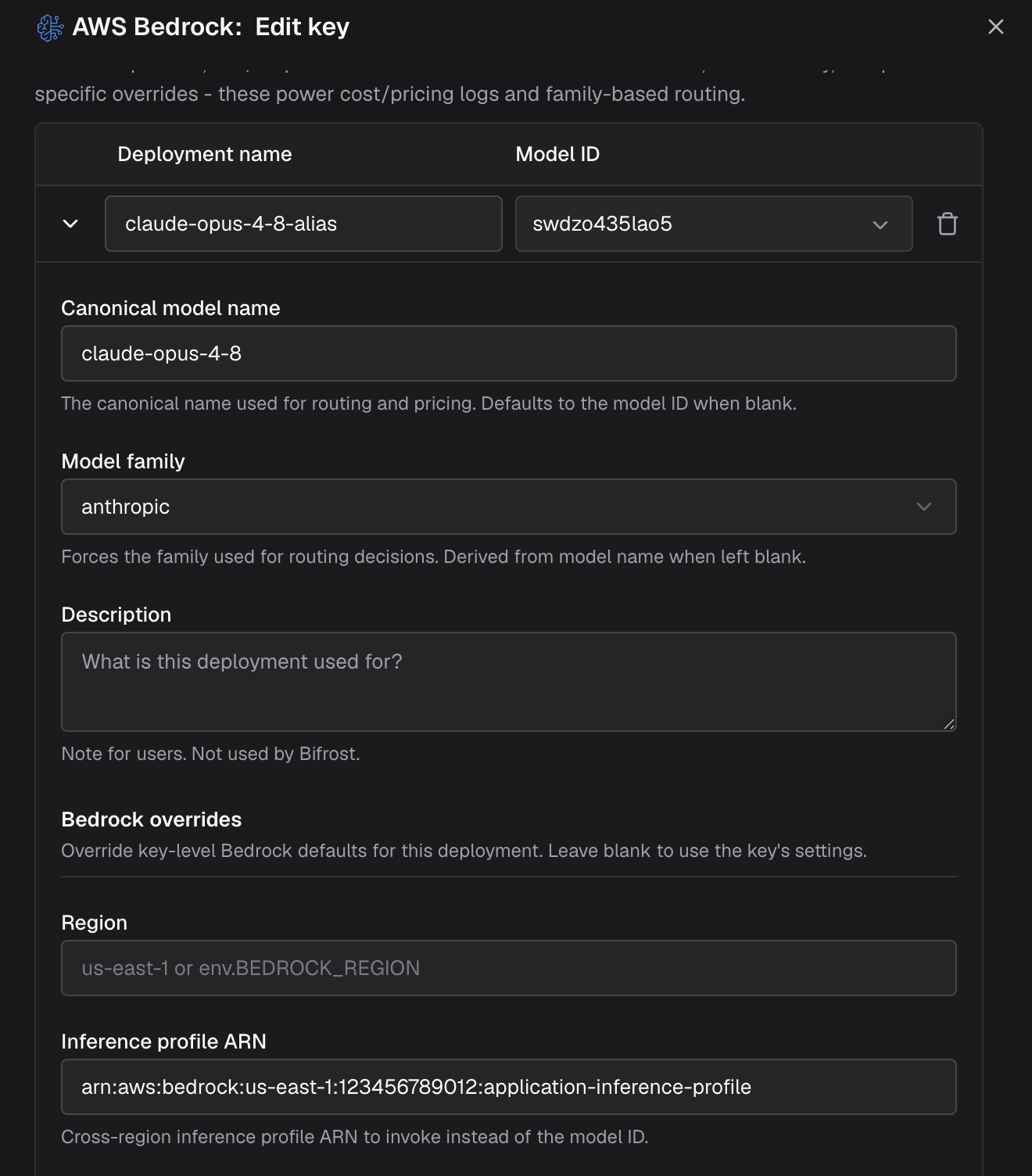
- Navigate to “Model Providers” → “Configurations” → “AWS Bedrock” and edit your key
- Add a deployment row - Deployment name:
claude-opus-4-8-alias, Model ID:abc12xyz - Expand the row and set:
- Canonical model name:
claude-opus-4-8- a profile resource ID carries no pricing information, so cost logs stay empty without this - Model family:
anthropic- a profile resource ID is not parseable into a family either - Inference profile ARN:
arn:aws:bedrock:us-east-1:123456789012:application-inference-profile - Region: only when this deployment lives in a different region than the key
- Canonical model name:
- Save, then call the model as
bedrock/claude-opus-4-8-alias
These examples use
"models": ["*"]. With a restricted list, the entries must
be the alias names (claude-opus-4-8-alias), not the profile resource IDs- key selection matches the requested model name before aliases are resolved.
The same applies to
blacklisted_models. See Aliasing Models.
Endpoints
- Runtime API:
bedrock-runtime.{region}.amazonaws.com/model/{path} - Control Plane:
bedrock.{region}.amazonaws.com(list models) - Batch API: Via bedrock-runtime
12. Error Handling
HTTP Status Mapping:
Error Response Structure:
- Context cancellation →
RequestCancelled - Request timeout →
ErrProviderRequestTimedOut - Streaming errors → Sent via channel with stream end indicator
- Response unmarshalling →
ErrProviderResponseUnmarshal
Caveats
Image Format Restriction
Image Format Restriction
Severity: High Behavior: Only base64/data URI images supported; remote
URLs not supported Impact: Requests with URL-based images fail Code:
chat.go:image handlingMinimum Reasoning Budget (Claude)
Minimum Reasoning Budget (Claude)
Severity: High
Behavior:
reasoning.max_tokens must be >= 1024
Impact: Requests with lower values fail with error
Code: chat.go:reasoning validationSystem Message Extraction
System Message Extraction
Severity: High Behavior: System messages removed from array, placed in
separate
system field Impact: Message array structure differs from input
Code: chat.go:message conversionTool Message Grouping
Tool Message Grouping
Severity: High Behavior: Consecutive tool messages merged into single
user message Impact: Message count and structure changes Code:
chat.go:tool message handlingModel Family-Specific Parameters
Model Family-Specific Parameters
Severity: Medium Behavior: Reasoning/thinking config varies
significantly by model family Impact: Parameter mapping differs for Claude
vs Nova vs other families Code:
chat.go, utils.go:model detectionText Completion Streaming Not Supported
Text Completion Streaming Not Supported
Severity: Medium Behavior: Text completion streaming returns error
Impact: Streaming not available for legacy completions API Code:
text.go:streamingStructured Output via Tool
Structured Output via Tool
Severity: Low Behavior:
response_format converted to special
bf_so_* tool Impact: Tool call count and structure changes internally
Code: chat.go:structured output handlingDeployment Region Prefix Handling
Deployment Region Prefix Handling
Severity: Low Behavior: Model IDs with region prefixes matched against
deployment config Impact: Model availability depends on deployment
configuration Code:
models.go:deployment matching