

library-research agent, which answers questions about software libraries, for these screenshots. Follow the steps with your own A2A agent and replace the example name, domain, and credentials with yours.
Register in the dashboard
1
Open the Agent Catalog
Open Agents → Agent Catalog and select New Agent.Give the registration a name such as
library-research. Use lowercase letters, digits, and single hyphens. The name becomes part of the gateway URL.For gRPC, agent names must be 63 characters or fewer because the name becomes a DNS label, such as
library-research in library-research.a2a.example.com. Longer names can still use JSON-RPC and REST.2
Fetch the agent card
Enter the complete agent card URL, including the path to the card, for example
The preview shows the agent’s skills, interfaces, capabilities, and advertised authentication. Check that this is the agent you intended to register.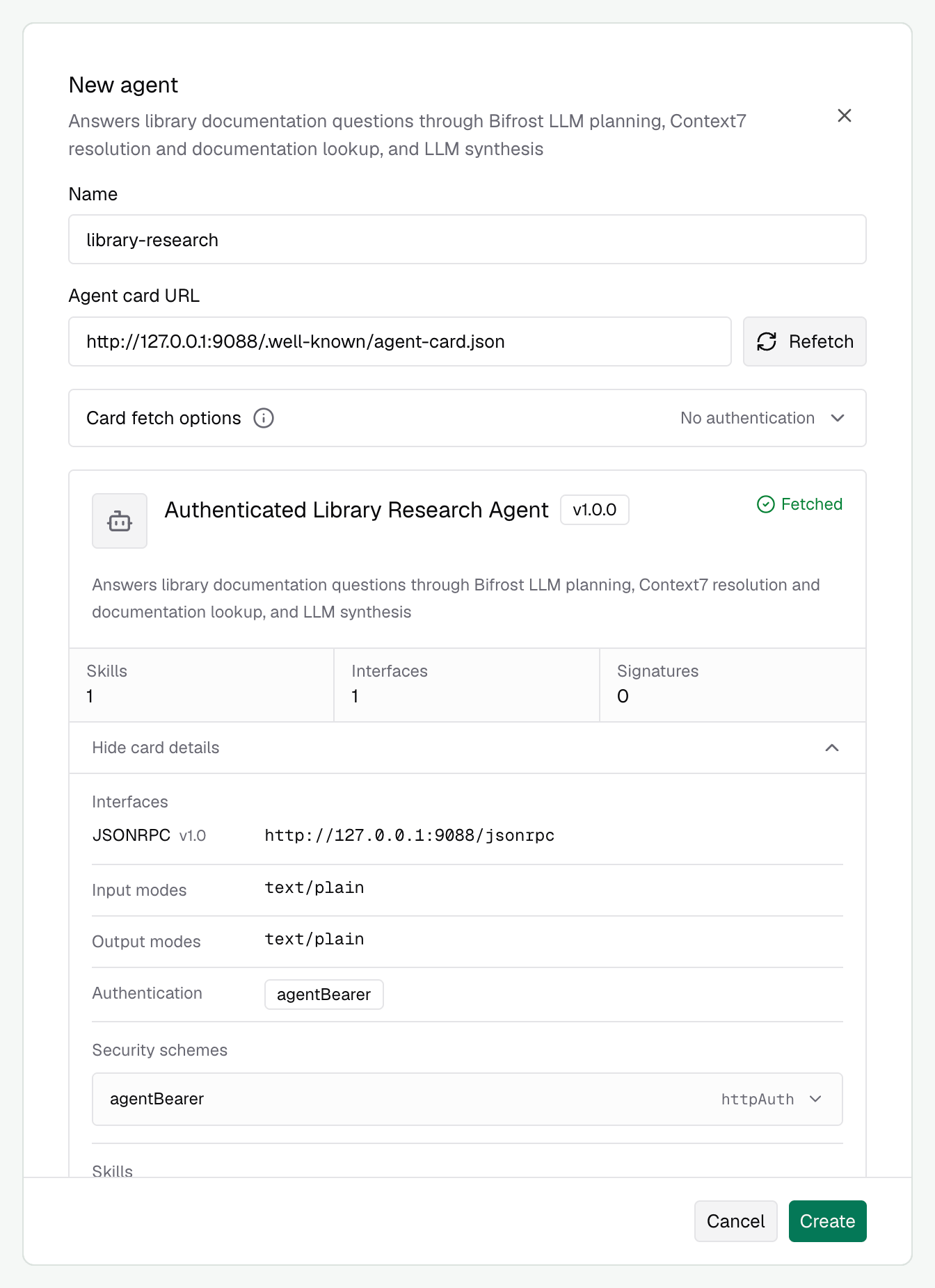
https://research.example.com/.well-known/agent-card.json. The base URL alone, such as https://research.example.com, is not enough. Select Fetch.Fetching a private agent card
Fetching a private agent card
Before selecting Fetch, expand Card fetch options and enter the credentials required to read the card. Bifrost uses these credentials for card discovery. Configure credentials for sending work separately under Request authentication.
3
Check request authentication
The card’s requirements select the request authentication fields. Fill in the credentials your agent expects.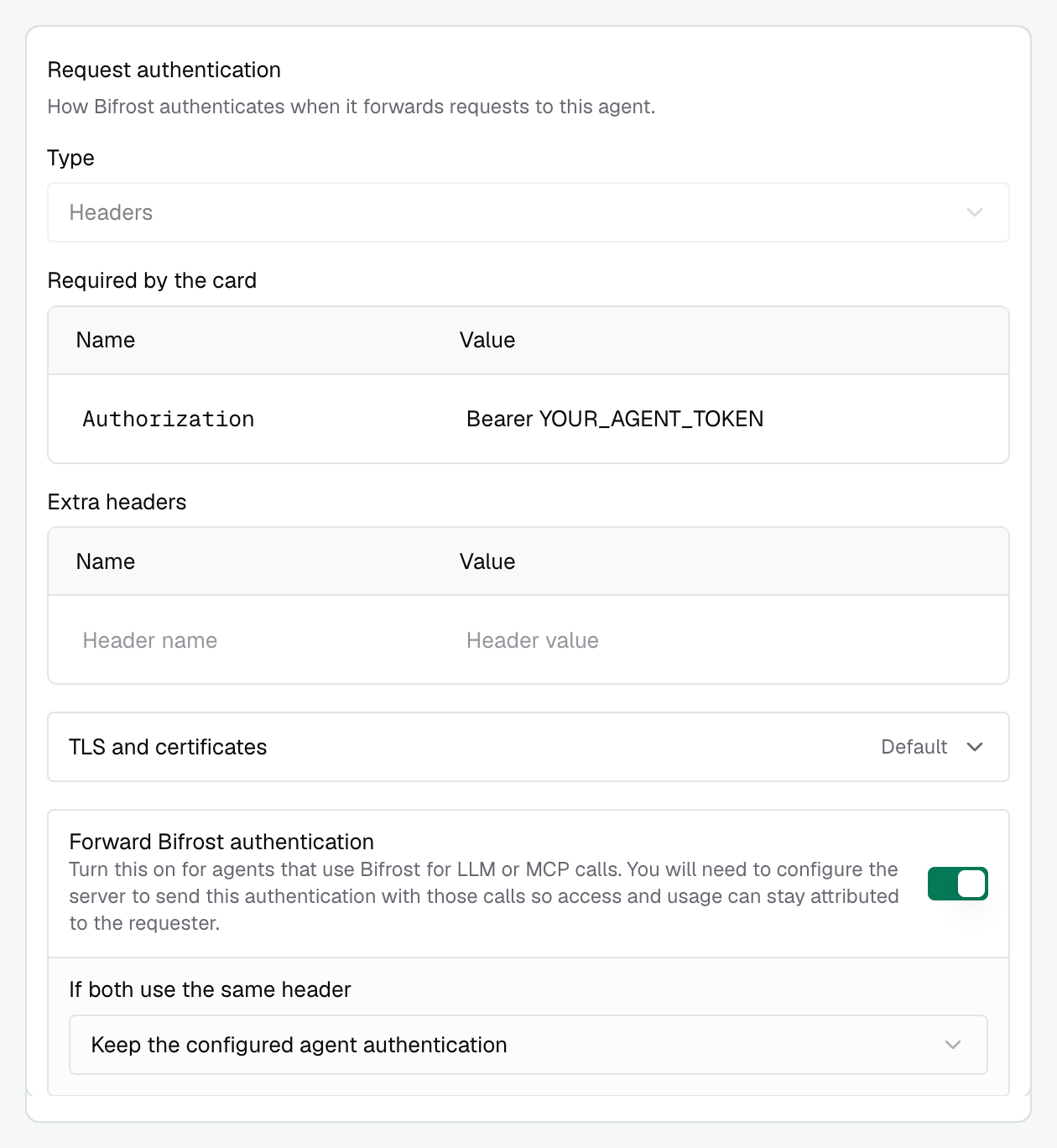
Authentication options
- Configure manually lets you override an inaccurate card or choose a different authentication setup. Use TLS and certificates for a private CA or mutual TLS.
- Forward Bifrost authentication passes the caller’s credentials to agents that use Bifrost for LLM or MCP calls. Enable it and configure your agent to reuse those credentials on its model and tool requests to preserve caller attribution.
4
Grant access and create
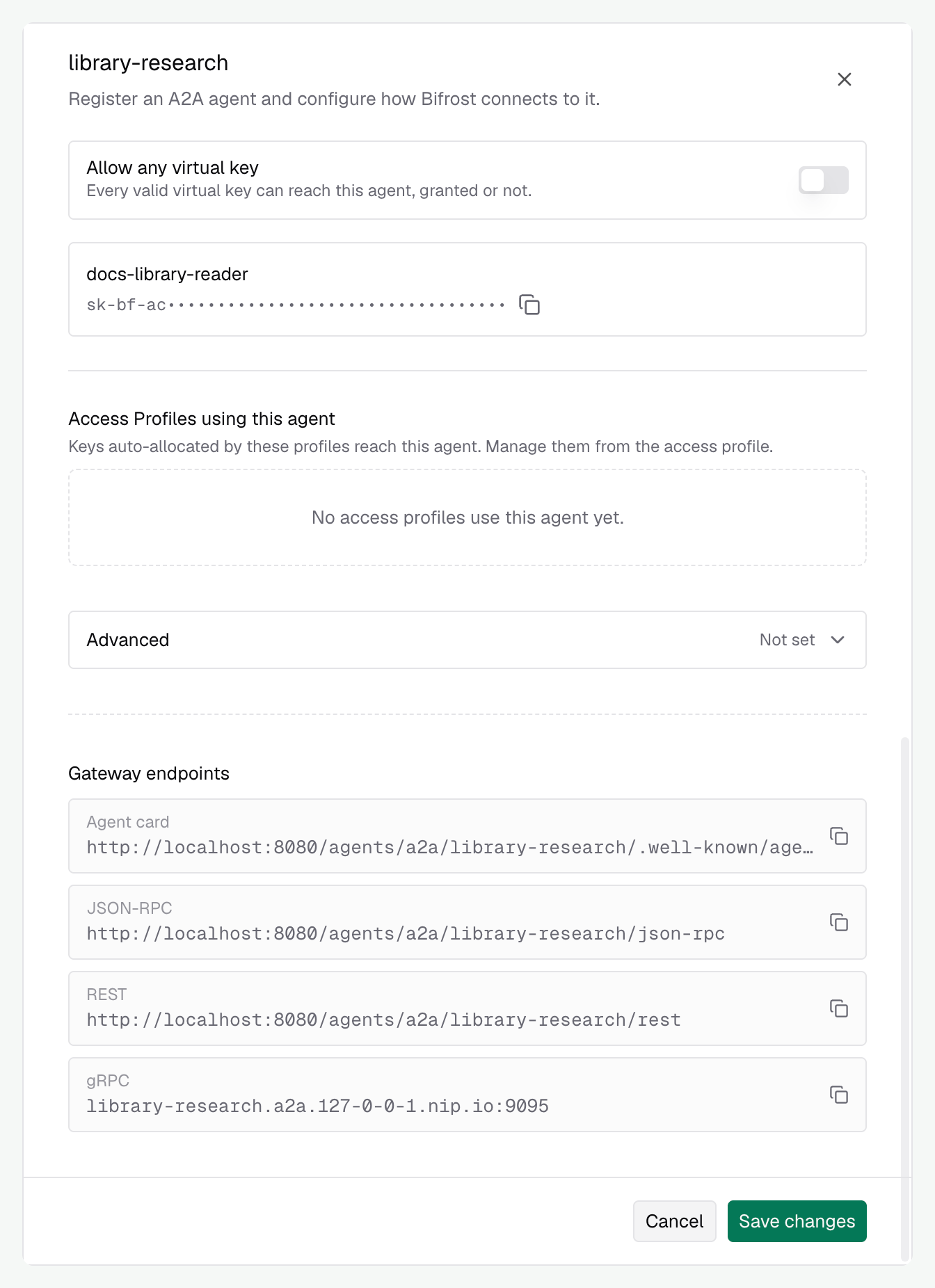
Select the virtual keys allowed to call the agent. Leave Allow any virtual key off for a restricted agent, or turn it on to allow identified callers without an explicit agent grant.Expand Advanced if you need to allow extension URIs for your A2A integration. Leave them empty for a basic registration. See Advanced registration options for their behavior.Select Create, then reopen the registration to copy its gateway endpoints. Point your client at the Bifrost agent card, rather than the original server card, so discovery returns the gateway routes.
Agent grants restrict authenticated callers. Enable inference authentication enforcement for a deployment that must reject anonymous calls. See access control.
Check your registered agent
Your agent appears in Agent Catalog after registration. Reopen it to review its access and copy the gateway endpoints.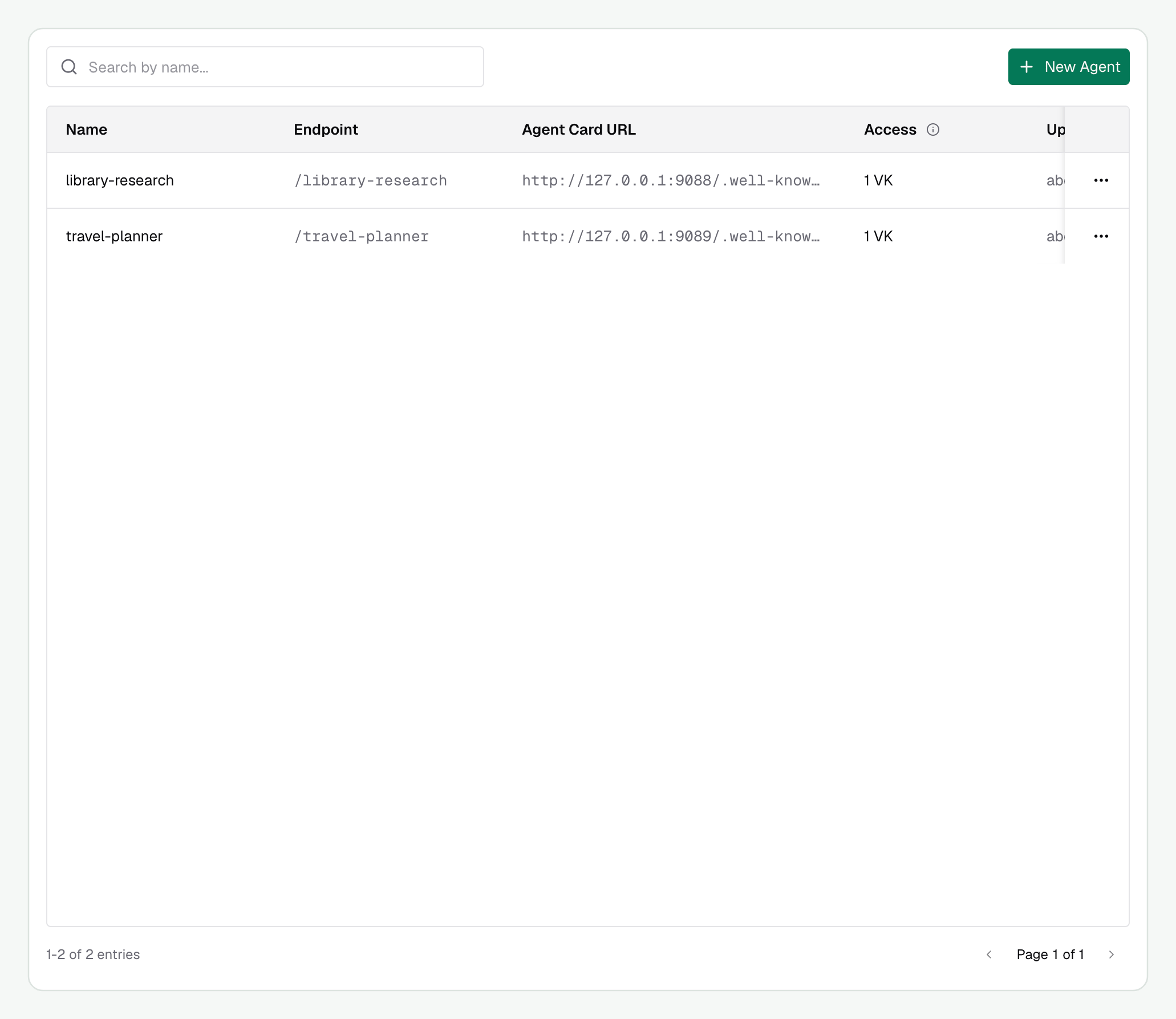
Each request to the gateway’s agent card URL fetches the current card from your agent server, using the configured card-fetch authentication. Bifrost rewrites its endpoints and authentication requirements for gateway access before returning it. It does not return a cached registration-time card. If your server cannot provide the card, the request fails.
Register from deployment configuration
- config.json
- Helm
Add an The virtual key must already exist or be declared in the deployment. Use its ID here, not its secret value. A runtime credential is only needed if your agent requires one.
agents entry to your configuration:split source of truth, removing an entry from the file does not delete its stored registration. With source_of_truth: "config.json", a present agents list is authoritative. See source of truth before mixing file and dashboard changes.
Manage registrations through the API
Manage registrations through the API
The API reference documents registration and card inspection endpoints. Management requests use dashboard or API authentication; that is separate from the credential used to call an agent.
PUT /api/agents/{name} replaces the registration. Include the settings and collections you intend to keep. Omitting authentication, extension URIs, or virtual-key IDs can remove them. The registration name stays fixed; use a new registration if you need a different route name.Make your first request
Use a virtual key granted access to this registration:Advanced registration options
Extension URIs
Extension URIs
A2A extensions describe extra protocol behavior identified by a URI. Allow the extensions your integration needs and the agent supports in
agents[].extension_uris. Your client must still request the extension through A2A negotiation. Adding an arbitrary URI does not implement it.If the card declares a required extension you have not allowed, registration or discovery can fail. A request for an unsupported extension is rejected before its protocol operation reaches the agent. Registration accepts at most 32 extension URIs, with each URI at most 2048 bytes; negotiated extension payloads are limited to 64 KiB.