

Overview
Bifrost provides 100% compatible endpoints for OpenAI, Anthropic, and Gemini APIs, making it seamless to integrate with any agent that uses these providers. By simply pointing your agent’s base URL to Bifrost, you unlock powerful features like:
- Universal Model Access: Use any provider/model configured in Bifrost with any agent (e.g., use GPT-5 with Claude Code, or Claude Sonnet 4.5 with Codex CLI)
- MCP Tools Integration: All Model Context Protocol tools configured in Bifrost become available to your agents
- Built-in Observability: Monitor all agent interactions in real-time through Bifrost’s logging dashboard
- Load Balancing: Automatically distribute requests across multiple providers and regions
- Advanced Features: Governance, caching, failover, and more - all transparent to your agent
Example Integrations
It is a modern, open-source chat client that supports multiple providers.
Setup:
-
Install LibreChat: There are multiple ways of local setup, please follow the LibreChat documentation for more details.
-
Add Bifrost as a custom provider: Now that you have LibreChat installed, you can add Bifrost as a custom provider.
Add the following to your
librechat.yaml file:
custom:
- name: "Bifrost"
apiKey: "dummy" # Add the authentication key if login is enabled, otherwise add a placeholder
baseURL: "http://host.docker.internal:8080/v1" # Or localhost:8080 if running locally, or {your-bifrost-container}:8080 if running in the same docker network
models:
default: ["openai/gpt-4o"] # Replace with the model you want to use
fetch: true
titleConvo: true
titleModel: "openai/gpt-4o" # Replace with the model you want to use for chat title generation
summarize: false # Set to true if you want to enable chat summary generation
summaryModel: "openai/gpt-4o" # Replace with the model you want to use for chat summary generation
forcePrompt: false # Set to true if you want to enable force prompt generation
modelDisplayLabel: "Bifrost"
iconURL: https://getbifrost.ai/bifrost-logo.png
If you’re running LibreChat in a docker container, LibreChat does not automatically use the librechat.yaml file, please check the Step 1 of the LibreChat documentation for more details.
-
Run LibreChat
Now you can start using Bifrost as a provider in LibreChat, with all the features of Bifrost.
It brings AI-powered coding capabilities directly to your terminal.
Setup:
-
Install Claude Code
npm install -g @anthropic-ai/claude-code
-
Configure Environment Variables
export ANTHROPIC_API_KEY=dummy-key # Handled by Bifrost (only set when using virtual keys)
export ANTHROPIC_BASE_URL=http://localhost:8080/anthropic
-
Run Claude Code
Now all Claude Code traffic flows through Bifrost, giving you access to any provider/model configured in your Bifrost setup, plus MCP tools and observability.
This setup automatically detects if you’re using Anthropic MAX account instead of a regular API key authentication :)
Model Configuration
Claude Code uses three model tiers: Sonnet (default), Opus (complex tasks), and Haiku (fast, lightweight). With Bifrost, you can override these defaults to use any model from any provider.
Override Default Models:
Set environment variables to replace Claude Code’s default model tiers with any Bifrost-configured model:
# Replace Sonnet tier with GPT-5
export ANTHROPIC_DEFAULT_SONNET_MODEL="openai/gpt-5"
# Replace Opus tier with Claude Opus 4.5
export ANTHROPIC_DEFAULT_OPUS_MODEL="anthropic/claude-opus-4-5-20251101"
# Replace Haiku tier with Azure-hosted Claude
export ANTHROPIC_DEFAULT_HAIKU_MODEL="azure/claude-haiku-4-5"
Alternative models must support tool use capabilities for file operations, terminal commands, and code editing to work properly with Claude Code.
Start with a Specific Model:
Launch Claude Code with a specific model using the --model flag:
# Start with Opus
claude --model claude-opus-4-5-20251101
# Start with Haiku for lightweight tasks
claude --model claude-haiku-4-5-20251001
Switching Models Mid-Session
Use the /model command to switch models during an active session:
# Using shorthand
/model opus
/model sonnet
/model haiku
# Using full model names
/model claude-opus-4-5-20251101
/model claude-sonnet-4-5-20250929
# Using different providers dynamically via Bifrost
/model vertex/claude-haiku-4-5
/model azure/claude-sonnet-4-5
/model bedrock/claude-sonnet-4-5
Run /model without arguments to check your current model. The switch is instantaneous and Claude Code seamlessly continues your conversation context with the new model.
If you use Claude-specific features like web search, computer use, or citations, ensure the model you switch to also supports these capabilities. Non-Claude models or Claude models on certain providers may not support all features.
Provider Compatibility
Not all providers work well with Claude Code. Since Claude Code heavily relies on tool calling for file operations, terminal commands, and code editing, providers must properly support and stream tool call arguments.Known Issues:
- OpenRouter: Does not stream function call arguments properly. Tool calls return with empty
arguments fields, causing Claude Code to fail when attempting file operations or other tool-based actions.
- Some proxy providers: May not fully implement the Anthropic API streaming specification for tool calls.
If you experience issues with tool calls not executing properly, try switching to a different provider in your Bifrost configuration.
Example: Full Bifrost Setup
Here’s a complete setup using Bifrost with custom model overrides:
# Core Bifrost configuration
export ANTHROPIC_API_KEY=your-bifrost-virtual-key
export ANTHROPIC_BASE_URL=http://localhost:8080/anthropic
# Custom model tiers (optional)
export ANTHROPIC_DEFAULT_SONNET_MODEL="anthropic/claude-sonnet-4-5-20250929"
export ANTHROPIC_DEFAULT_OPUS_MODEL="openai/gpt-5"
export ANTHROPIC_DEFAULT_HAIKU_MODEL="azure/claude-haiku-4-5"
# Start Claude Code
claude
Add these exports to your ~/.bashrc or ~/.zshrc for persistent configuration across terminal sessions.
It provides powerful code generation and completion capabilities.
Setup:
-
Install Codex CLI
npm install -g @openai/codex
-
Configure Environment Variables
export OPENAI_API_KEY=dummy-key # Handled by Bifrost (only set when using virtual keys)
export OPENAI_BASE_URL=http://localhost:8080/openai
-
Run Codex
It is Google’s powerful coding assistant with advanced reasoning capabilities.
Setup:
-
Install Gemini CLI
npm install -g @google/gemini-cli
-
Configure Environment Variables
export GEMINI_API_KEY=dummy-key # Handled by Bifrost (only set when using virtual keys)
export GOOGLE_GEMINI_BASE_URL=http://localhost:8080/genai
-
Run Gemini CLI
-
Select Use Gemini API Key in the CLI prompt for authentication.
It is Alibaba’s powerful coding assistant with advanced reasoning capabilities.
Setup:
-
Install Qwen Code
npm install -g @qwen-code/qwen-code
-
Configure Base URL
export OPENAI_BASE_URL=http://localhost:8080/openai
-
Run Qwen Code
Setup
- Configure Bifrost
{
"$schema": "https://opencode.ai/config.json",
// Theme configuration
"theme": "opencode",
"autoupdate": true,
"provider": {
"openai": {
"name": "Bifrost",
"options": {
"baseURL": "http://localhost:8080/openai",
"apiKey": "{{virtual-key-if-enabled}}"
},
"models": {
"openai/gpt-5": {
"options": {
"reasoningEffort": "high",
"textVerbosity": "low",
"reasoningSummary": "auto",
"include": [
"reasoning.encrypted_content"
],
},
},
"anthropic/claude-sonnet-4-5-20250929": {
"options": {
"thinking": {
"type": "enabled",
"budgetTokens": 16000,
},
},
},
},
}
}
}
- Select Bifrost models using ctrl+p
Editors
- Configure Bifrost provider.
"language_models": {
"openai_compatible": {
"Bifrost": {
"api_url": "{{bifrost-base-url}}/openai",
"available_models": [
{
"name": "anthropic/claude-sonnet-4.5",
"max_tokens": 200000,
"max_output_tokens": 4096,
"capabilities": {
"tools": true,
"images": true,
"parallel_tool_calls": true,
"prompt_cache_key": false
}
},
{
"name": "openai/gpt-4o",
"max_tokens": 128000,
"max_output_tokens": 4096,
"capabilities": {
"tools": true,
"images": true,
"parallel_tool_calls": true,
"prompt_cache_key": false
}
},
{
"name": "openai/gpt-5",
"max_tokens": 256000,
"max_output_tokens": 4096,
"capabilities": {
"tools": true,
"images": true,
"parallel_tool_calls": true,
"prompt_cache_key": false
}
}
]
}
}
}
- Reload workspace to make sure Zed editor recognizes and reloads the provider list.
Configuration
Agent integrations work with your existing Bifrost configuration. Ensure you have:
Monitoring Agent Traffic
All agent interactions are automatically logged and can be monitored at http://localhost:8080/logs. You can filter by provider, model, or search through conversation content to track your agents’ performance.
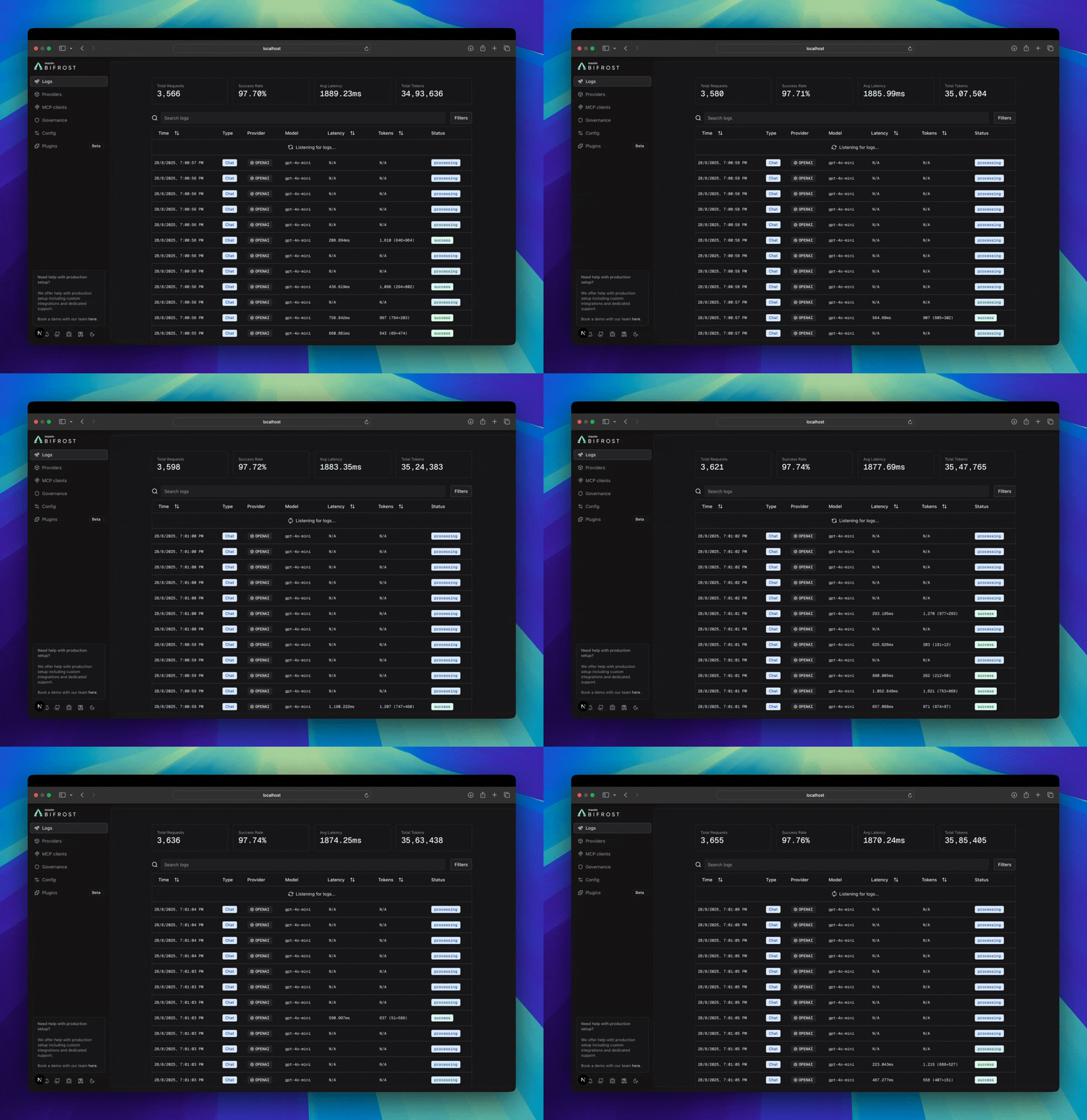
For complete monitoring capabilities, see Built-in Observability.
This feature is only available on v1.4.0-prerelease1 and above.
Bifrost exposes all configured MCP tools through a dedicated MCP server endpoint at /mcp. This allows external MCP clients (Claude Code, Cursor, and other MCP-compatible applications) to connect directly and access your tools.
Connect Claude Code to Bifrost MCP
Add Bifrost as an MCP server to Claude Code:
claude mcp add --transport http bifrost http://localhost:8080/mcp
Using Virtual Key Authentication:
If you have virtual key authentication enabled in Bifrost, connect using the JSON configuration format:
claude mcp add-json bifrost '{"type":"http","url":"http://localhost:8080/mcp","headers":{"Authorization":"Bearer bf-virtual-key"}}'
Replace bf-virtual-key with your actual Bifrost virtual key.
Claude Code will only have access to the specific MCP tools permitted by the virtual key’s configuration. To grant access to additional tools, verify or modify the virtual key’s MCP tool permissions in the Bifrost dashboard.
Supported Agents
You can connect any MCP-compatible client to Bifrost’s MCP server:
- Claude Code - Add via
claude mcp add command
- Cursor IDE - Configure in cursor settings
- Custom Applications - Any app implementing the MCP protocol
Control which tools each client can access using Virtual Keys:
- Create a Virtual Key for each client/environment
- Configure which MCP servers and tools the key can access
- Bifrost automatically enforces these permissions
For complete setup instructions and tool filtering options, see MCP Gateway URL.
Next Steps