
Overview

This guide walks you through configuring Okta as your identity provider for Bifrost Enterprise. After completing this setup, your users will be able to sign in to Bifrost using their Okta credentials, with roles and team memberships automatically synchronized.

Prerequisites

  • An Okta organization with admin access
  • Bifrost Enterprise deployed and accessible
  • The redirect URI for your Bifrost instance (e.g., https://your-bifrost-domain.com/login)

Step 1: Create an OIDC Application

  1. Log in to the Okta Admin Console
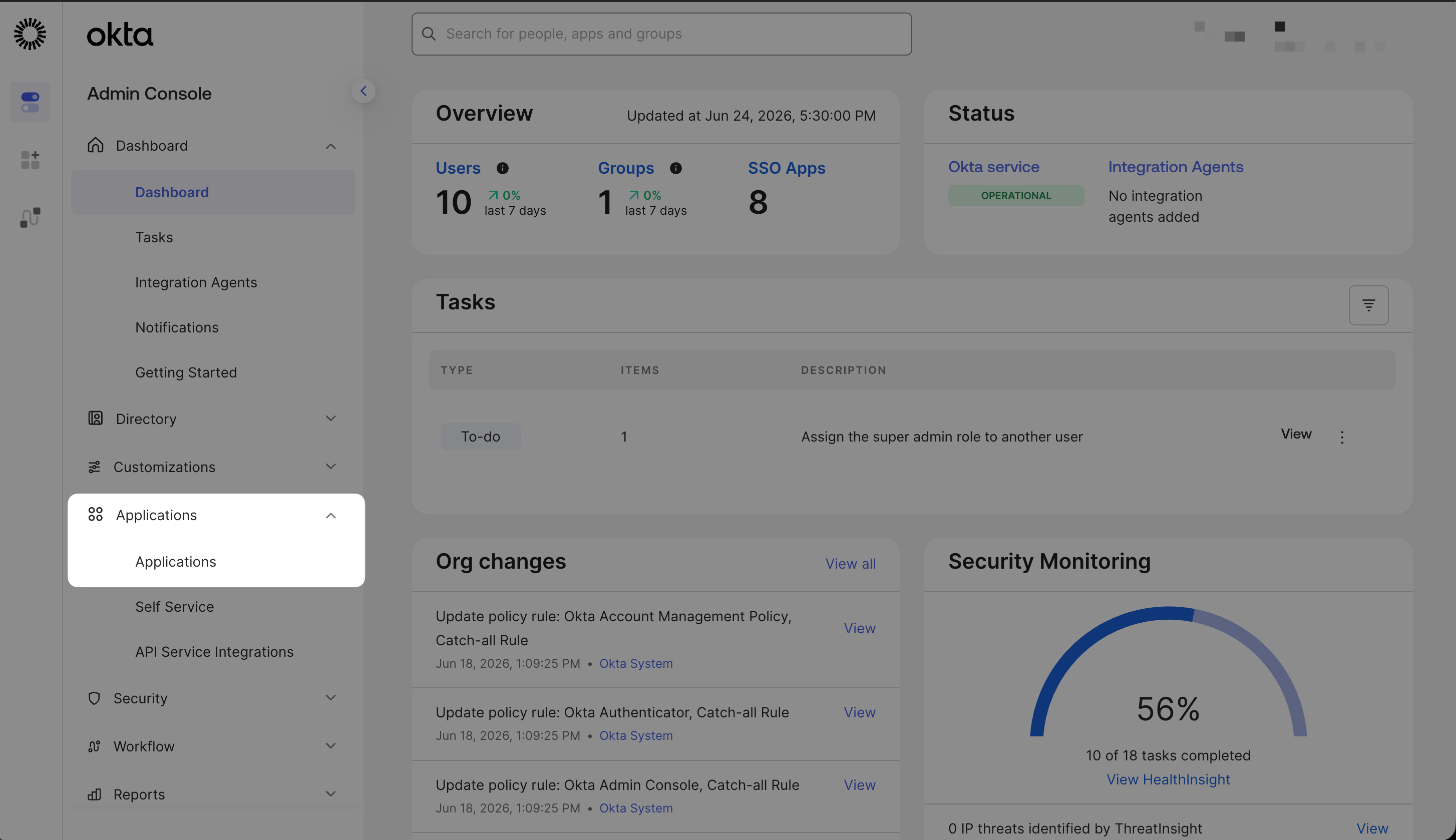
  2. Navigate to ApplicationsApplications
  3. Click Create App Integration
Okta Applications page
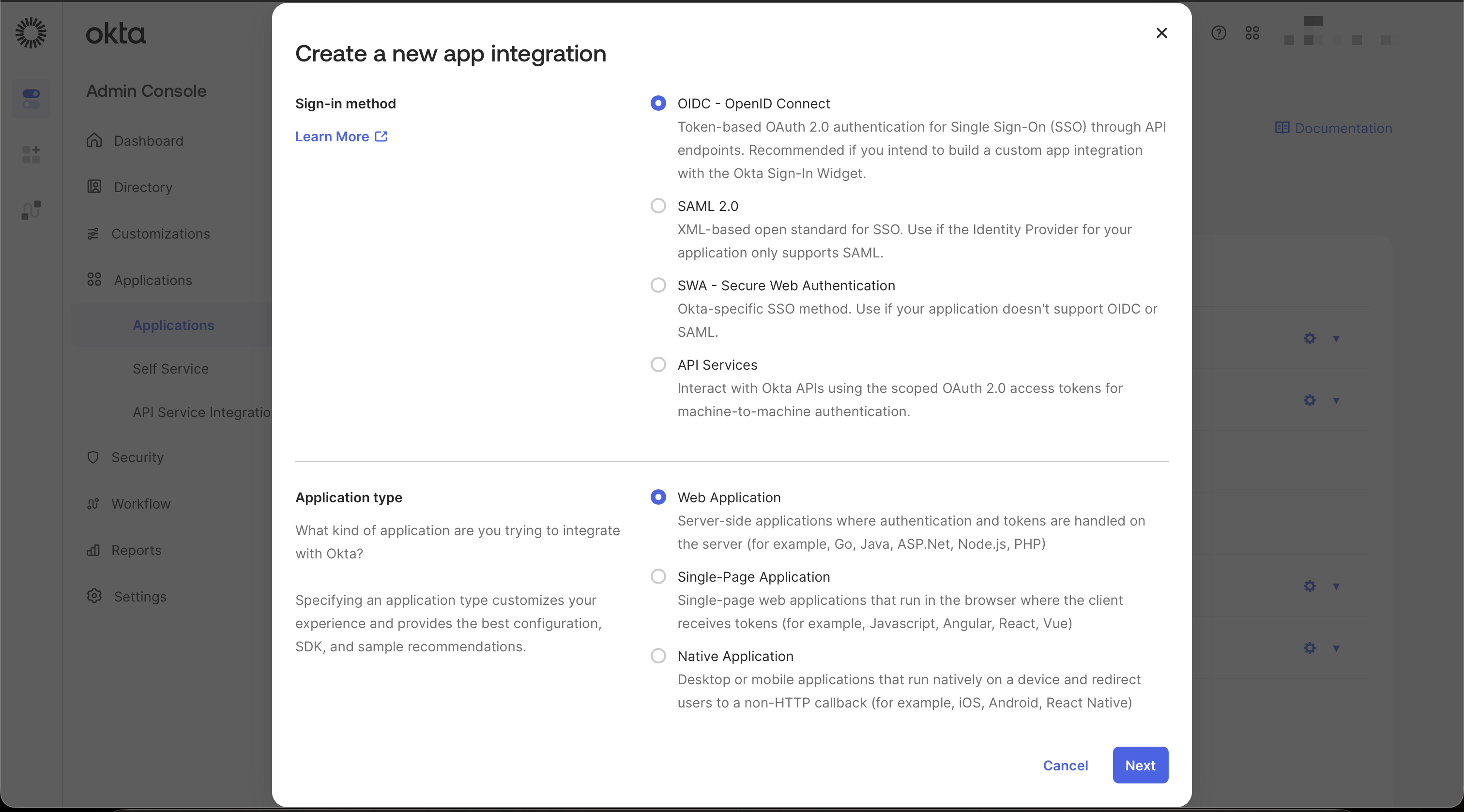
  1. In the dialog, select:
    • Sign-in method: OIDC - OpenID Connect
    • Application type: Web Application
Create new app integration dialog
  1. Click Next to continue

Step 2: Configure Application Settings

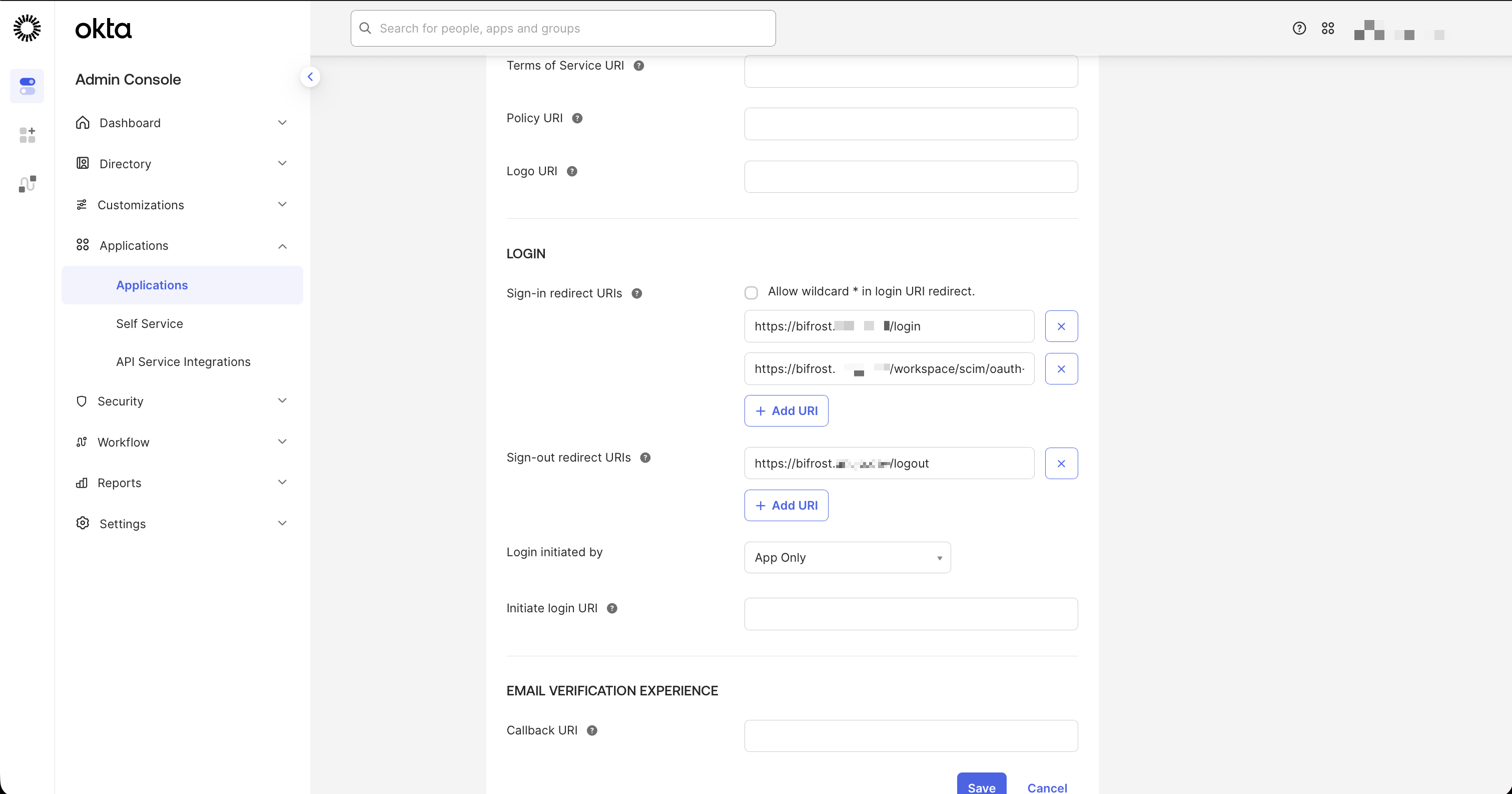
Configure the following settings for your application:
New Web App Integration settings
General Settings: Grant type:
  • Enable Authorization Code
  • Enable Refresh Token
Sign-in redirect URIs:
  • Add your Bifrost login callback URL: https://your-bifrost-domain.com/login
Sign-out redirect URIs (Optional):
  • Add your Bifrost base URL: https://your-bifrost-domain.com
Assignments:
  • Choose Skip group assignment for now (we’ll configure this later)
  1. Click Save to create the application
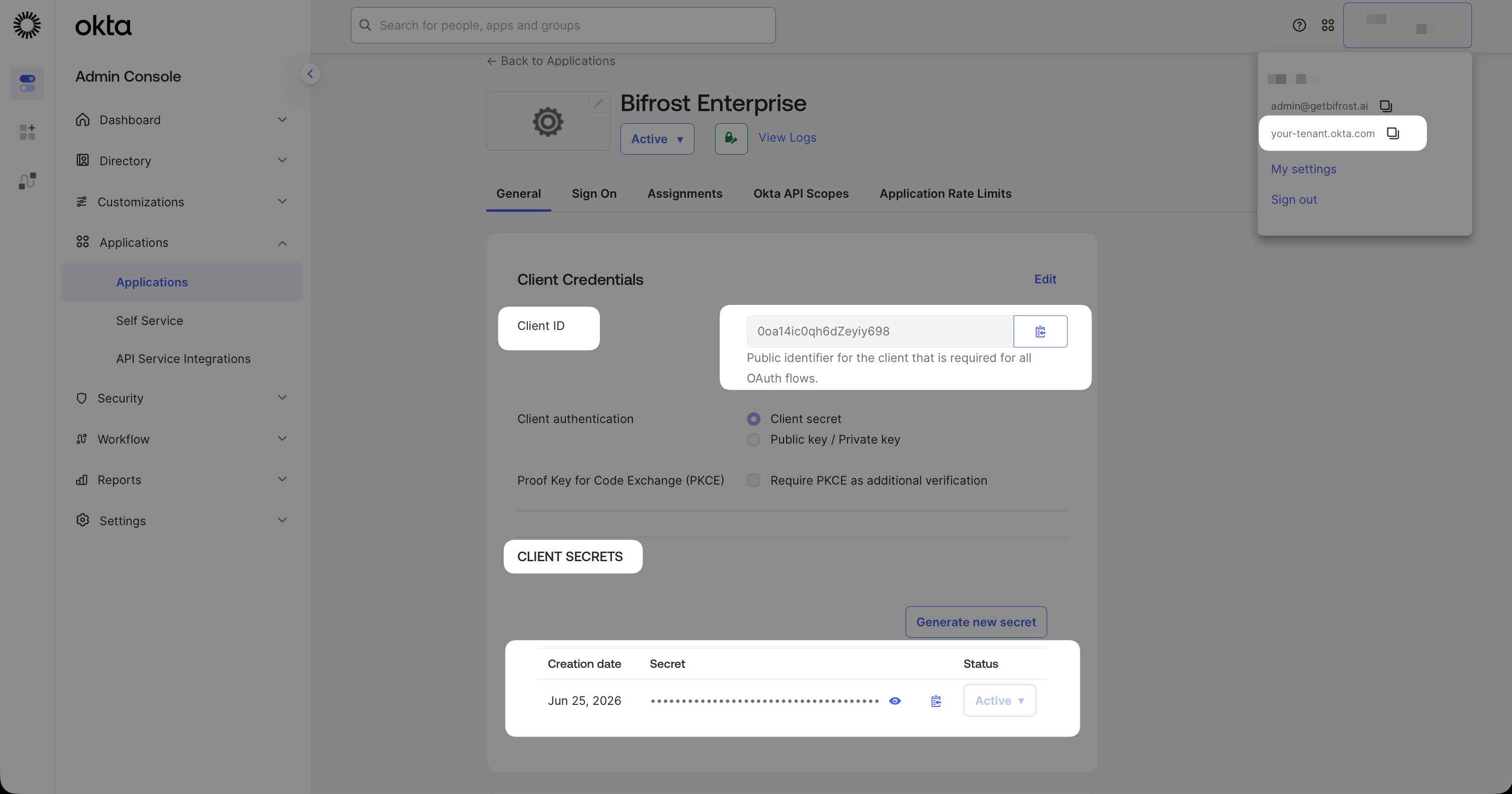
  2. After saving, note down the following from the General tab:
    • Client ID
    • Client Secret (click to reveal)

Step 3: Configure Authorization Server (optional)

The default authorization server (/oauth2/default) is available to all Okta plans and supports custom claims, including role claims. The API Access Management paid add-on is only required to create additional custom authorization servers beyond the default.
Bifrost uses Okta’s Authorization Server to issue tokens. You have three options:
  1. Use /oauth2/default with role claims (recommended) — Complete Steps 4-7 to configure custom role claims on the default authorization server. This enables automatic RBAC synchronization.
  2. Use /oauth2/default without role claims — Skip Steps 4-7. The first user to sign in automatically receives the Admin role and can manage RBAC for all subsequent users through the Bifrost dashboard.
  3. Skip Step 3 entirely — Authorization is not configured through Okta. You’ll need an alternative authentication mechanism.

Configuring the Authorization Server

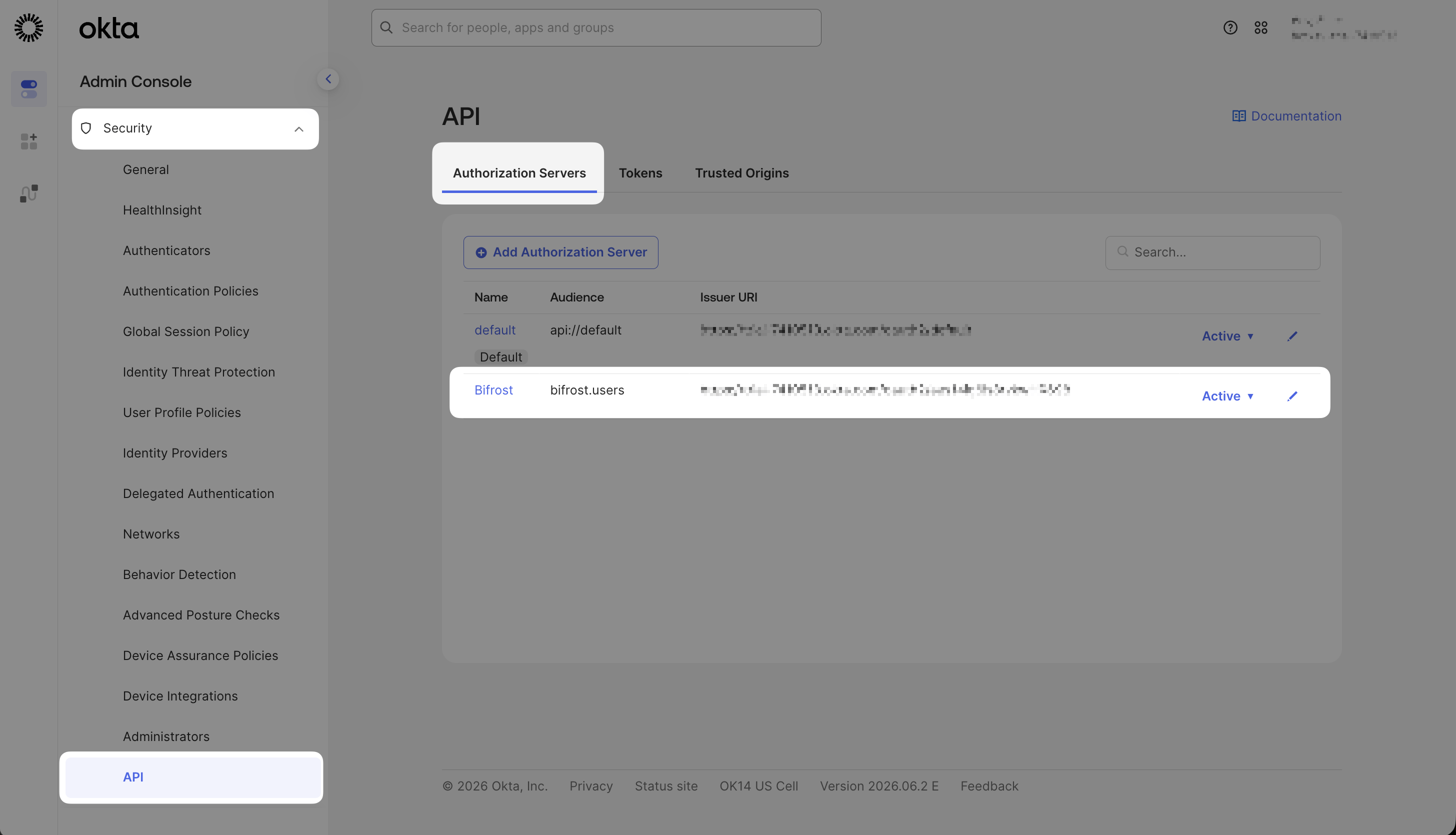
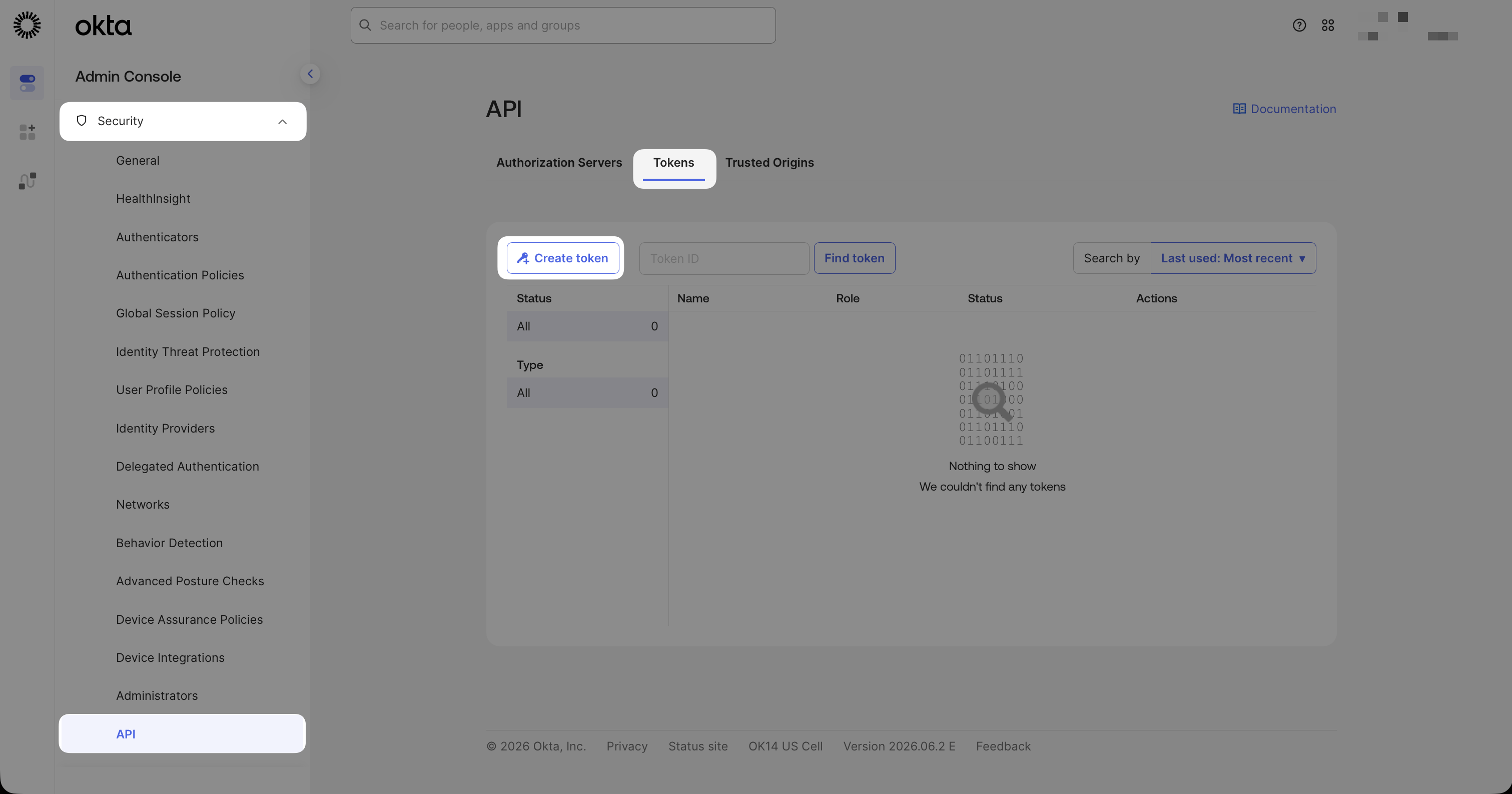
  1. Navigate to SecurityAPI
  2. Click on Authorization Servers
Okta Authorization Servers
  1. Note the Issuer URI for your authorization server (e.g., https://your-domain.okta.com/oauth2/default)
The Issuer URI is used as the issuerUrl in your Bifrost configuration. Make sure to use the full URL including /oauth2/default (or your custom authorization server path).

Step 4: Create Custom Role Attribute

To map Okta users to Bifrost roles (Admin, Developer, Viewer), you need to create a custom attribute.
  1. Navigate to DirectoryProfile Editor
Okta Profile Editor
  1. Click on your application’s user profile (e.g., Bifrost Enterprise User)
  2. Click Add Attribute
  3. Configure the attribute:
Add custom attribute for bifrostRole
FieldValue
Data typestring
Display namebifrostRole
Variable namebifrostRole
EnumCheck “Define enumerated list of values”
Attribute membersAdmin → admin, Developer → developer, Viewer → viewer
Attribute typePersonal
  1. Click Save

Step 5: Add Role Claim to Tokens

Configure the authorization server to include the role in the access token.
  1. Navigate to SecurityAPIAuthorization Servers
  2. Click on your authorization server (e.g., default)
  3. Go to the Claims tab
  4. Click Add Claim
Add role claim
Configure the claim:
FieldValue
Namerole
Include in token typeAccess Token, Always
Value typeExpression
Valueuser.bifrostRole
Include inAny scope
  1. Click Create
If you named your custom attribute differently, update the Value expression accordingly (e.g., user.yourAttributeName).

Step 6: Configure Groups for Team and Role Synchronization

Bifrost can automatically sync Okta groups for two purposes:
  • Team synchronization — Groups are synced as Bifrost teams
  • Role mapping — Groups can be mapped to Bifrost roles (Admin, Developer, Viewer) using Group-to-Role Mappings in the Bifrost UI

Create Groups in Okta

  1. Navigate to DirectoryGroups
Okta Groups page
  1. Click Add group
  2. Create groups that correspond to your teams or roles (e.g., bifrost-staging-admins, bifrost-staging-viewers)
Groups created in Okta
Use a consistent naming convention for your groups. This makes it easier to configure group filters and role mappings later.

Add Groups Claim to Tokens

You have two options for configuring the groups claim. Choose the one that best fits your Okta plan and requirements.

Option A: Using App-Level Groups Claim (All Okta Plans)

This approach configures the groups claim directly in your application’s settings and works with all Okta plans, including free tiers.
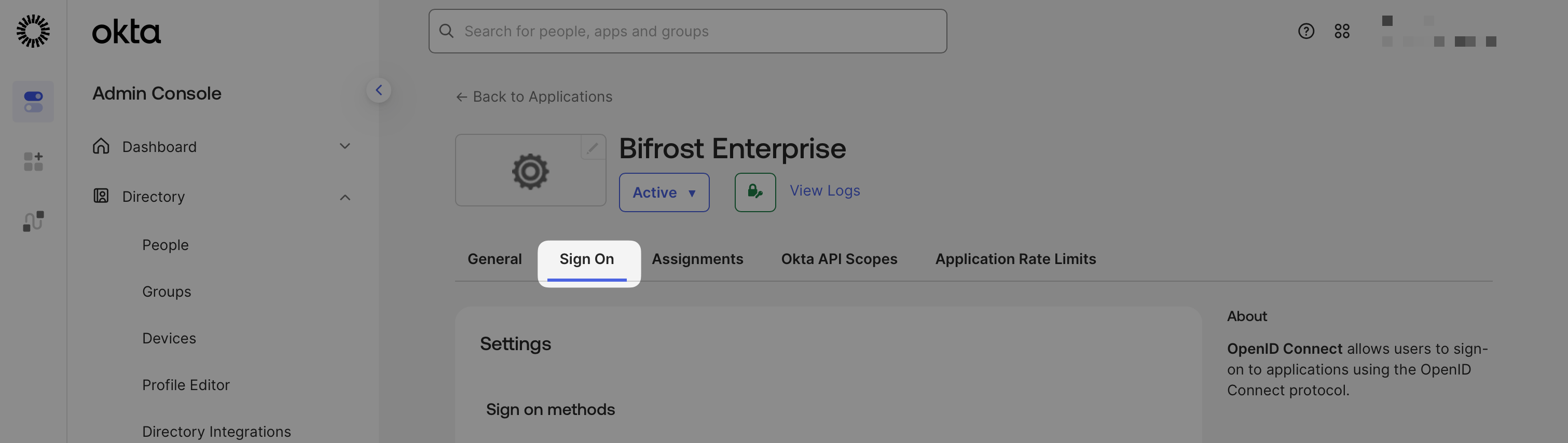
  1. Navigate to your application’s Sign On tab
  2. Scroll down to the OpenID Connect ID Token section
  3. Click Edit to modify the settings
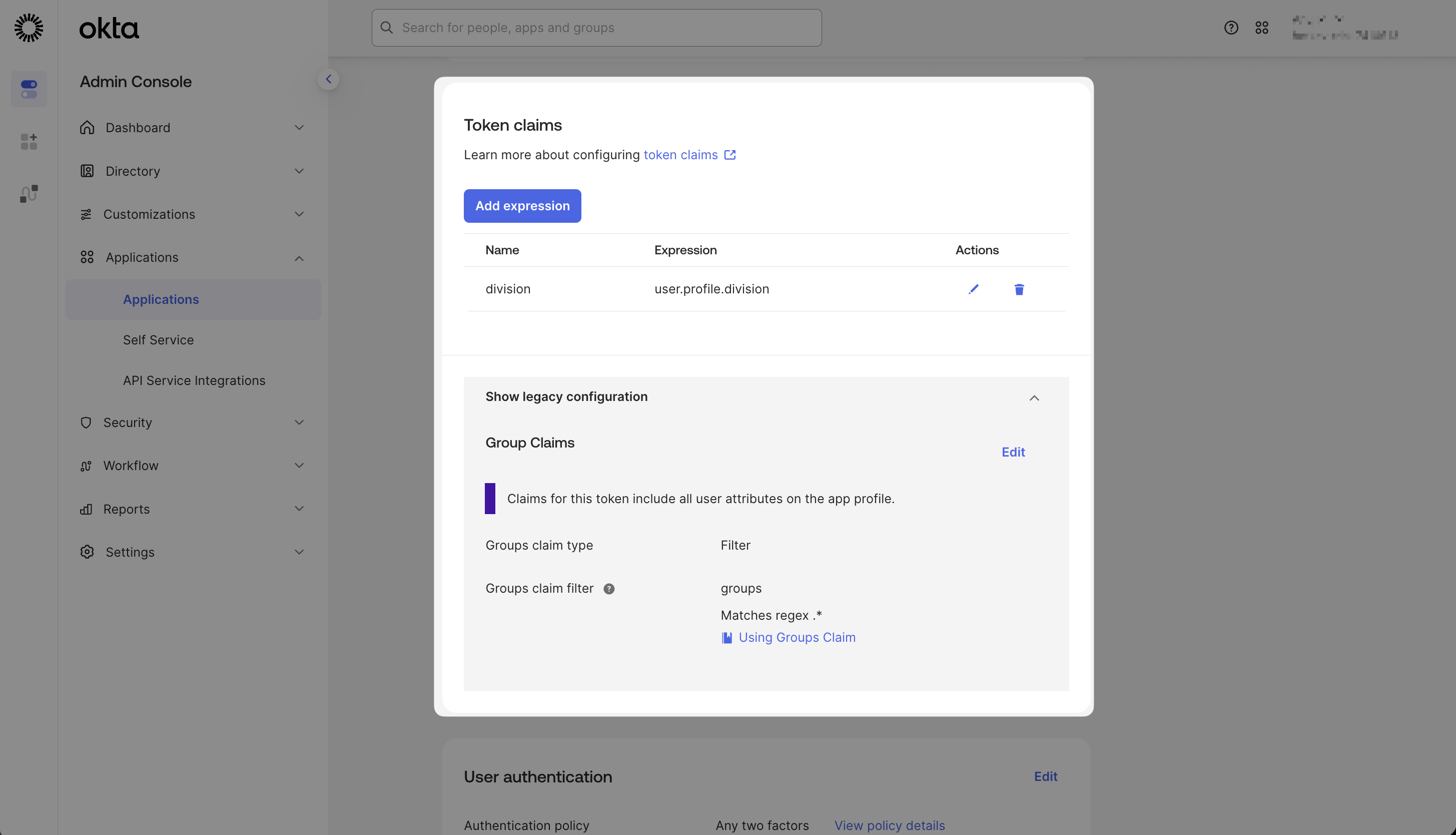
  4. Configure the Groups claim filter:
    • Groups claim type: Filter
    • Groups claim filter: Set a claim name (e.g., groups) and filter condition (e.g., “Starts with” bifrost-staging)
Application Groups claim configuration
  1. Click Save
The filter ensures only relevant groups are included in the token. Adjust the filter condition based on your group naming convention.

Option B: Using Authorization Server Groups Claim

This approach adds the groups claim through your authorization server, providing more flexibility for complex configurations.
  1. Navigate to SecurityAPIAuthorization Servers
  2. Select your authorization server (e.g., default)
  3. Go to the Claims tab
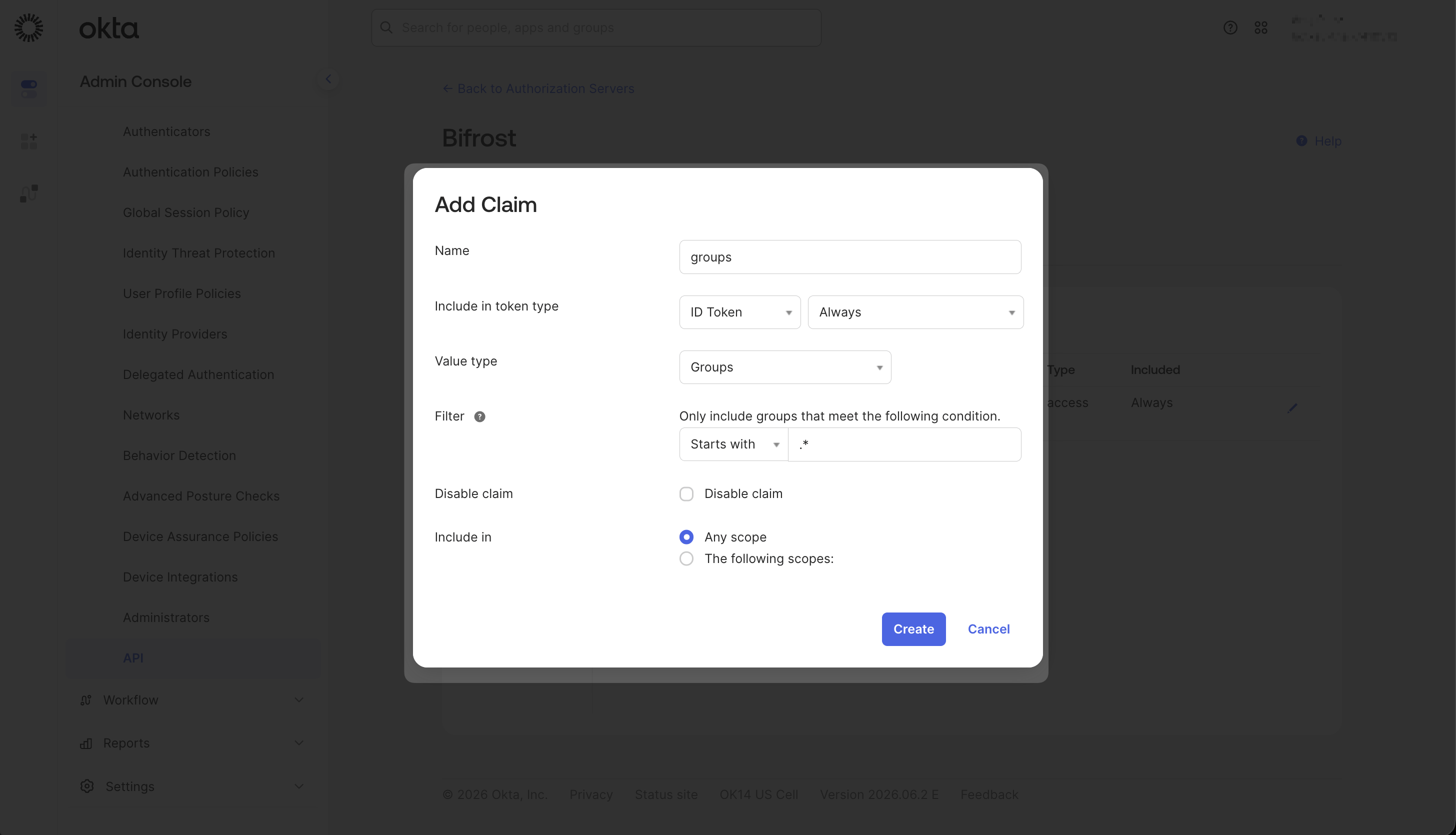
  4. Click Add Claim
Configure the groups claim:
FieldValue
Namegroups
Include in token typeID Token, Always
Value typeGroups
FilterMatches regex: .* (or specify a prefix like bifrost-.*)
Include inAny scope
  1. Click Create
You can also configure an additional groups claim in the application’s Sign On settings:
  1. Navigate to your application’s Sign On tab
Application Sign On configuration
  1. Under OpenID Connect ID Token, configure:
    • Groups claim type: Expression
    • Groups claim expression: Arrays.flatten(Groups.startsWith("OKTA", "bifrost", 100))
Adjust the group filter expression based on your naming convention. The example above includes groups starting with “bifrost”.

Step 7: Assign Users to the Application

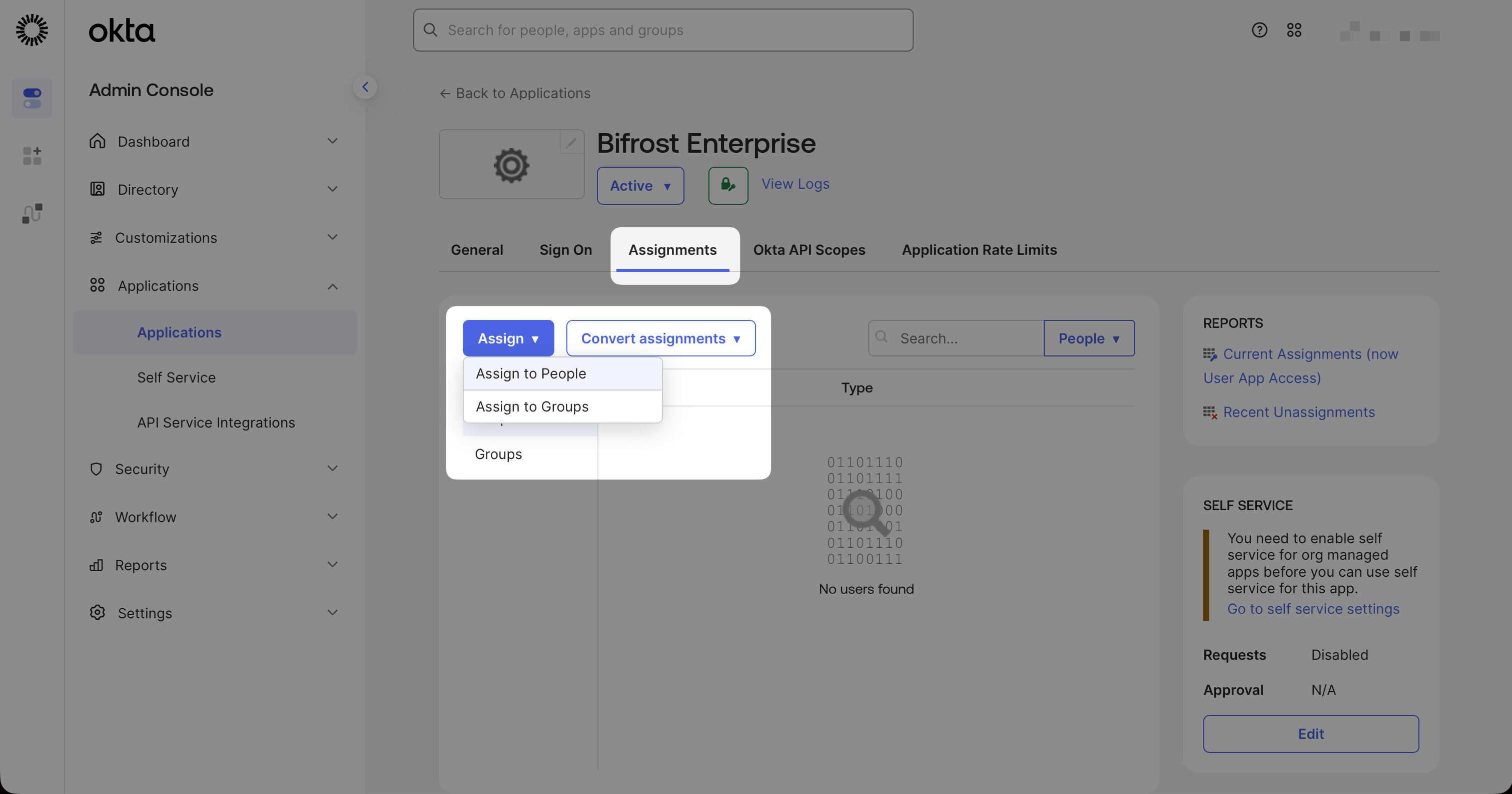
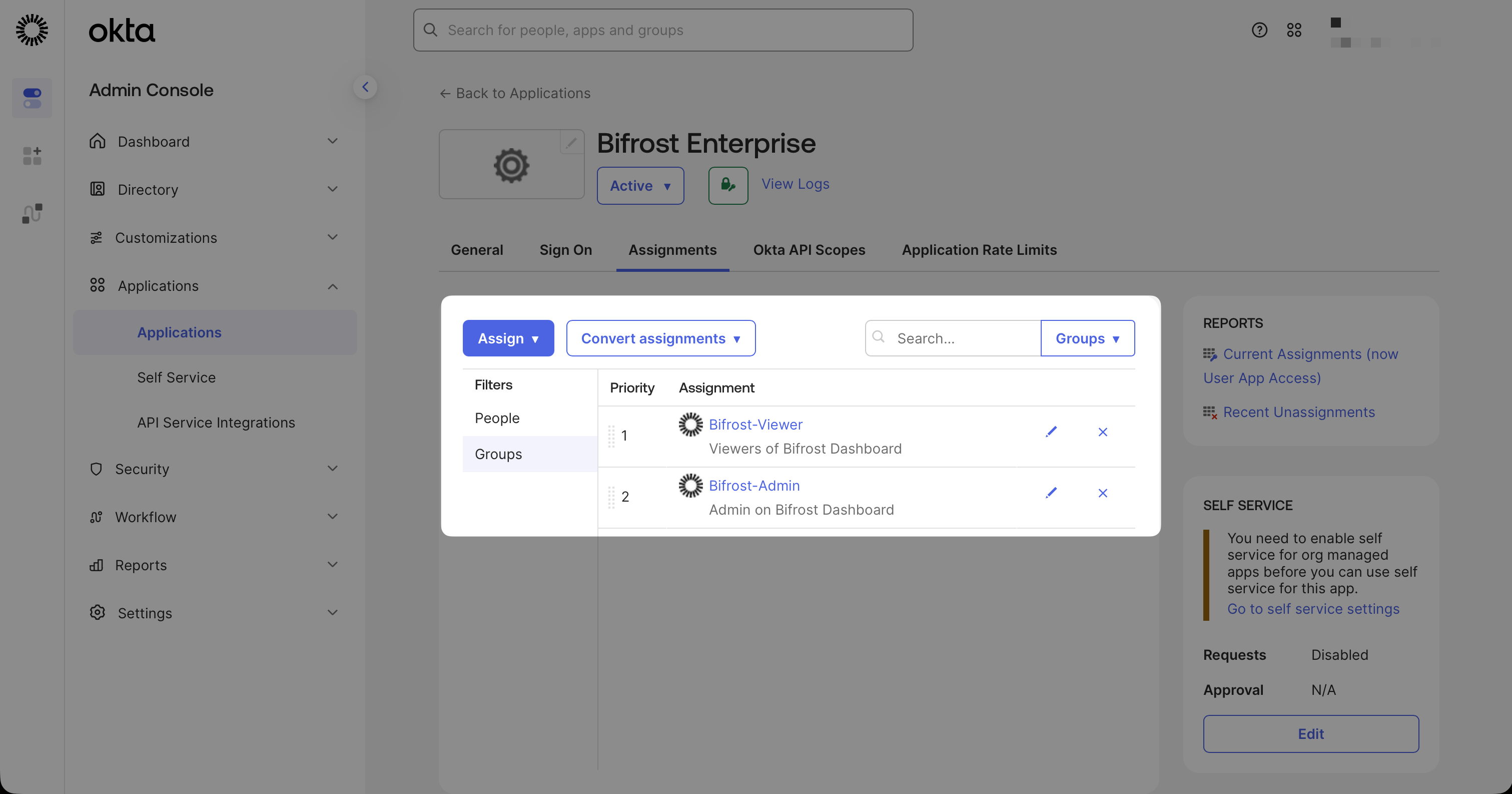
  1. Navigate to your application’s Assignments tab
Application Assignments tab
  1. Click AssignAssign to People or Assign to Groups
  2. For each user, set their bifrostRole:
Assign custom role to user
  1. Click Save and Go Back
Role claims are available only when you configure custom claims on your authorization server. Ensure you add role claims to your chosen authorization server (for example, /oauth2/default) to enable RBAC. If you skipped Steps 4-7, the first user to sign in automatically receives the Admin role and can manage RBAC for all subsequent users through the Bifrost dashboard.

Step 8: Configure Bifrost

Now configure Bifrost to use Okta as the identity provider.

Using the Bifrost UI

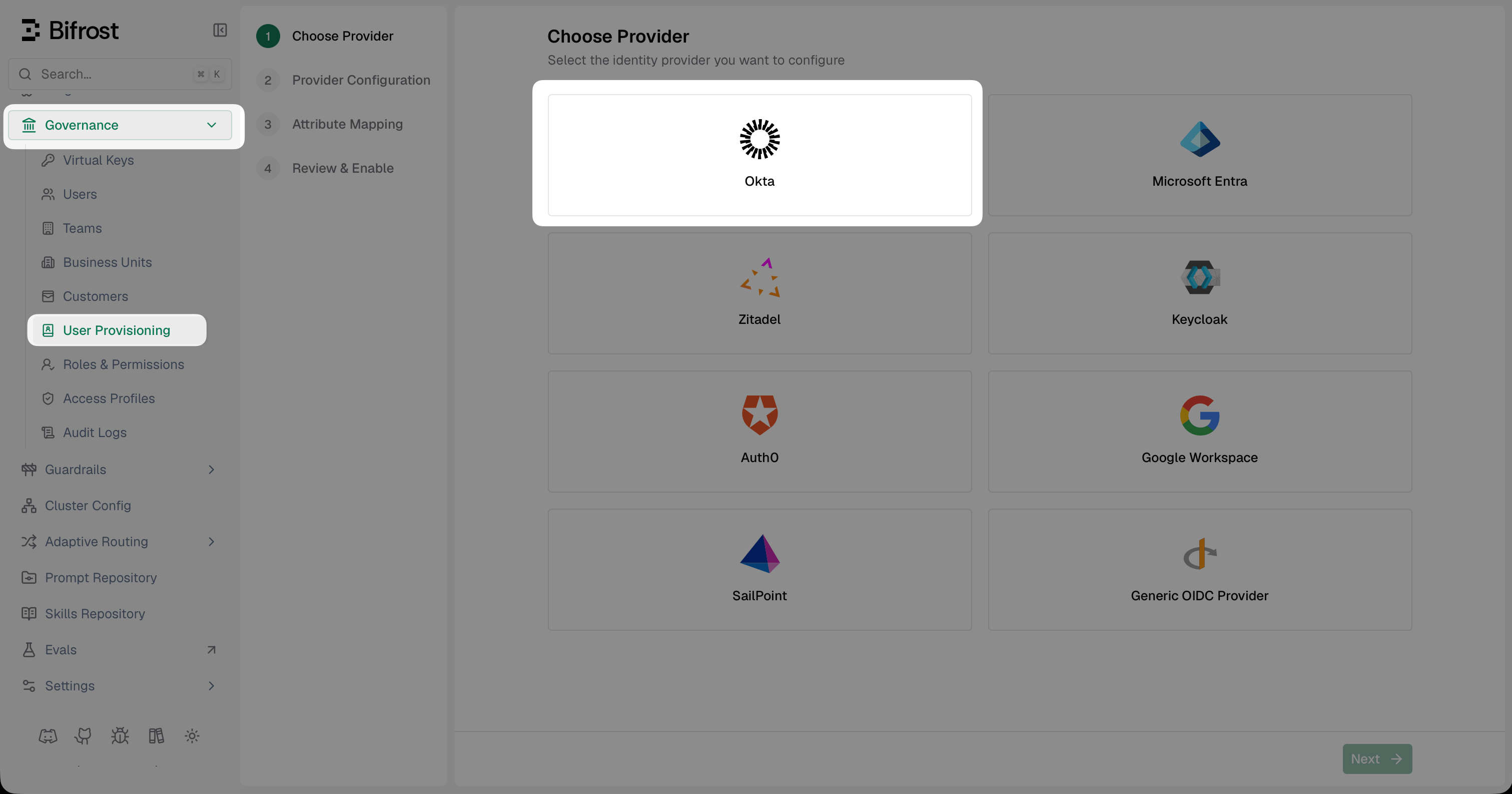
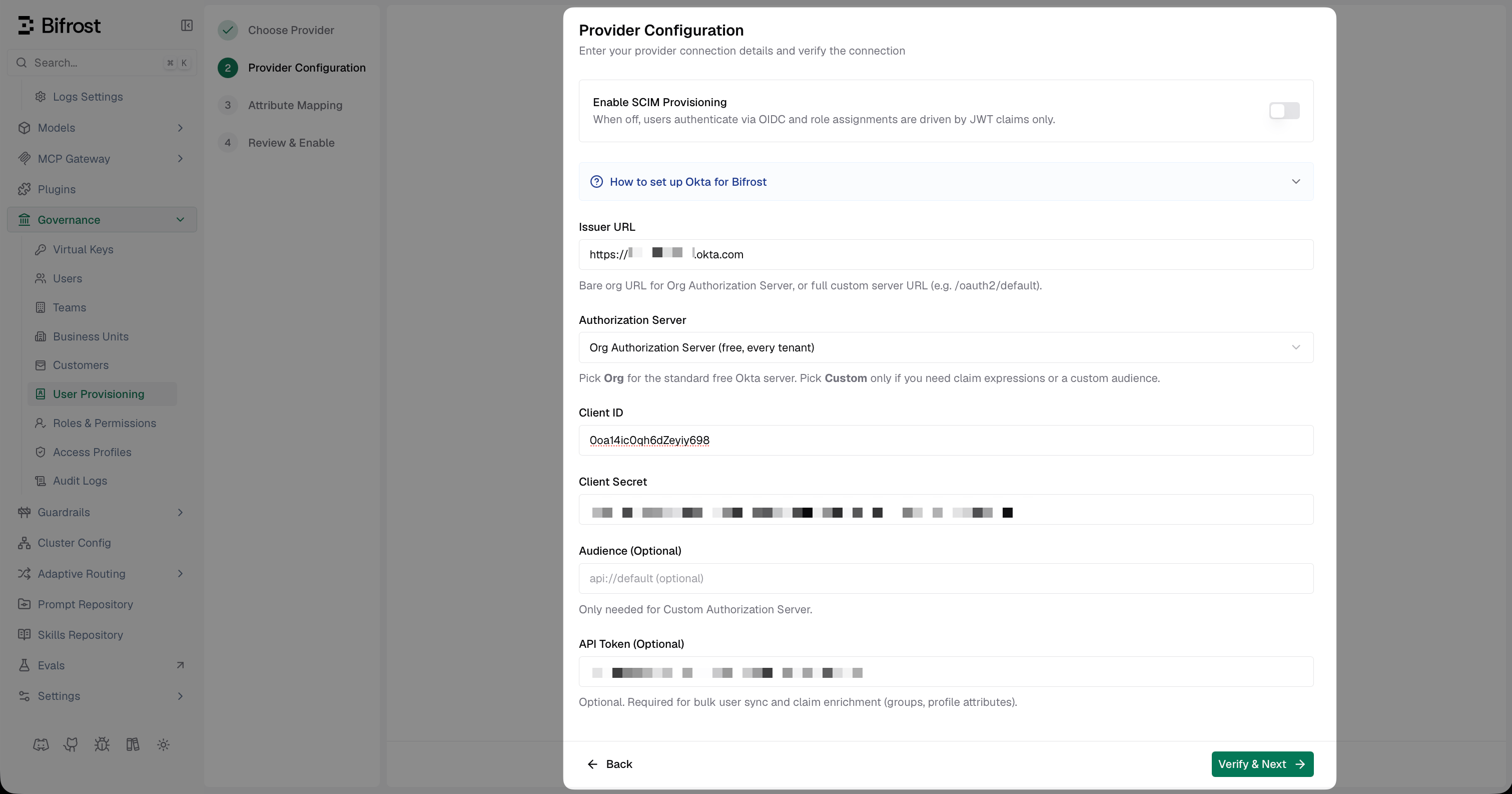
  1. Navigate to GovernanceUser Provisioning in your Bifrost dashboard
  2. Select Okta as the SCIM Provider
  3. Enter the following configuration:
FieldValue
Client IDYour Okta application Client ID
Issuer URLIssuer URL
AudienceYour API audience (e.g., api://default or custom)
Client SecretYour Okta application Client Secret (optional, for token revocation)
  1. Toggle Enabled to activate the provider
  2. Click Save Configuration

Group-to-Role Mappings (Optional)

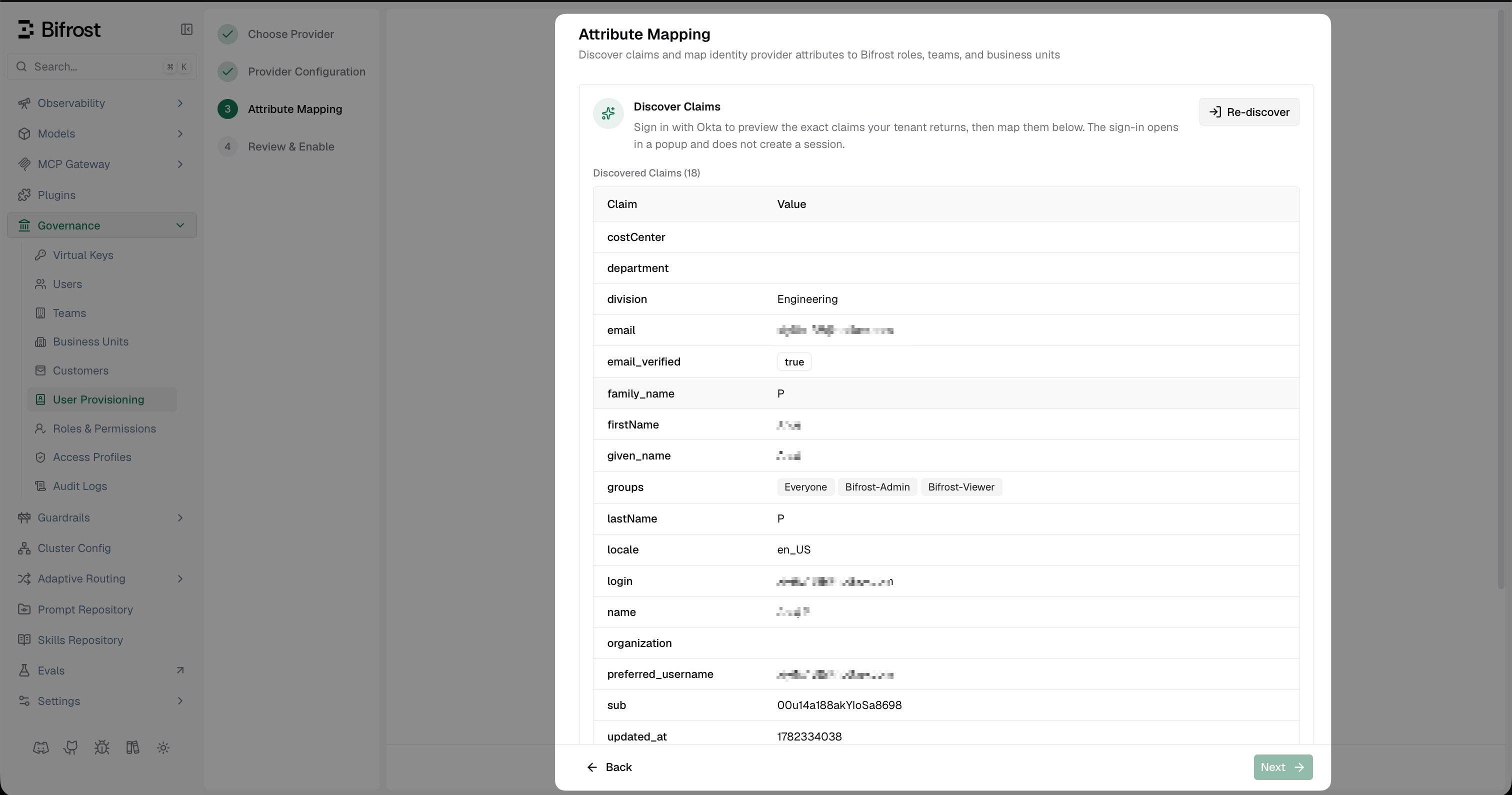
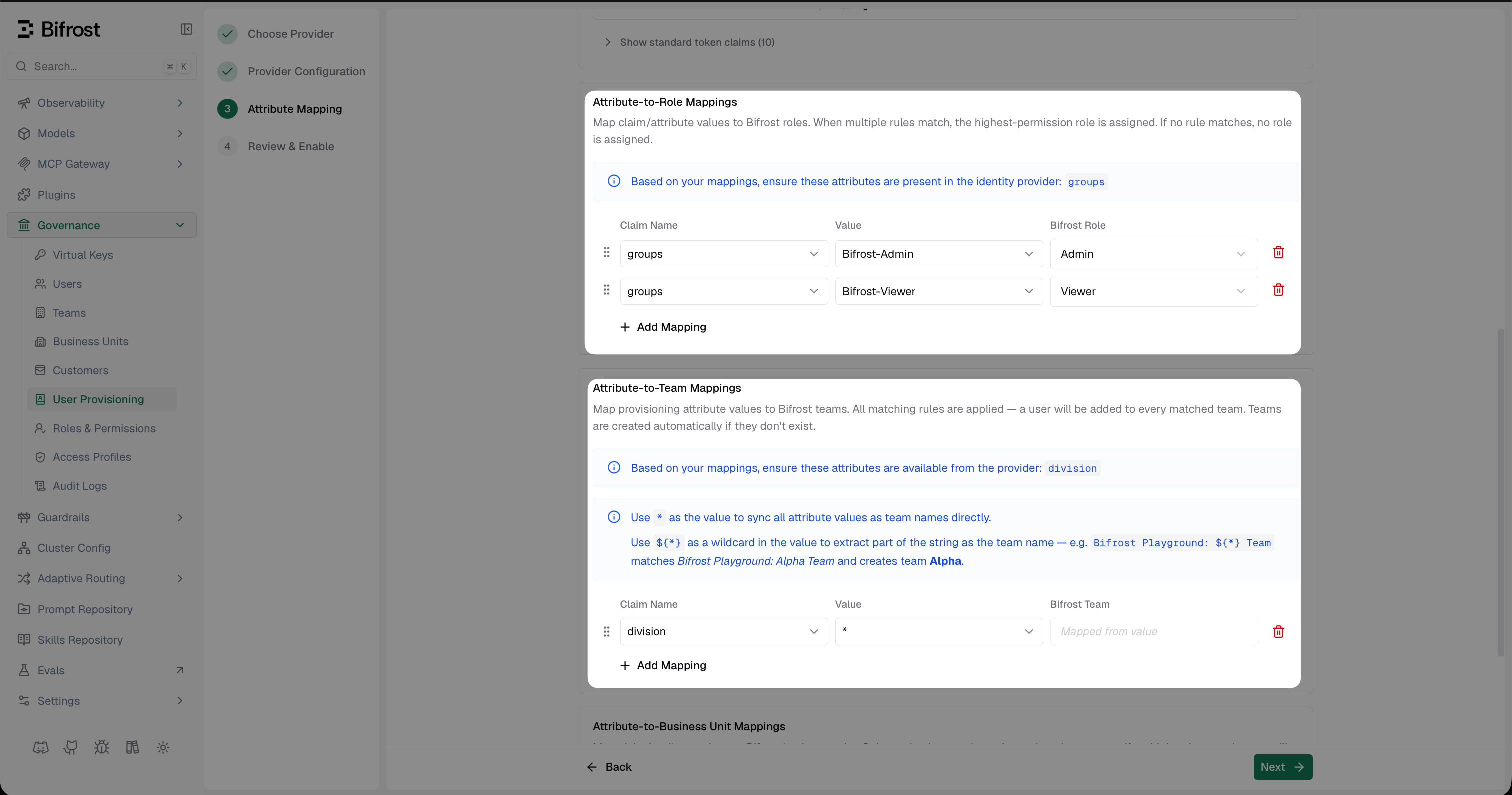
If you configured groups in Okta (Step 6), you can map Okta group names directly to Bifrost roles. This is an alternative to using custom role claims (Steps 4-5) and works with all Okta plans.
  1. In the User Provisioning configuration, scroll down to Group-to-Role Mappings
  2. Click Add Mapping
  3. Enter the Group Claim Name exactly as it appears in your Okta groups (e.g., bifrost-staging-admins)
  4. Select the corresponding Role (Admin, Developer, or Viewer)
  5. Repeat for each group you want to map
Group-to-Role Mappings configuration in Bifrost
Group Claim NameRole
bifrost-staging-adminsAdmin
bifrost-staging-viewersViewer
If a user belongs to multiple groups with different role mappings, the highest privilege role is assigned. If no mapping matches, the first user to sign in receives the Admin role, and subsequent users receive the Viewer role.
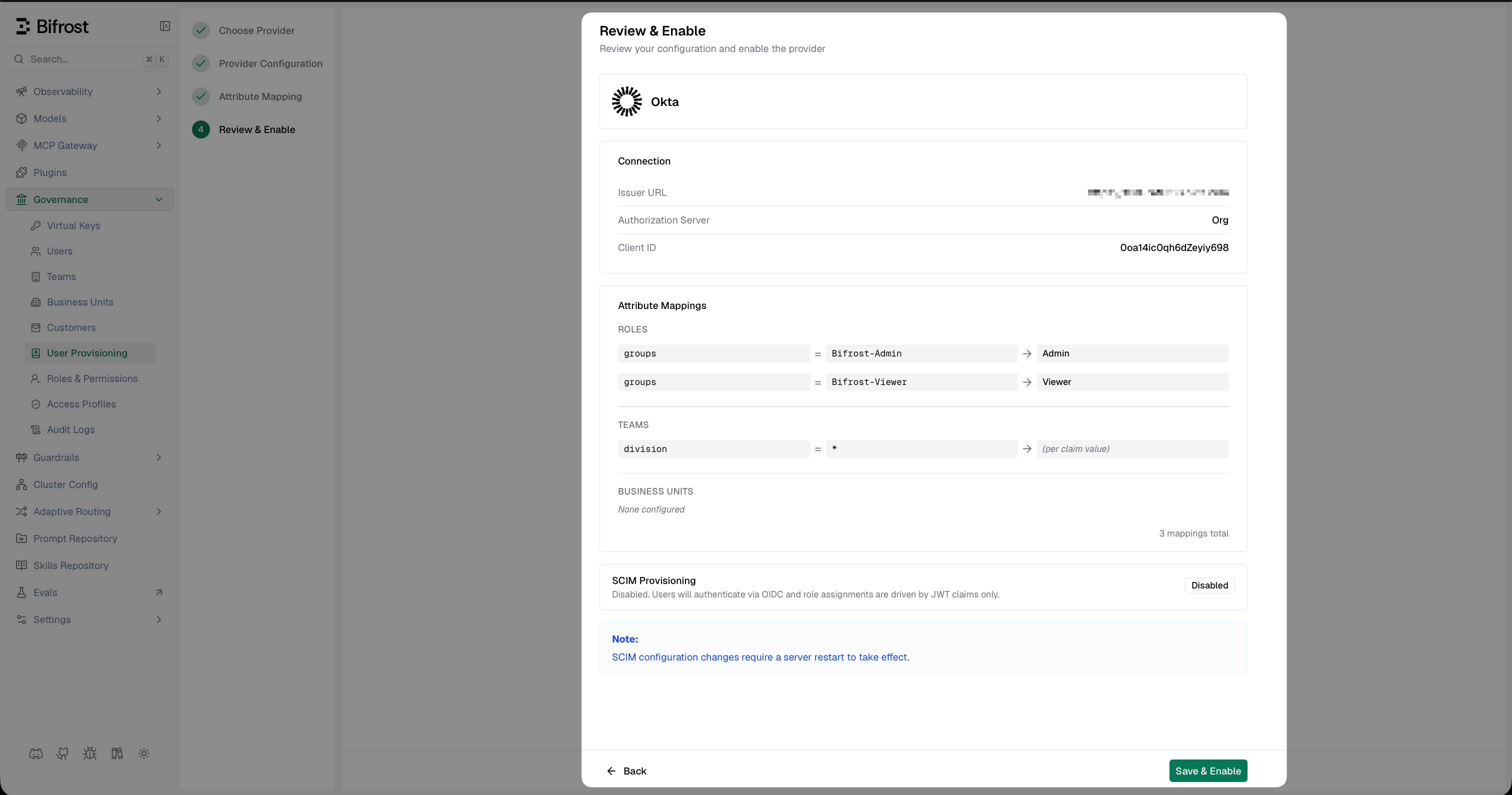
  1. Click Save Configuration
After saving, you’ll need to restart your Bifrost server for the changes to take effect.

Configuration Reference

FieldRequiredDescription
issuerUrlYesOkta authorization server URL (e.g., https://your-domain.okta.com/oauth2/default)
clientIdYesApplication Client ID from Okta
clientSecretNoApplication Client Secret (enables token revocation)
audienceYesAPI audience identifier from your authorization server
userIdFieldNoJWT claim for user ID (default: uid)
rolesFieldNoJWT claim for roles (default: roles)
teamIdsFieldNoJWT claim for group/team IDs (default: groups)

Testing the Integration

  1. Open your Bifrost dashboard in a new browser or incognito window
  2. You should be redirected to Okta for authentication
  3. Log in with an assigned user
  4. After successful authentication, you’ll be redirected back to Bifrost
  5. Verify the user appears in the Bifrost users list with the correct role

Troubleshooting

User not redirected to Okta

  • Verify the SCIM provider is enabled in Bifrost
  • Check that the Bifrost server was restarted after configuration
  • Ensure the Issuer URL is correct and accessible

”Invalid audience” error

  • Verify the audience field matches your Okta authorization server’s audience
  • Check if you’re using a custom authorization server and update the issuer URL accordingly

Roles not syncing

  • Ensure the role claim is configured in your authorization server
  • Verify users have the bifrostRole attribute set
  • Check that the claim is included in the access token (use Okta’s Token Preview feature)

Groups not appearing as teams

  • Verify the groups claim is configured in your authorization server
  • Ensure users are assigned to the relevant groups
  • Check that groups are assigned to the application

Token refresh failing

  • Ensure the Refresh Token grant type is enabled for your application
  • Verify the offline_access scope is included in your authorization requests

Next Steps