
Documentation Index

Fetch the complete documentation index at: https://docs.getbifrost.ai/llms.txt

Use this file to discover all available pages before exploring further.

Overview

This guide walks you through configuring Microsoft Entra ID (formerly Azure Active Directory) as your identity provider for Bifrost Enterprise. After completing this setup, your users will be able to sign in to Bifrost using their Microsoft credentials, with roles and team memberships automatically synchronized.

Prerequisites

  • A Microsoft Azure account with access to Entra ID (Azure AD)
  • Admin access to create app registrations
  • Bifrost Enterprise deployed and accessible
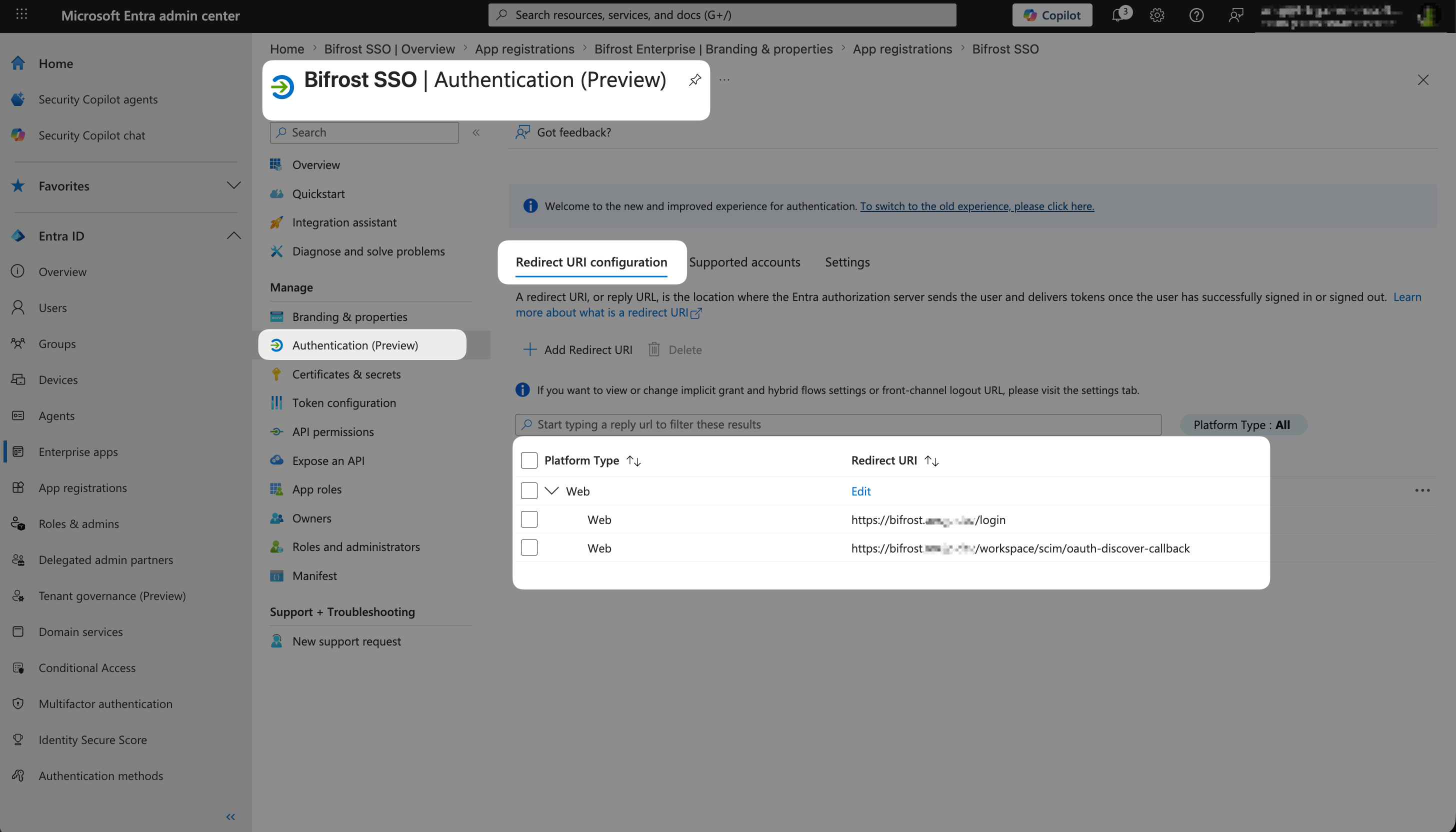
  • The redirect URI for your Bifrost instance (e.g., https://your-bifrost-domain.com/login)

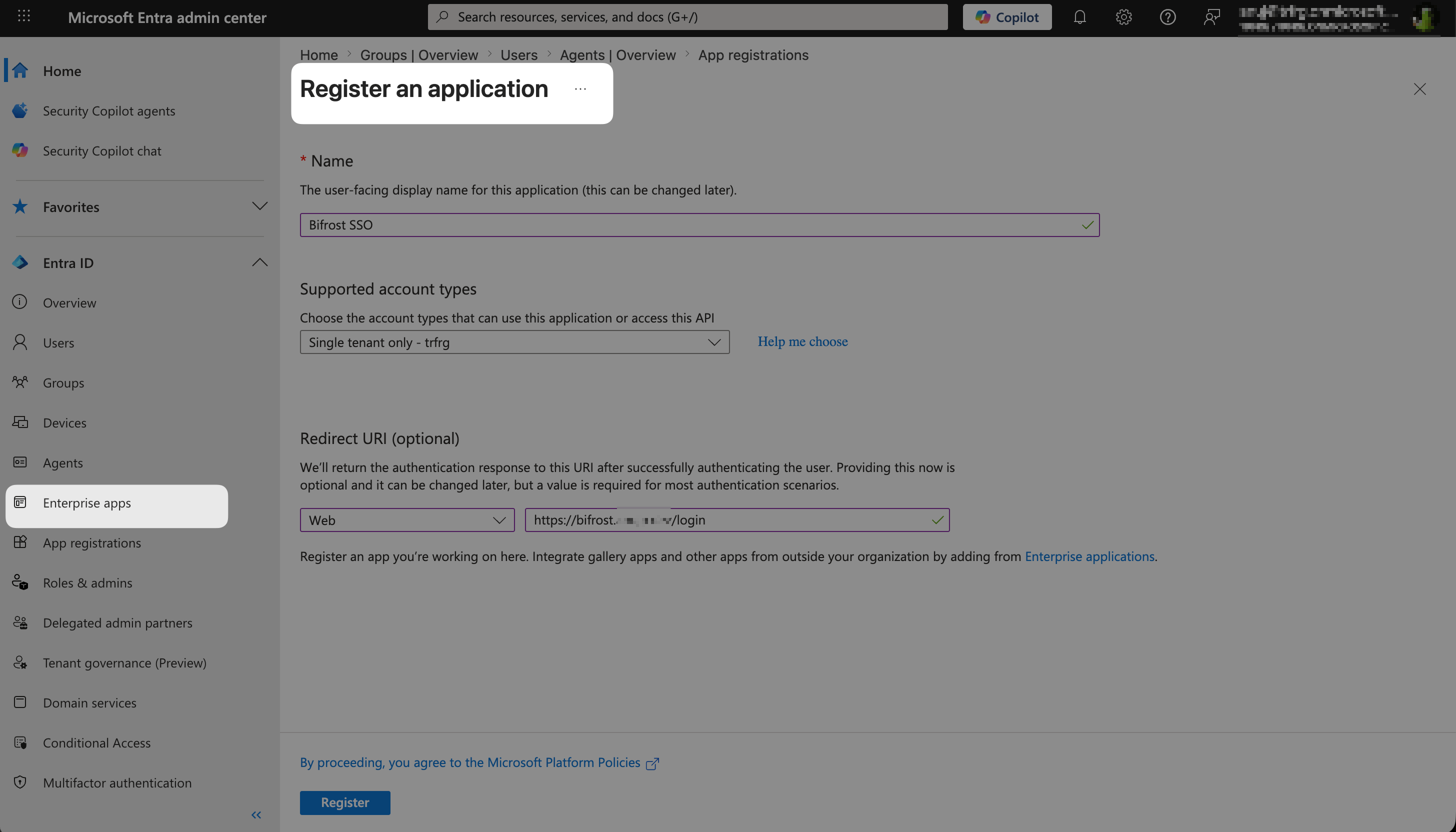
Step 1: Register an Application

  1. Sign in to the Azure Portal
  2. Navigate to Microsoft Entra ID (or Azure Active Directory)
  3. Go to App registrations
  4. Click New registration
Configure the registration:
FieldValue
NameBifrost Enterprise
Supported account typesAccounts in this organizational directory only (Single tenant)
Redirect URIWeb: https://your-bifrost-domain.com/login
  1. Click Register
You can add an app icon to make the application easily recognizable. The Bifrost logo is available at: https://www.getmaxim.ai/bifrost/bifrost-logo-only.png

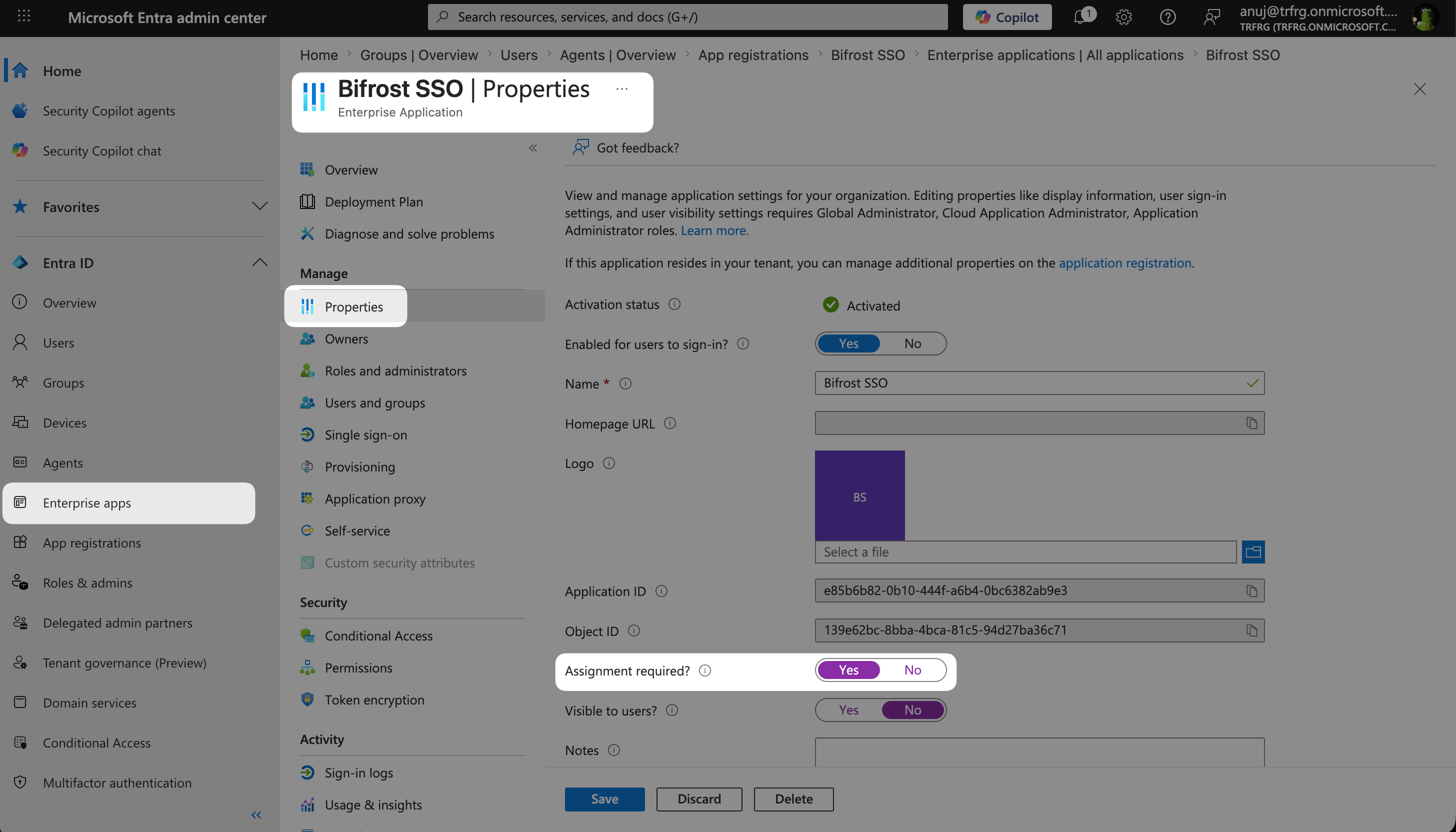
Enable assignment requirement on the Enterprise Application

This step controls which users can access Bifrost. The toggle lives on the Enterprise Application, which is a different blade from the App Registration you just created (both share the same app name and Application ID, but they are separate entries in the Entra ID left navigation).
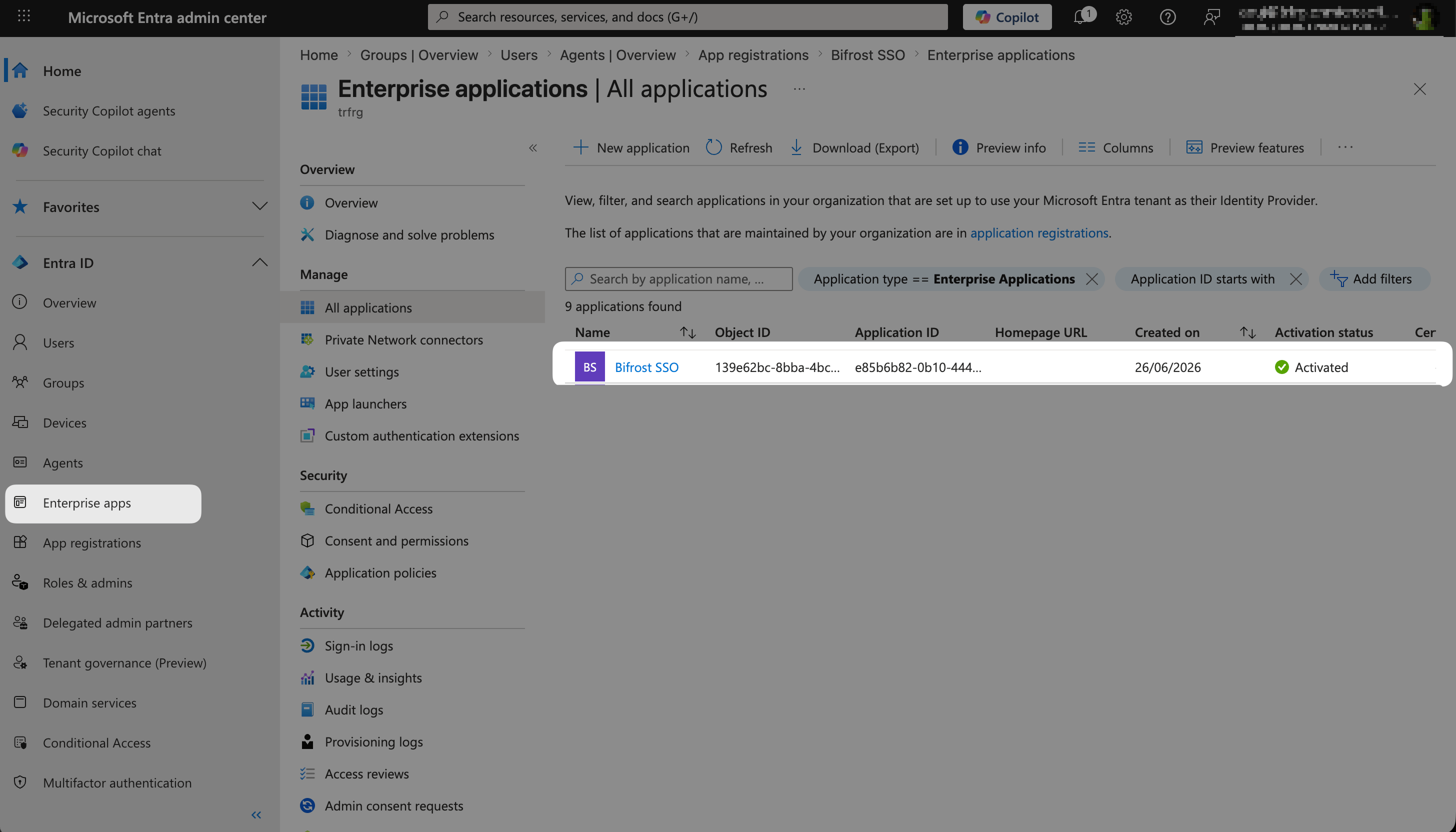
  1. From the Entra ID main menu, go to Enterprise applications
  2. Find and select Bifrost Enterprise (the service principal created automatically when you registered the app above)
  3. Go to Properties
Entra Enterprise Application Properties
  1. Set Assignment required? to Yes
  2. Set Enabled for users to sign-in? to Yes
  3. Click Save

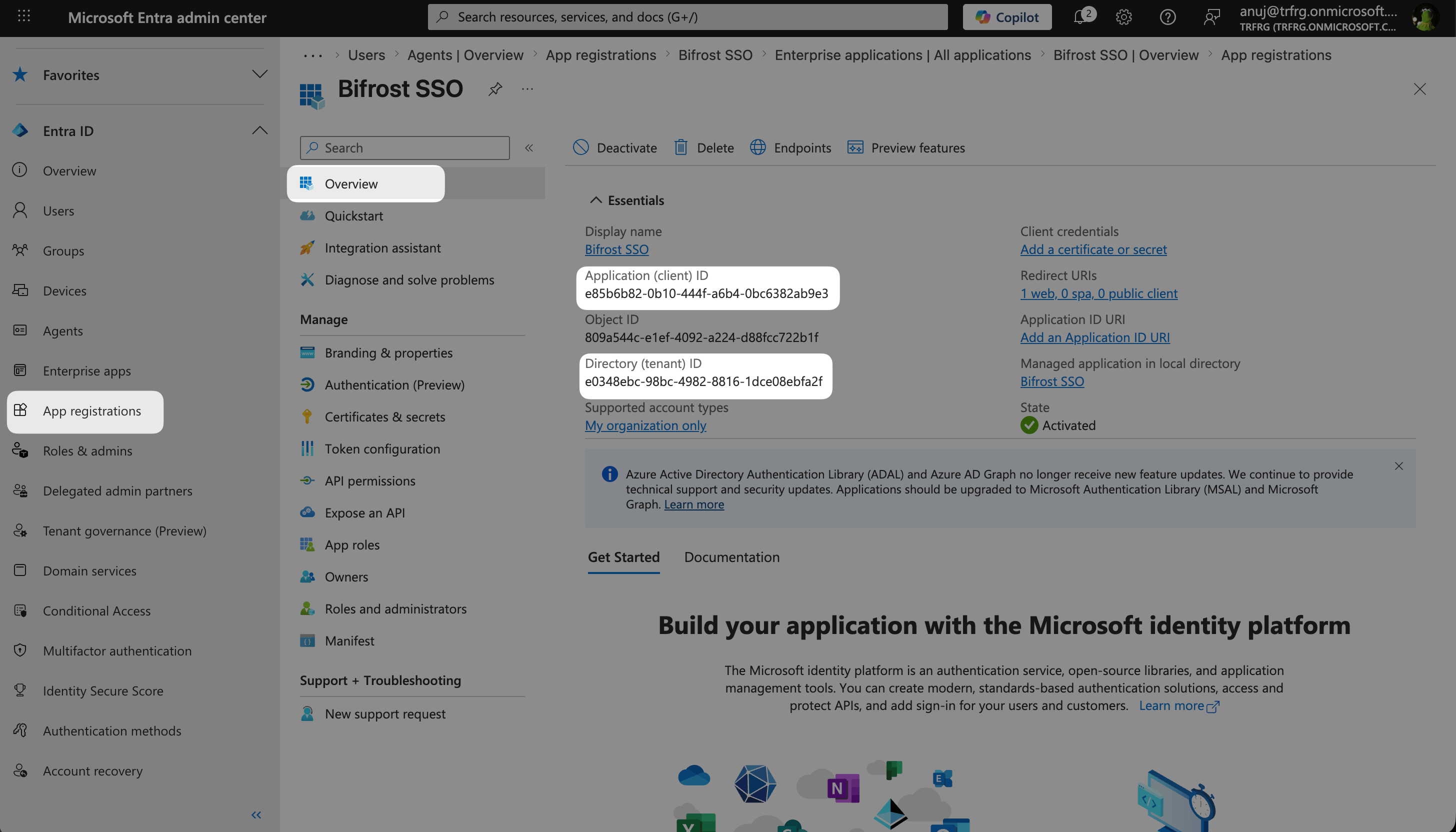
Step 2: Capture App Registration Information

Navigate to Entra Home → App Registrations → <your app name> → Overview to capture the values below.
Entra App Registration Overview
ValueWhere to Find
Application (client) IDOverview → Essentials
Directory (tenant) IDOverview → Essentials

Step 3: Create App Roles (Optional)

This step is optional. You can create custom roles if that’s the preferred way. Or you can map any attribute to role/team/business unit. Role mapping is a required step.
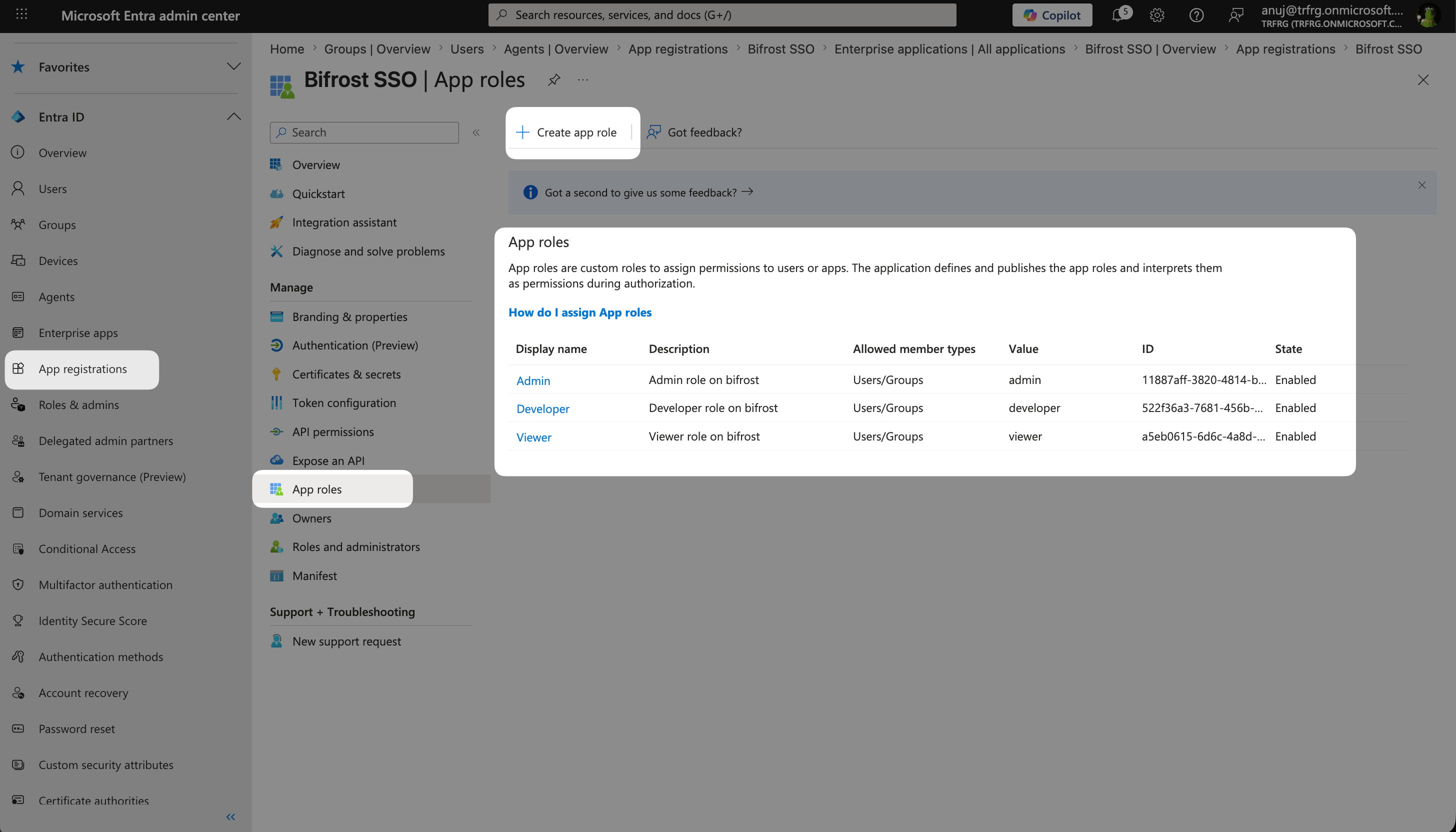
Configure roles in Entra that map to Bifrost’s role hierarchy (Admin, Developer, Viewer).
  1. In your app registration, go to App roles
  2. Click Create app role
  3. Create the following three roles:
Entra App Roles configuration

Viewer Role

FieldValue
Display nameViewer
Allowed member typesUsers/Groups
Valueviewer
DescriptionViewer role on Bifrost
StateEnabled

Developer Role

FieldValue
Display nameDeveloper
Allowed member typesUsers/Groups
Valuedeveloper
DescriptionDeveloper role on Bifrost
StateEnabled

Admin Role

FieldValue
Display nameAdmin
Allowed member typesUsers/Groups
Valueadmin
DescriptionAdmin role on Bifrost
StateEnabled

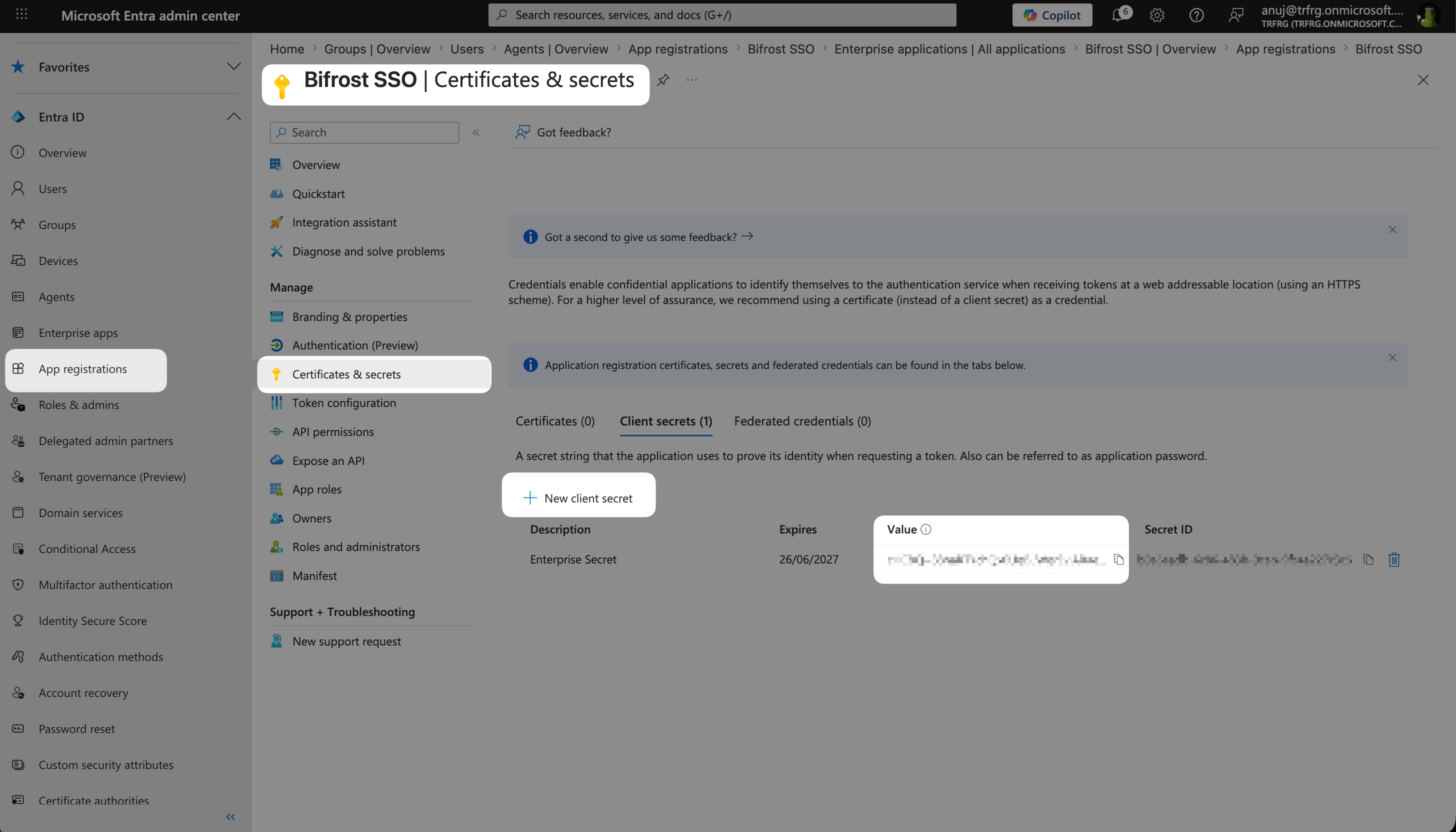
Step 4: Create a Client Secret

Bifrost requires a client secret for OAuth authentication.
  1. Go back to App registrationsBifrost Enterprise
  2. Navigate to Certificates & secrets
  3. Click New client secret
Entra Enterprise Client Secrets
FieldValue
DescriptionBifrost Enterprise Secret
ExpiresChoose based on your security policy (e.g., 24 months)
  1. Click Add
  2. Copy the secret value immediately - it won’t be shown again!
Store the client secret securely. You’ll need it for the Bifrost configuration.

Step 5: Configure API Permissions

Ensure your application has the necessary permissions.
Entra Enterprise API Permissions
  1. In your app registration, go to API permissions
  2. Click Add a permission
  3. Select Microsoft Graph
  4. Choose the permission type as indicated in the next steps
  5. Add the following Delegated permissions (Add a permission → Microsoft Graph → Delegated permissions):
    • openid
    • profile
    • email
    • offline_access (for refresh tokens)
    • User.Read
  6. Add the following Application permissions (Add a permission → Microsoft Graph → Application permissions):
    • User.Read.All
    • GroupMember.Read.All
    • Group.Read.All
    • Application.Read.All — required for syncing app-role-based role mappings during user import. If you don’t want to do bulk syncing, you can skip this permission.
    • AppRoleAssignment.ReadWrite.All — required to read each user’s app role assignments via Microsoft Graph
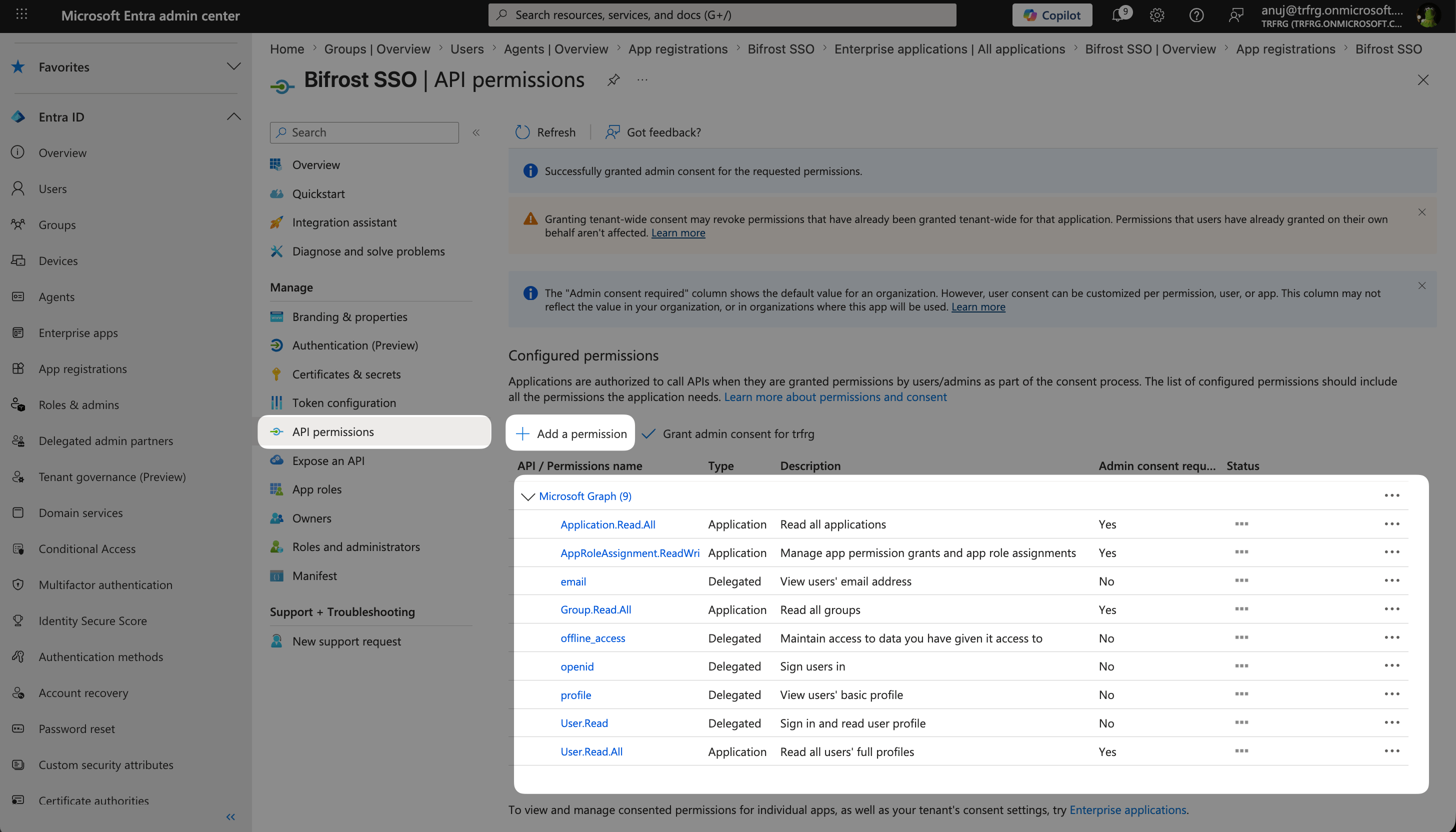
Permission type matters: openid, profile, email, offline_access, and User.Read must be Delegated, while User.Read.All, GroupMember.Read.All, Group.Read.All, Application.Read.All, and AppRoleAssignment.ReadWrite.All must be Application. The same name can exist under both types — adding the wrong one will cause sign-in or sync failures even though the permission appears granted.
  1. Click Add permissions
  2. Click Grant admin consent for [Your Organization] (this is required — without admin consent, Application permissions are not effective even though they appear in the list)
Application.Read.All and AppRoleAssignment.ReadWrite.All are only needed if you plan to use app role based role mappings (i.e. mappings whose attribute is roles) during the bulk user sync. Login-time role mapping works from the JWT alone, but bulk sync from Microsoft Graph needs these permissions to read each user’s app-role assignments and resolve them to their role values (e.g. admin, developer).

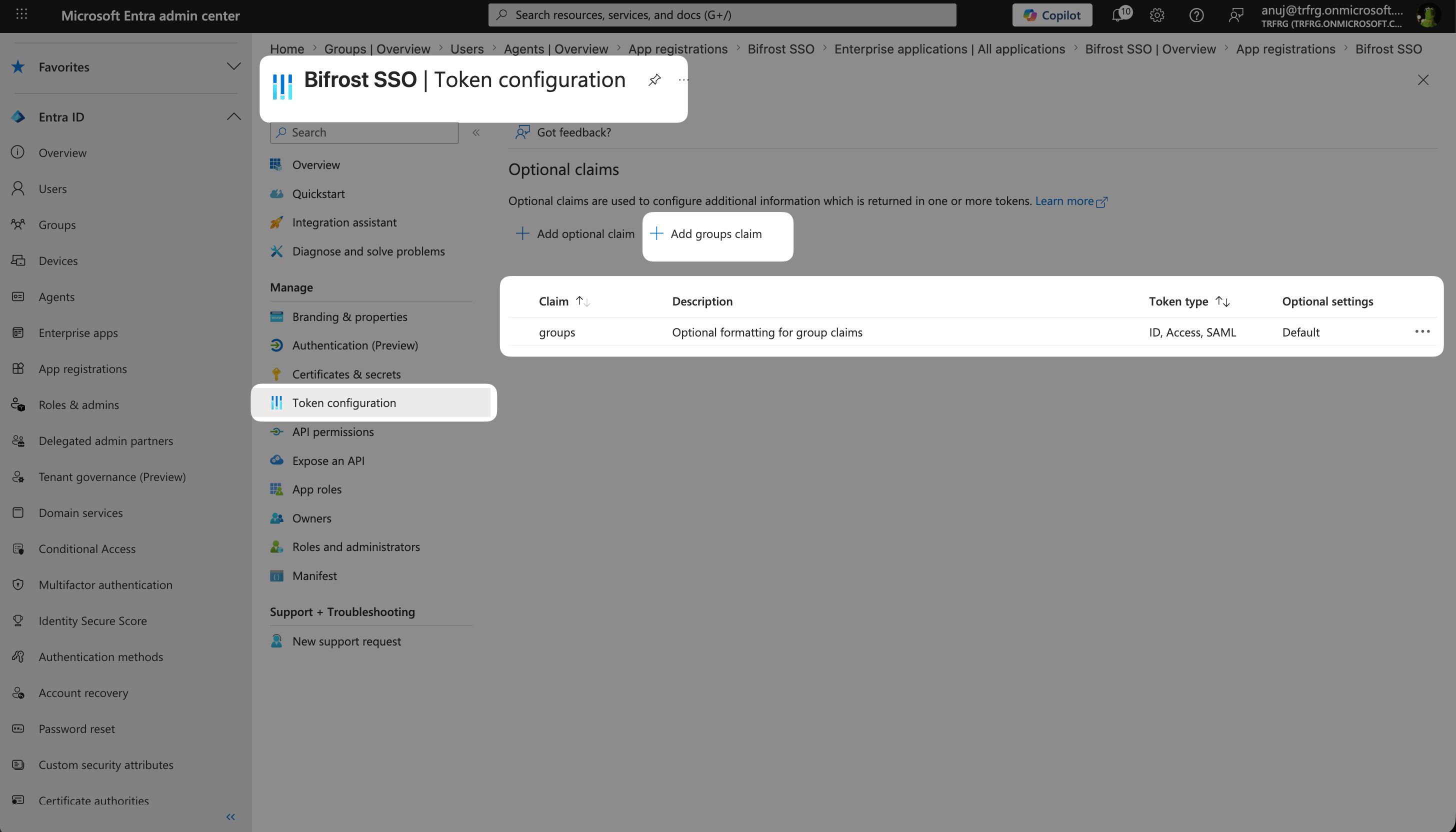
Step 6: Configure Token Claims

Groups and other attributes are required in the claim when you configure their mapping in Bifrost.
By default, Entra includes the roles claim when app roles are assigned. To include group memberships for team synchronization:
  1. Go to Token configuration
  2. Click Add groups claim
  3. Select:
    • Security groups or Groups assigned to the application
    • For token type, enable ID and Access
  4. Click Add

Step 7: Assign Users and Roles

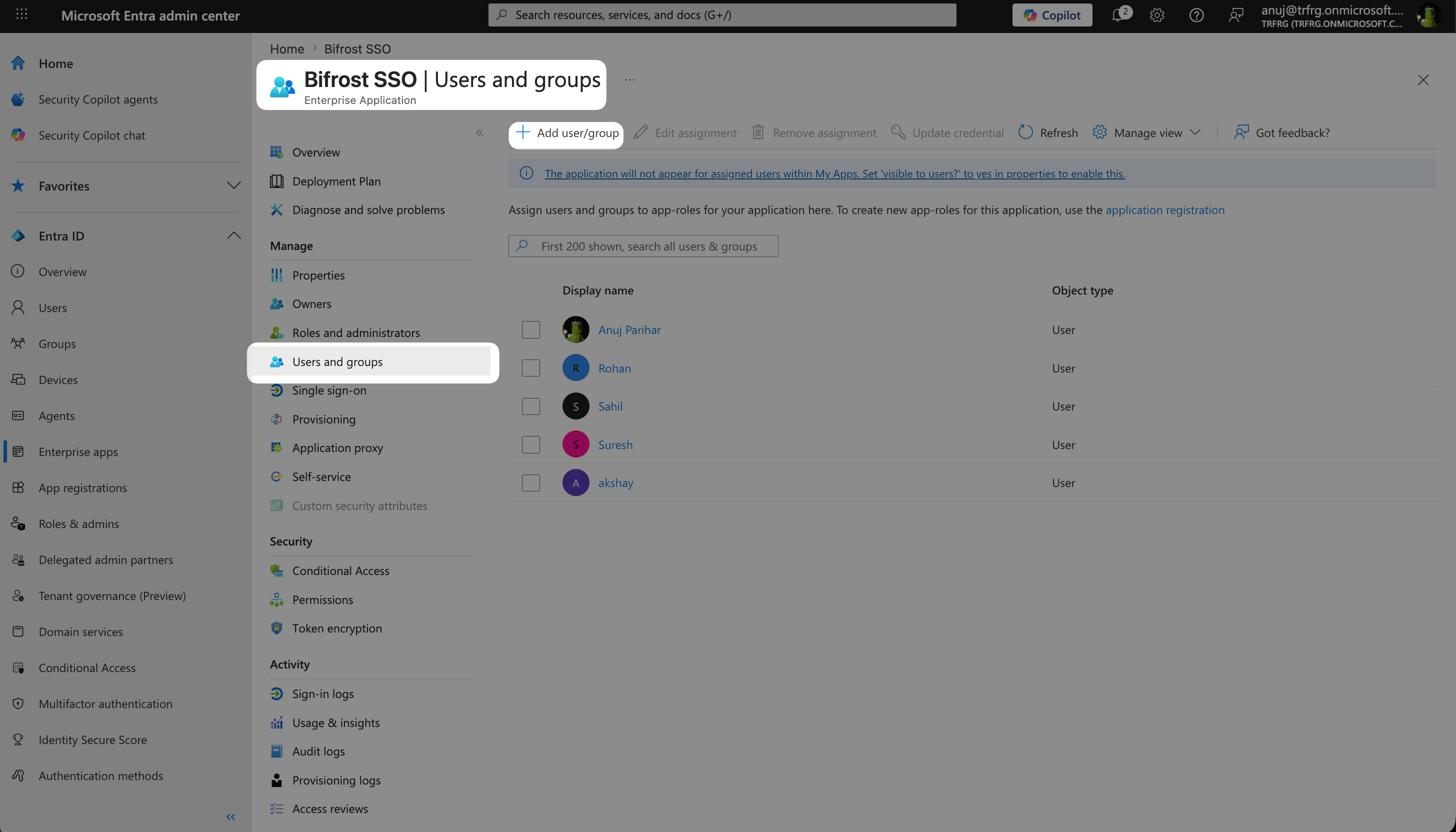
Entra User Assignments
  1. Go to Enterprise applicationsBifrost Enterprise
  2. Navigate to Users and groups
  3. Click Add user/group
  4. Select users or groups
  5. Select the appropriate role (Admin, Developer, or Viewer)
  6. Click Assign
You must select a role when assigning a user or group. Adding a user to the application without picking a role causes Entra to omit the roles claim from the issued ID token, and login will be rejected with Claim "roles" is not present in the token. If you don’t want to use app roles, configure your Bifrost role mappings on the groups attribute instead (see Attribute Mappings below).
You can assign roles to groups for easier management. All users in a group will inherit the assigned role. The group itself must be added as an assignment with a role selected — adding users to a group that isn’t assigned to the application will not propagate roles.

Step 8: Configure App Manifest

Microsoft entra app manifest
You will need to make the following changes in the app manifest. Set the access token version to v2. For the Microsoft Graph App Manifest (current schema, default in the Azure Portal “Manifest” blade for app registrations created or migrated after the 2023 redesign):
"requestedAccessTokenVersion": 2
For the AAD Graph App Manifest (legacy schema, deprecated; only present on older app registrations that have not been migrated):
"accessTokenAcceptedVersion": 2
Add the optional roles and groups claims to the ID token:
"optionalClaims": {
  "idToken": [
    {
      "name": "roles",
      "source": null,
      "essential": false,
      "additionalProperties": []
    },
    {
      "name": "groups",
      "source": null,
      "essential": false,
      "additionalProperties": ["cloud_displayname", "sam_account_name"]
    }
  ],
  "accessToken": [],
  "saml2Token": []
}
Restrict the groups claim to groups assigned to this application (recommended):
"groupMembershipClaims": "ApplicationGroup"
Setting groupMembershipClaims to "ApplicationGroup" ensures the groups claim only contains groups that are explicitly assigned to the Bifrost Enterprise application — not every group the user belongs to tenant-wide. This keeps your team and role mappings predictable and avoids leaking unrelated group memberships into the token. Use "SecurityGroup" or "All" only if you intentionally want broader group visibility.

Step 9: Configure Bifrost

Now configure Bifrost to use Microsoft Entra as the identity provider.

Using the Bifrost UI

Create token dialog in Entra
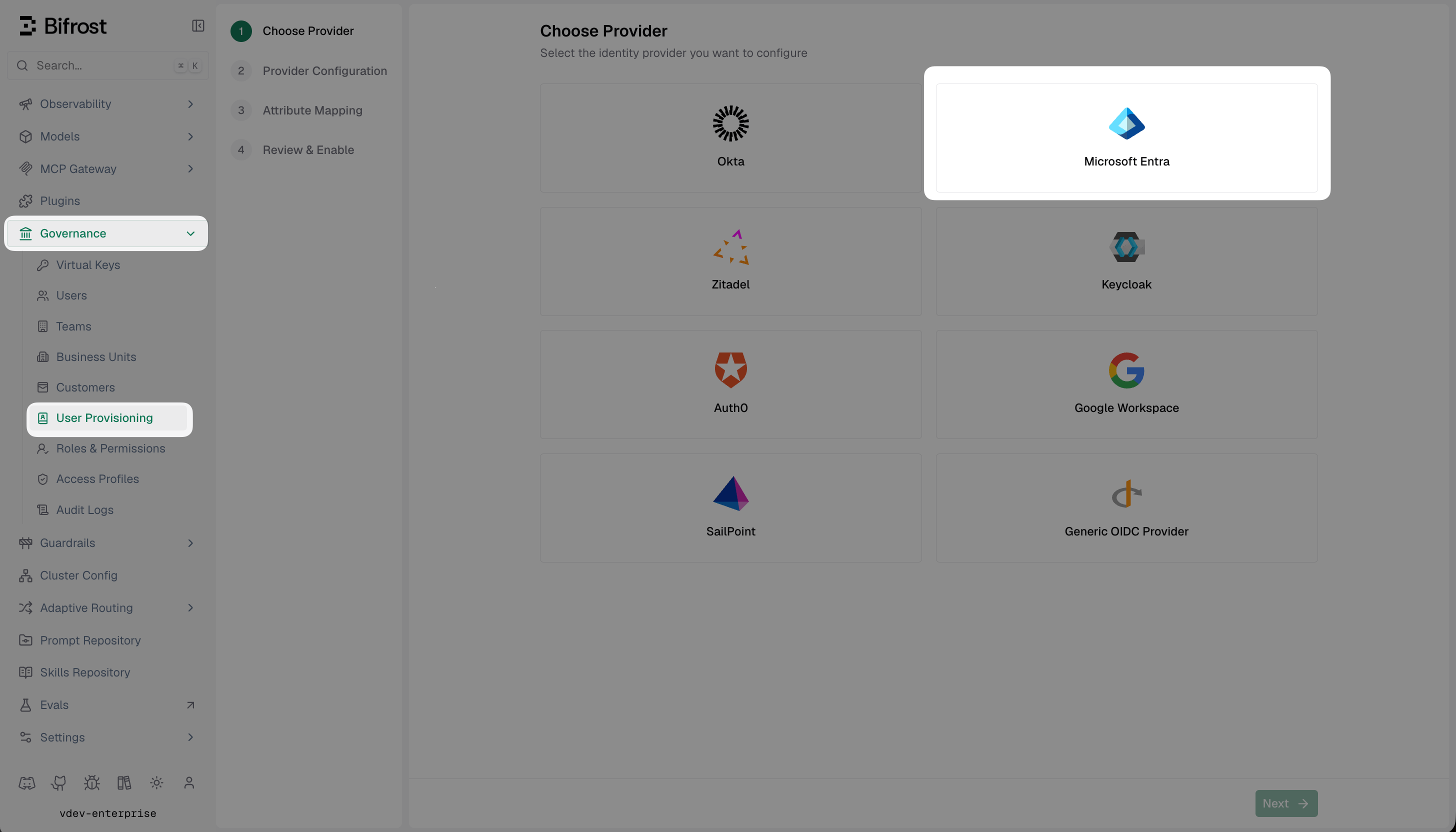
  1. Navigate to GovernanceUser Provisioning in your Bifrost dashboard
  2. Select Microsoft Entra as the SCIM Provider
  3. Enter the following configuration:
FieldValue
Client IDApplication (client) ID from Azure
Tenant IDDirectory (tenant) ID from Azure
Client SecretThe secret you created in Step 4
AudienceYour Client ID (optional, defaults to Client ID)
App ID URIapi://{client-id} (optional, for v1.0 tokens)
  1. Verify configuration and see if you get any errors. Make sure you get no errors/warnings.
  2. Toggle Enabled to activate the provider
  3. Click Save Configuration
After saving, you’ll need to restart your Bifrost server for the changes to take effect.

Configuration Reference

FieldRequiredDescription
tenantIdYesAzure Directory (tenant) ID
clientIdYesApplication (client) ID
clientSecretYesClient secret for OAuth authentication
audienceNoJWT audience for validation (defaults to clientId)
attributeRoleMappingsYesOrdered list of attribute→role mappings. First match wins.
attributeTeamMappingsNoAttribute→team mappings (all matches apply).
attributeBusinessUnitMappingsNoAttribute→business-unit mappings (all matches apply).

Attribute Mappings

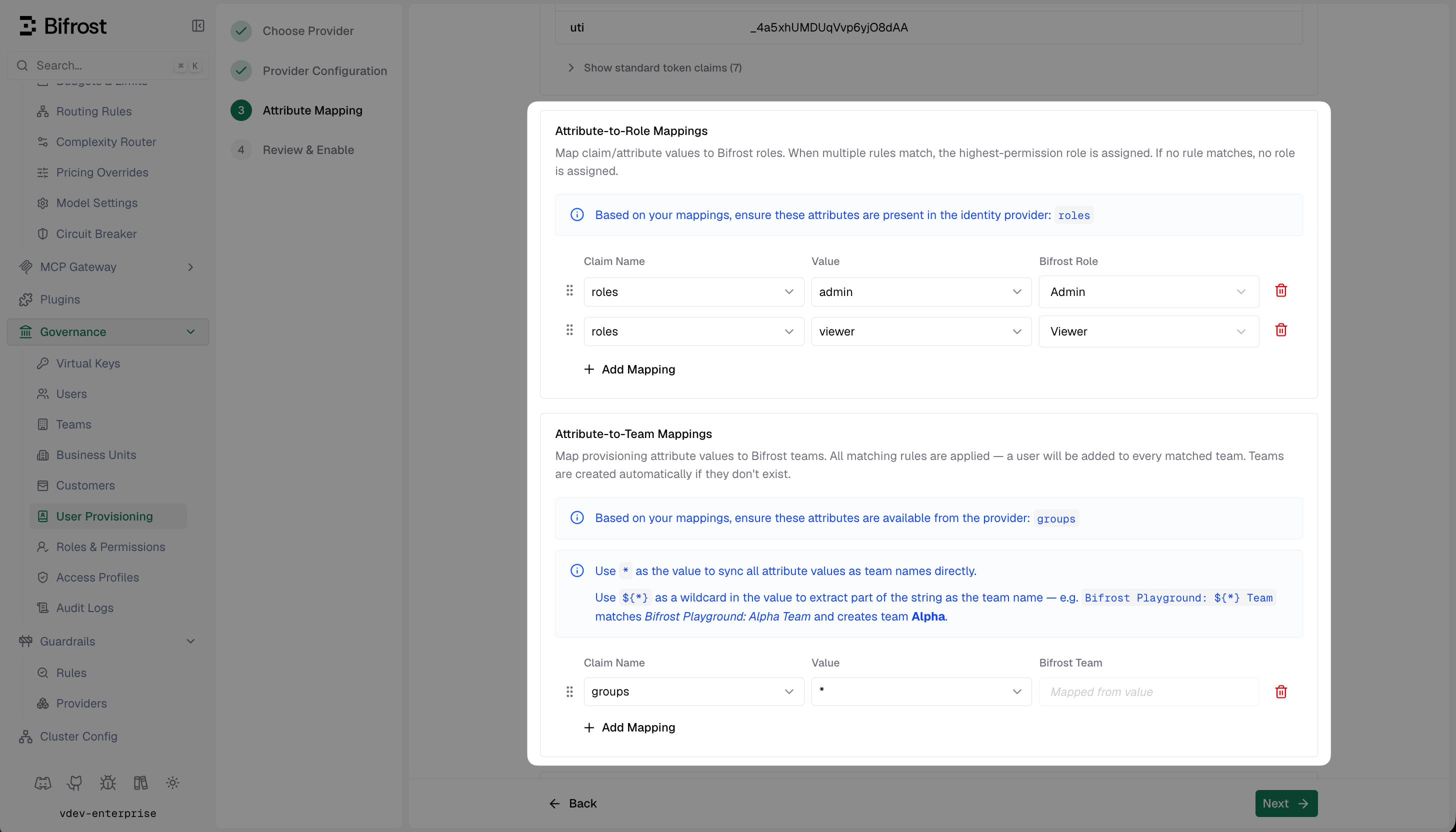
Attribute mappings let you translate Entra claim values into Bifrost roles, teams, or business units without restructuring your Okta claims. Bifrost supports three mapping types:
  • attributeRoleMappings: map a claim value to a Bifrost role (Admin, Developer, Viewer, or a custom role)
  • attributeTeamMappings: map a claim value to a Bifrost team
  • attributeBusinessUnitMappings: map a claim value to a Bifrost business unit
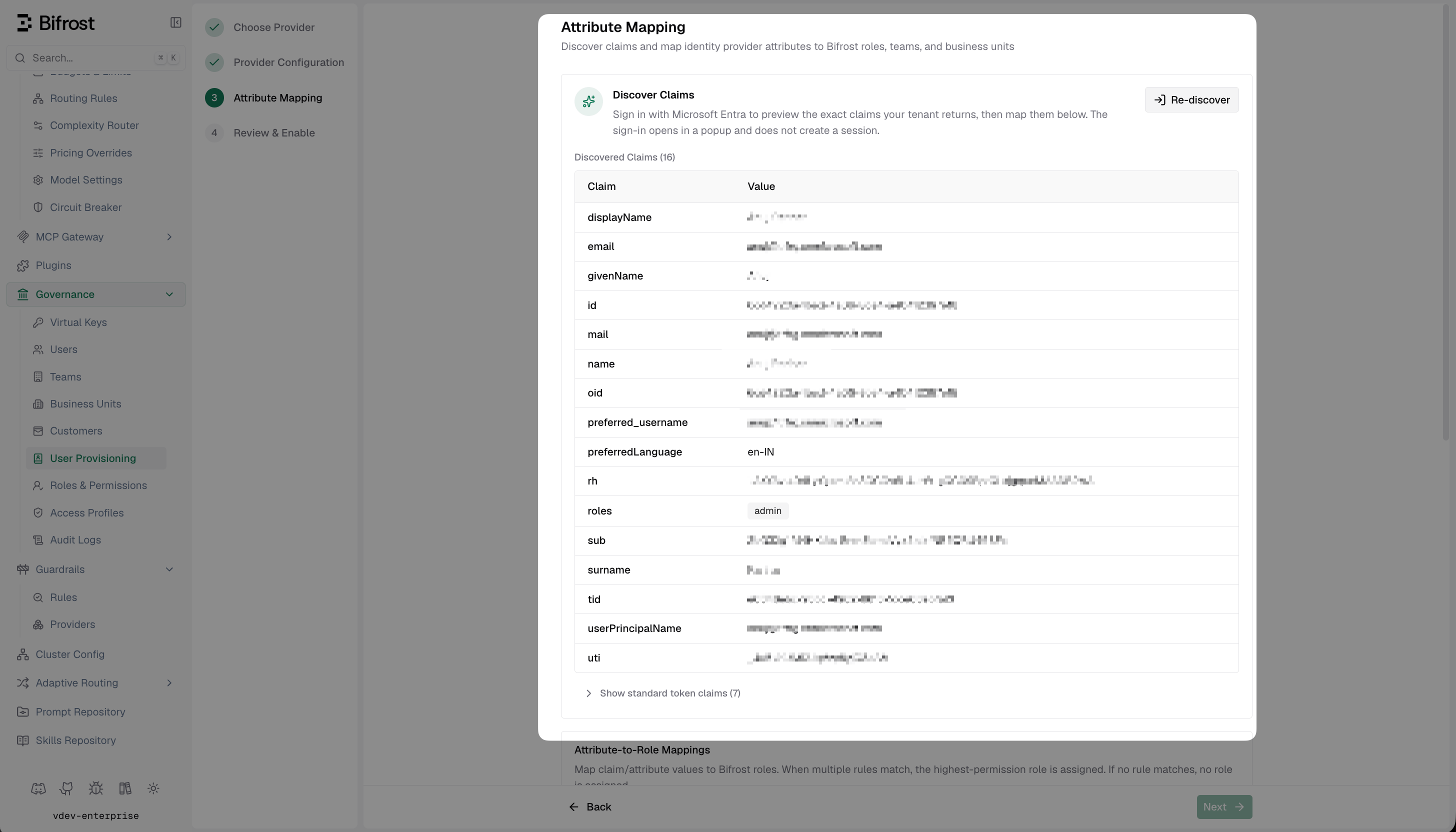
These mappings work with any Entra claim - the groups claim from Step 6, the app-role roles claim from Step 3, or any other claim your authorization server includes in the token (e.g., department, organization). To configure attribute mappings:
  1. In the User Provisioning configuration, scroll down to Attribute Mappings
  2. Click Add Mapping under the relevant mapping type (Role, Team, or Business Unit)
  3. Enter the Attribute (the claim name from the token), the Value to match, and the target Role, Team, or Business Unit
  4. Repeat for each rule you need
Attribute Mappings configuration in Bifrost
When you mark value as ”*” - the claim value is mapped as is to the entity name. Values comparisons are case-insensitive.

Custom attribute mapping

You can also map any custom attributes to any entity (role, team or business unit). Make sure these are configured to send back to Bifrost in token configuration.
Attribute Mappings configuration in Bifrost

Evaluation rules

  • Role mappings: Ordered, first match wins. If no rule matches, users are not allowed to login into the system.
  • Team and business unit mappings: All matching rules apply - users can be placed on multiple teams and business units simultaneously.
  • Claim values: Can be strings, arrays, or nested objects. Bifrost resolves dotted paths (e.g., realm_access.roles).
If a user matches multiple role mapping rules, the highest privilege role is assigned. If no mapping matches, the first user to sign in receives the Admin role, and subsequent users receive the Viewer role.
  1. Click Save Configuration

Testing the Integration

  1. Open your Bifrost dashboard in a new browser or incognito window
  2. You should be redirected to Entra for authentication
  3. Log in with an assigned user
  4. After successful authentication, you’ll be redirected back to Bifrost
  5. Verify the user appears in the Bifrost users list with the correct role

Troubleshooting

User not redirected to Microsoft login

  • Verify the SCIM provider is enabled in Bifrost
  • Check that the Bifrost server was restarted after configuration
  • Ensure the Tenant ID and Client ID are correct

”AADSTS50011: The reply URL does not match”

  • Verify the redirect URI in your app registration exactly matches your Bifrost login URL
  • Ensure there are no trailing slashes or protocol mismatches (http vs https)

“AADSTS7000215: Invalid client secret”

  • Regenerate the client secret in Azure
  • Ensure you’re using the secret Value, not the secret ID
  • Check for any leading/trailing whitespace when copying

Token validation errors

  • Ensure the Tenant ID matches your Azure directory
  • Verify the Client ID is correct
  • Check that the app registration is in the same tenant as your users

Claim "roles" is not present in the token on login

This means the user signed in successfully but Entra did not emit a roles claim in the ID token. Bifrost rejects the login because none of your role mappings can be evaluated. Causes and fixes:
  • User isn’t assigned to a role at the Enterprise Application level. Go to Enterprise applications → Bifrost Enterprise → Users and groups, edit the assignment, and pick a role (admin/developer/viewer). Adding a user to the app without selecting a role does not emit the roles claim.
  • Role assignment is via a group that isn’t itself assigned to the app. The group needs to appear in Users and groups with a role selected — Entra does not walk transitive group memberships to populate roles.
  • Optional roles claim missing from the manifest. Confirm Step 8 (App Manifest) lists roles under optionalClaims.idToken.
  • Sign out and back in. Existing sessions still carry the old token without roles.
If you don’t want to use app roles at all, switch your Bifrost mappings to use the groups attribute (which is already in the token) instead of roles. See Attribute Mappings.

Bulk user sync assigns Viewer instead of the mapped role

If users come in via User Provisioning → Import users and end up on the default role (Viewer) despite having a matching app-role-based mapping configured:
  • Confirm the user actually has the app role assigned in Entra (Enterprise applications → Bifrost Enterprise → Users and groups).
  • Confirm both Application.Read.All and AppRoleAssignment.ReadWrite.All are granted with admin consent in Step 5. Without these, Bifrost cannot read the app role catalog or per-user assignments via Microsoft Graph, so the synthetic roles claim used by the importer will be empty.
  • Server logs will contain [ENTRA-ROLES] failed to fetch app role catalog: ... 403 if the permission is missing.

Next Steps