> ## Documentation Index
> Fetch the complete documentation index at: https://docs.getbifrost.ai/llms.txt
> Use this file to discover all available pages before exploring further.
# Security at Bifrost
> Overview of security practices across Bifrost's CI/CD pipelines, container images, supply chain, and deployment infrastructure.
Bifrost applies defense-in-depth across its open-source and enterprise repositories. Every pull request,
dependency update, and container image goes through multiple layers of automated security checks before
reaching production.
| Domain | Tool / Practice | Coverage |
| ------------------- | ------------------------------ | ------------------------------------- |
| Dependency Scanning | Snyk Open Source | Go, Node, Python - all projects |
| SAST | Snyk Code, CodeQL | Full codebase static analysis |
| Container Scanning | Docker Scout | Docker Hub auto-scan on push |
| Artifact Scanning | GCP Artifact Registry | Enterprise container images |
| Dependency Updates | Dependabot | gomod, npm, Docker, GitHub Actions |
| Supply Chain | SHA pinning, npm provenance | 100 % of GitHub Actions (OSS) |
| Container Hardening | FIPS base image, non-root user | Production Dockerfile |
| Security Hardening | StepSecurity, CODEOWNERS | Workflow hardening, code review gates |
| Network Security | Tailscale VPN | Enterprise deployments |
***
## Vulnerability Scanning - Snyk
Bifrost runs two Snyk scanning jobs on every push and pull request. Results are uploaded as
[SARIF](https://docs.github.com/en/code-security/code-scanning/integrating-with-code-scanning/sarif-support-for-code-scanning)
to the GitHub Security tab.
The **Snyk Open Source** job scans all Go, Node, and Python dependencies for known vulnerabilities.
```yaml theme={null}
snyk test --all-projects --detection-depth=4 --sarif-file-output=snyk.sarif
```
* Scans every module across `core/`, `framework/`, `transports/`, `plugins/`, `ui/`, and `tests/`
* Detection depth of 4 catches transitive dependencies
* Snyk CLI pinned to `v1.1303.2`
The **Snyk Code** job performs Static Application Security Testing on the full codebase.
A complete build is performed first (Go + Node + Python) so Snyk can analyze compiled artifacts.
```yaml theme={null}
snyk code test --sarif-file-output=snyk-code.sarif
```
* Detects injection flaws, hardcoded secrets, insecure crypto, and other code-level vulnerabilities
* Builds the full project before scanning for accurate analysis
Snyk checks can be skipped by including `--skip-ci` in the first line of a commit message. This is
intended for documentation-only or CI configuration changes.
***
## Container Image Security
### Dockerfile Hardening
Production containers follow a strict hardening checklist:
Three stages - UI builder (Node), Go builder, and minimal Alpine runtime - ensure no build tools or
source code leak into the final image.
Production images use a FIPS 140-2 validated Alpine base image with compliant OpenSSL.
The FIPS base image includes a dedicated `appuser`. The container runs as this unprivileged user -
never as root.
Go binaries are compiled with `-ldflags="-w -s"` to strip debug symbols and DWARF information,
reducing attack surface and image size.
Additional hardening measures:
* **Static builds** - Compiled with `-tags "sqlite_static"` and `-extldflags '-static'` for fully static linking
* **Build verification** - `RUN test -f /app/main || exit 1` ensures the binary exists before proceeding
* **CVE patching** - Enterprise Dockerfiles include targeted patches (e.g., `apk upgrade --no-cache openssl` for CVE-2026-22796)
* **Minimal runtime dependencies** - The FIPS base image provides only essential libraries (`musl`, `libgcc`, `ca-certificates`)
```dockerfile theme={null}
# Runtime stage excerpt (production)
FROM
WORKDIR /app
COPY --from=builder /app/main .
COPY --from=builder /app/docker-entrypoint.sh .
RUN mkdir -p $APP_DIR/logs
USER appuser
ENTRYPOINT ["/app/docker-entrypoint.sh"]
CMD ["/app/main"]
```
 ### Docker Scout
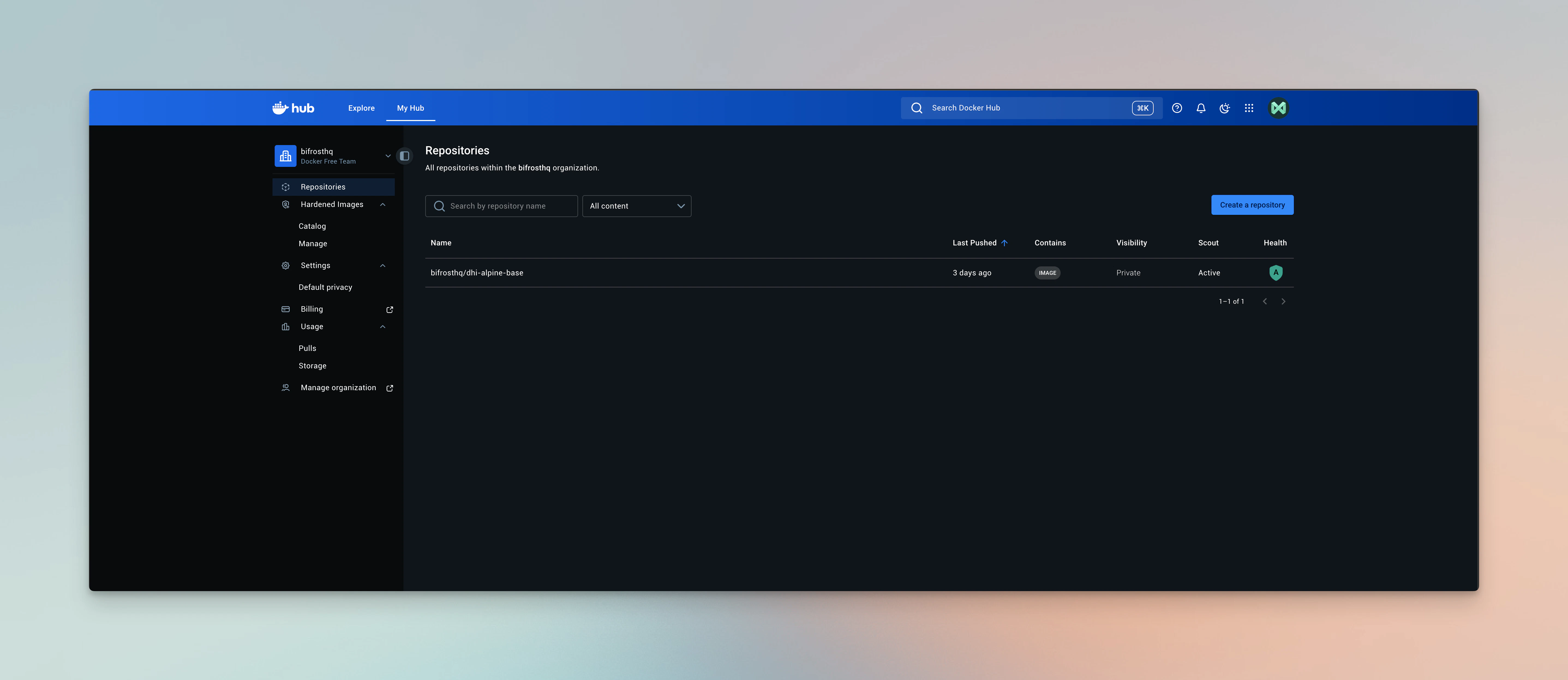
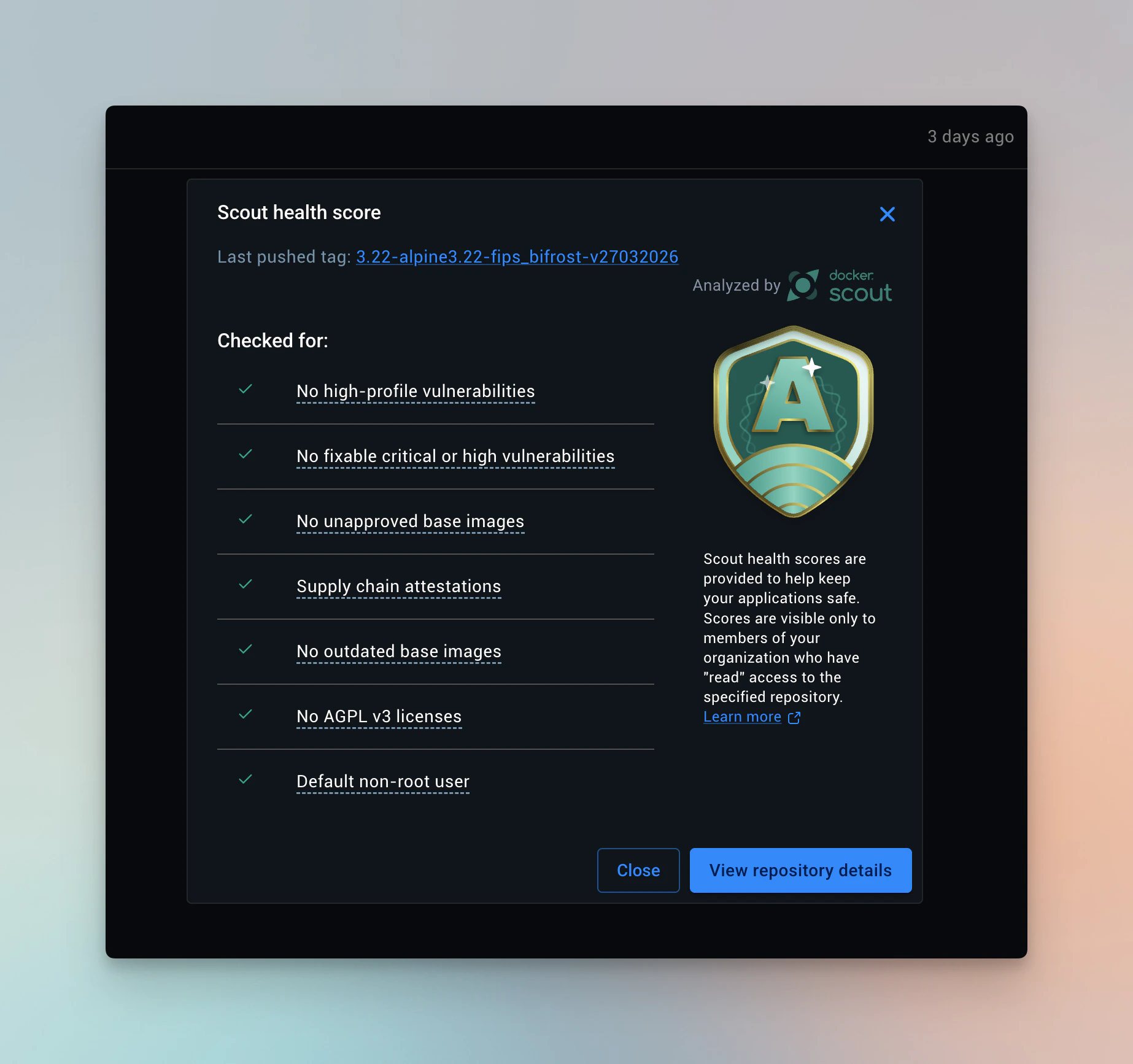
[Docker Scout](https://docs.docker.com/scout/) is enabled at the Docker Hub repository level for the
`maximhq/bifrost` image. Every image pushed to Docker Hub is automatically scanned for CVEs against
continuously updated vulnerability databases.
### Docker Scout
[Docker Scout](https://docs.docker.com/scout/) is enabled at the Docker Hub repository level for the
`maximhq/bifrost` image. Every image pushed to Docker Hub is automatically scanned for CVEs against
continuously updated vulnerability databases.
 ### GCP Artifact Registry Scanning
Enterprise images are pushed to **GCP Artifact Registry** (and AWS ECR for select environments).
GCP Artifact Registry provides [built-in vulnerability scanning](https://cloud.google.com/artifact-registry/docs/analysis)
that automatically analyzes container images for OS and language package vulnerabilities.
***
## Supply Chain Security
### GitHub Actions SHA Pinning
All GitHub Actions in the open-source repository are pinned to exact commit SHAs - not mutable version
tags. This prevents supply chain attacks where a compromised action maintainer could push malicious code
to an existing tag.
```yaml theme={null}
# Every action is pinned to a full SHA with a version comment
- uses: actions/checkout@de0fac2e4500dabe0009e67214ff5f5447ce83dd # v6.0.2
- uses: actions/setup-go@4b73464bb391d4059bd26b0524d20df3927bd417 # v6.3.0
- uses: docker/build-push-action@10e90e3645eae34f1e60eeb005ba3a3d33f178e8 # v6.19.2
```
**Coverage:**
| Repository | Pinning Strategy | Actions Pinned |
| -------------------- | ----------------------------- | ----------------- |
| `bifrost` (OSS) | Full SHA with version comment | 103 / 103 (100 %) |
| `bifrost-enterprise` | Full SHA with version comment | 103 / 103 (100 %) |
### NPM Provenance
Published npm packages include [SLSA provenance attestations](https://docs.npmjs.com/generating-provenance-statements),
providing a verifiable link between the published package and its source commit.
```yaml theme={null}
permissions:
id-token: write # Required for npm provenance
# ...
npm publish --provenance --access public
```
### Dependency Pinning in CI
All language runtimes are pinned to specific versions across CI workflows to ensure reproducible builds
and prevent unexpected behavior from runtime updates.
| Runtime | Pinned Version | Used For |
| ------- | ----------------------------------- | -------------------------------- |
| Go | `1.26.1` | Core build, tests |
| Node | `25` | UI build, npm packages |
| Python | `3.11` | Integration and governance tests |
| uv | SHA-pinned via `astral-sh/setup-uv` | Python package management |
Python test dependencies are locked via `uv.lock` files for deterministic, reproducible installs:
```
tests/integrations/uv.lock
tests/governance/uv.lock
```
### GCP Artifact Registry Scanning
Enterprise images are pushed to **GCP Artifact Registry** (and AWS ECR for select environments).
GCP Artifact Registry provides [built-in vulnerability scanning](https://cloud.google.com/artifact-registry/docs/analysis)
that automatically analyzes container images for OS and language package vulnerabilities.
***
## Supply Chain Security
### GitHub Actions SHA Pinning
All GitHub Actions in the open-source repository are pinned to exact commit SHAs - not mutable version
tags. This prevents supply chain attacks where a compromised action maintainer could push malicious code
to an existing tag.
```yaml theme={null}
# Every action is pinned to a full SHA with a version comment
- uses: actions/checkout@de0fac2e4500dabe0009e67214ff5f5447ce83dd # v6.0.2
- uses: actions/setup-go@4b73464bb391d4059bd26b0524d20df3927bd417 # v6.3.0
- uses: docker/build-push-action@10e90e3645eae34f1e60eeb005ba3a3d33f178e8 # v6.19.2
```
**Coverage:**
| Repository | Pinning Strategy | Actions Pinned |
| -------------------- | ----------------------------- | ----------------- |
| `bifrost` (OSS) | Full SHA with version comment | 103 / 103 (100 %) |
| `bifrost-enterprise` | Full SHA with version comment | 103 / 103 (100 %) |
### NPM Provenance
Published npm packages include [SLSA provenance attestations](https://docs.npmjs.com/generating-provenance-statements),
providing a verifiable link between the published package and its source commit.
```yaml theme={null}
permissions:
id-token: write # Required for npm provenance
# ...
npm publish --provenance --access public
```
### Dependency Pinning in CI
All language runtimes are pinned to specific versions across CI workflows to ensure reproducible builds
and prevent unexpected behavior from runtime updates.
| Runtime | Pinned Version | Used For |
| ------- | ----------------------------------- | -------------------------------- |
| Go | `1.26.1` | Core build, tests |
| Node | `25` | UI build, npm packages |
| Python | `3.11` | Integration and governance tests |
| uv | SHA-pinned via `astral-sh/setup-uv` | Python package management |
Python test dependencies are locked via `uv.lock` files for deterministic, reproducible installs:
```
tests/integrations/uv.lock
tests/governance/uv.lock
```
 ***
## Dependency Management - Dependabot
Dependabot monitors four ecosystems on a weekly schedule, automatically opening pull requests for
outdated or vulnerable dependencies.
Covers `/core`, `/framework`, `/transports`, `/plugins/*`, and `/examples/**`
Covers `/ui`, `/npx`, and `/examples/**`
Monitors base images in `/transports`
Tracks action version updates across all workflows
A separate **Dependabot Alerts** workflow runs daily and automatically
creates GitHub issues for any open Dependabot security alerts, categorized by severity and ecosystem.
***
## Code Analysis - CodeQL
GitHub's [CodeQL](https://codeql.github.com/) performs semantic code analysis on every push and pull request,
complementing Snyk's SAST coverage with GitHub-native findings.
* Analyzes Go and JavaScript/TypeScript codebases
* Detects security vulnerabilities, bugs, and code quality issues using GitHub's query suites
* Results appear directly in the GitHub Security tab alongside Snyk findings
***
## Dependency Management - Dependabot
Dependabot monitors four ecosystems on a weekly schedule, automatically opening pull requests for
outdated or vulnerable dependencies.
Covers `/core`, `/framework`, `/transports`, `/plugins/*`, and `/examples/**`
Covers `/ui`, `/npx`, and `/examples/**`
Monitors base images in `/transports`
Tracks action version updates across all workflows
A separate **Dependabot Alerts** workflow runs daily and automatically
creates GitHub issues for any open Dependabot security alerts, categorized by severity and ecosystem.
***
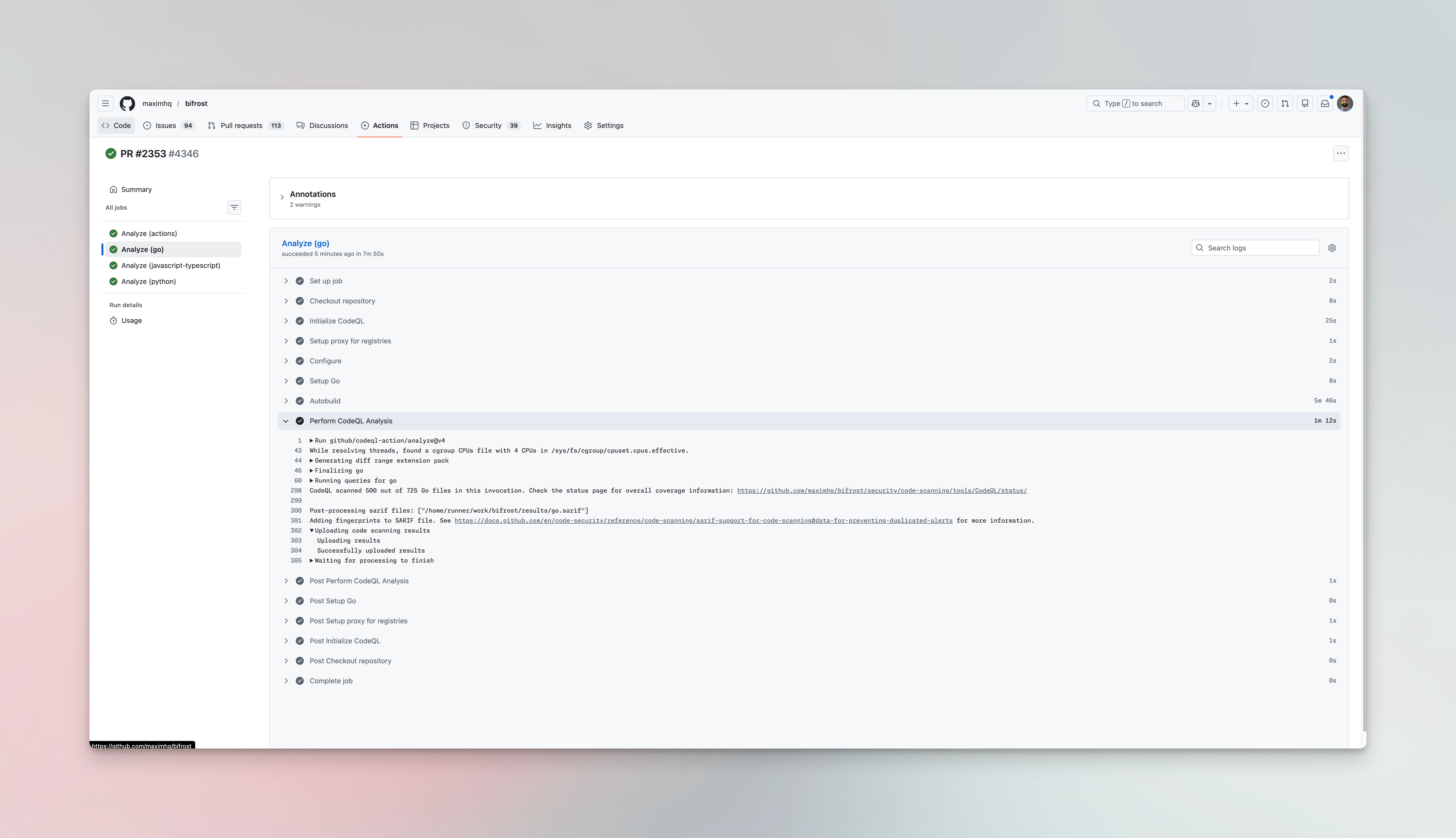
## Code Analysis - CodeQL
GitHub's [CodeQL](https://codeql.github.com/) performs semantic code analysis on every push and pull request,
complementing Snyk's SAST coverage with GitHub-native findings.
* Analyzes Go and JavaScript/TypeScript codebases
* Detects security vulnerabilities, bugs, and code quality issues using GitHub's query suites
* Results appear directly in the GitHub Security tab alongside Snyk findings
 ***
## Workflow & Network Security
### Principle of Least Privilege
All GitHub Actions workflows follow the principle of least privilege. Permissions are set at the
job level, not the workflow level, and are scoped to the minimum required.
| Permission | Granted To | Reason |
| ------------------------ | ----------------------- | -------------------------------- |
| `contents: read` | All jobs (default) | Read repository code |
| `contents: write` | Tag creation, releases | Create git tags and releases |
| `security-events: write` | Snyk jobs | Upload SARIF to Security tab |
| `id-token: write` | Cloud auth, npm publish | OIDC federation, npm provenance |
| `pull-requests: write` | PR test reporters | Post test results as PR comments |
### Tailscale VPN
Enterprise deployment workflows authenticate through [Tailscale](https://tailscale.com/) before
accessing any infrastructure. This ensures that CI/CD runners can only reach deployment targets
through an encrypted, identity-aware network - never over the public internet.
```yaml theme={null}
- name: Authenticate Tailscale
uses: tailscale/github-action@v4
with:
oauth-client-id: '${{ secrets.TS_OAUTH_CLIENT_ID }}'
oauth-secret: '${{ secrets.TS_OAUTH_SECRET }}'
tags: 'tag:gha-ci'
version: 1.84.0
```
* **OAuth-based authentication** - No long-lived API keys; runners authenticate via OAuth client credentials
* **Version pinned** - Tailscale `1.84.0` to prevent unexpected behavior from updates
* **Tagged runners** - `gha-ci` tag enables Tailscale ACL policies scoped to CI/CD access
### StepSecurity
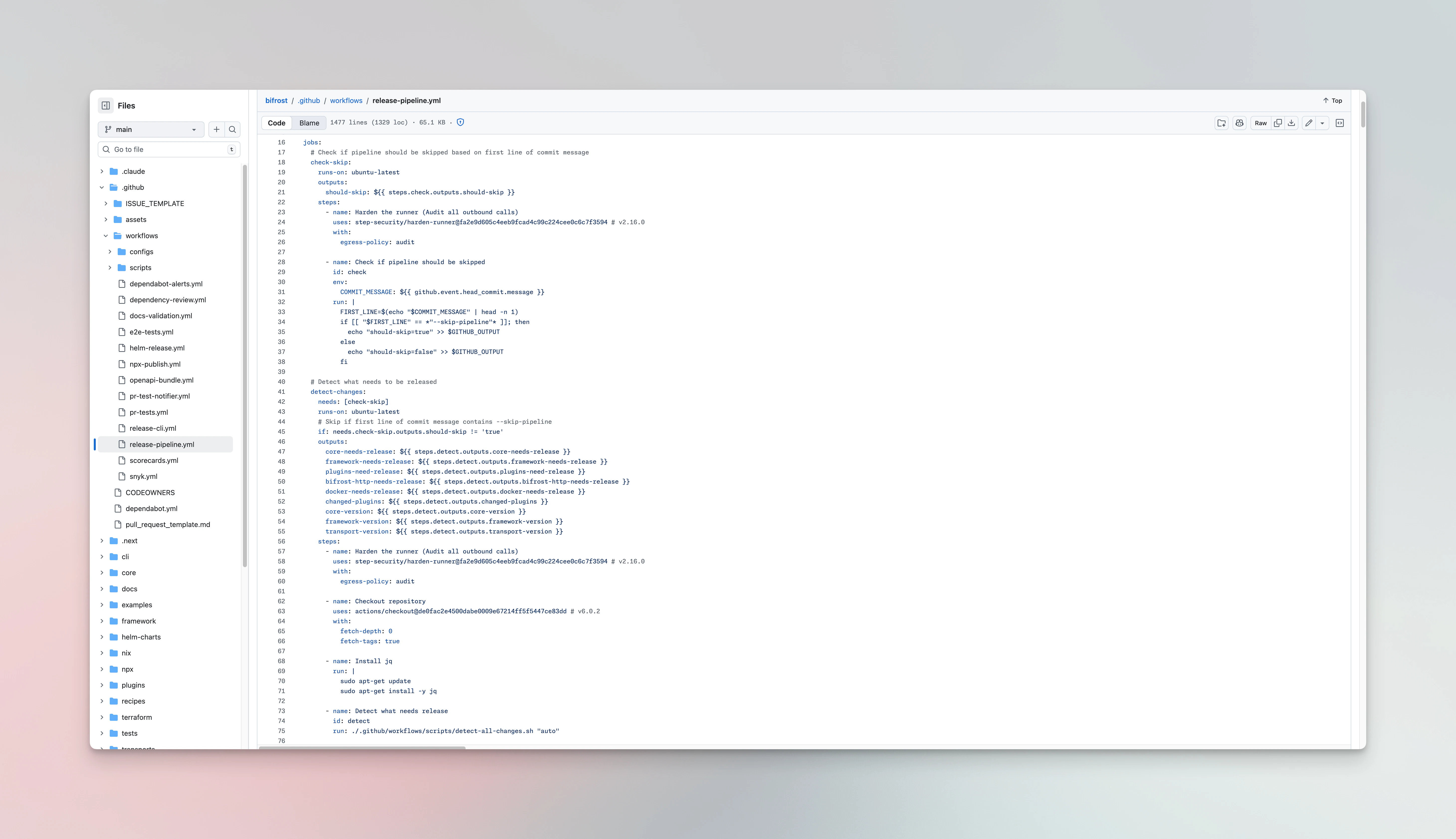
[StepSecurity](https://www.stepsecurity.io/) automatically hardens GitHub Actions workflows by applying
security best practices across all CI/CD pipelines.
* Adds `permissions` blocks to workflows that are missing them
* Pins action versions to full SHAs where mutable tags were used
* Detects insecure patterns like unquoted interpolations and artifact poisoning risks
***
## Workflow & Network Security
### Principle of Least Privilege
All GitHub Actions workflows follow the principle of least privilege. Permissions are set at the
job level, not the workflow level, and are scoped to the minimum required.
| Permission | Granted To | Reason |
| ------------------------ | ----------------------- | -------------------------------- |
| `contents: read` | All jobs (default) | Read repository code |
| `contents: write` | Tag creation, releases | Create git tags and releases |
| `security-events: write` | Snyk jobs | Upload SARIF to Security tab |
| `id-token: write` | Cloud auth, npm publish | OIDC federation, npm provenance |
| `pull-requests: write` | PR test reporters | Post test results as PR comments |
### Tailscale VPN
Enterprise deployment workflows authenticate through [Tailscale](https://tailscale.com/) before
accessing any infrastructure. This ensures that CI/CD runners can only reach deployment targets
through an encrypted, identity-aware network - never over the public internet.
```yaml theme={null}
- name: Authenticate Tailscale
uses: tailscale/github-action@v4
with:
oauth-client-id: '${{ secrets.TS_OAUTH_CLIENT_ID }}'
oauth-secret: '${{ secrets.TS_OAUTH_SECRET }}'
tags: 'tag:gha-ci'
version: 1.84.0
```
* **OAuth-based authentication** - No long-lived API keys; runners authenticate via OAuth client credentials
* **Version pinned** - Tailscale `1.84.0` to prevent unexpected behavior from updates
* **Tagged runners** - `gha-ci` tag enables Tailscale ACL policies scoped to CI/CD access
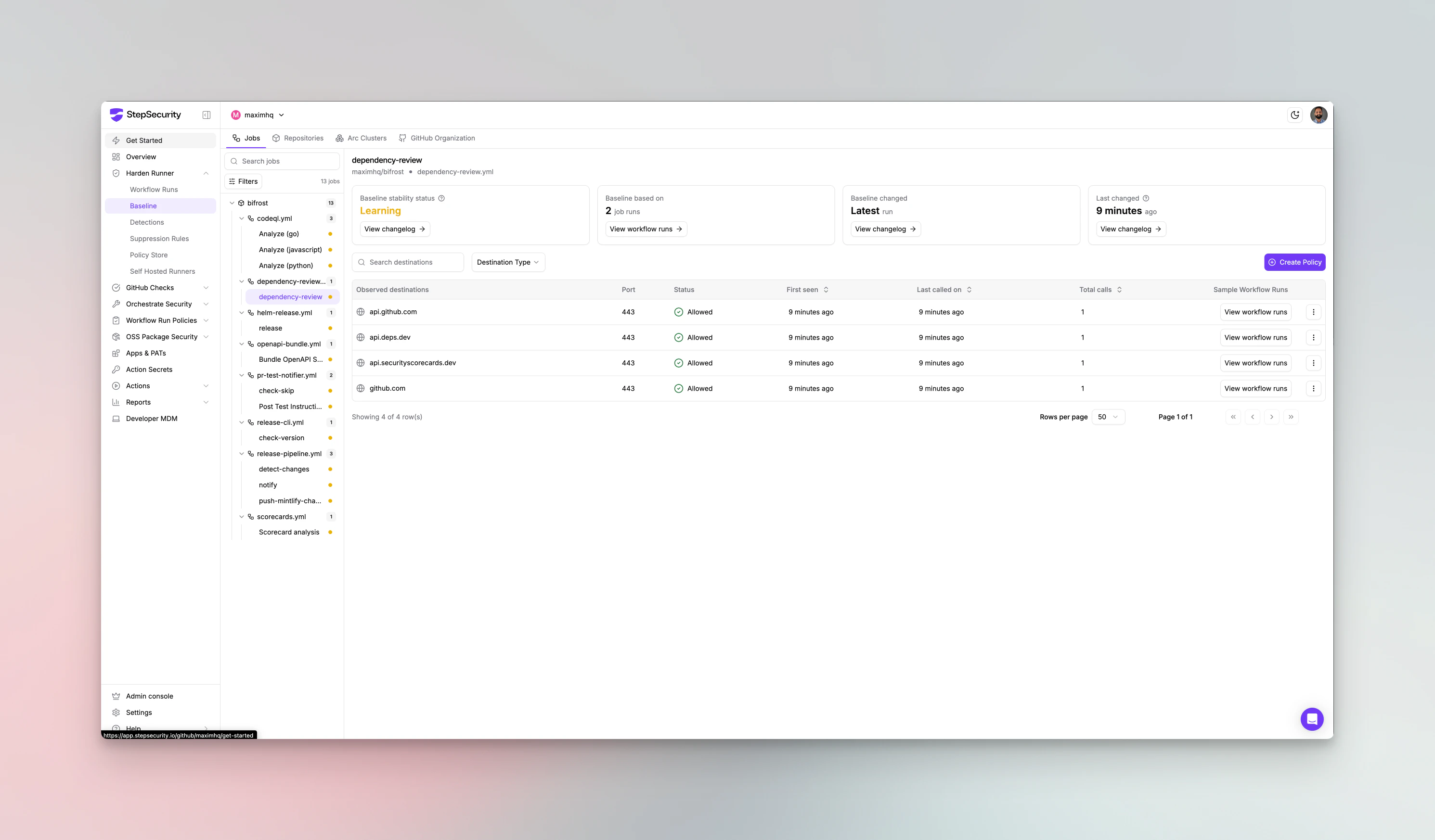
### StepSecurity
[StepSecurity](https://www.stepsecurity.io/) automatically hardens GitHub Actions workflows by applying
security best practices across all CI/CD pipelines.
* Adds `permissions` blocks to workflows that are missing them
* Pins action versions to full SHAs where mutable tags were used
* Detects insecure patterns like unquoted interpolations and artifact poisoning risks
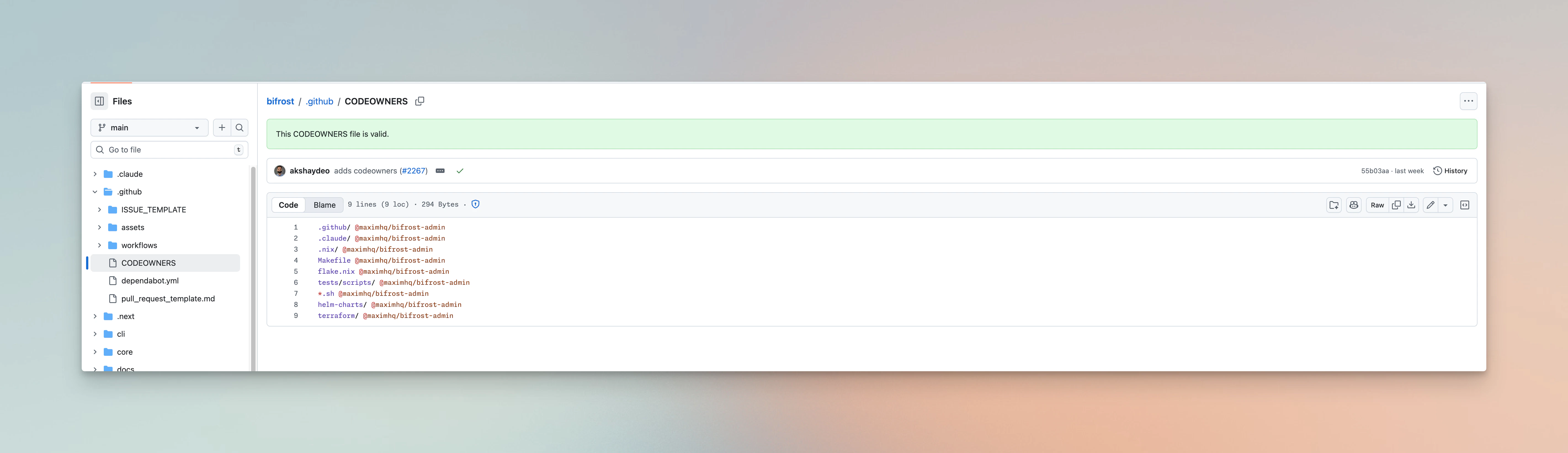
 ### CODEOWNERS
Critical paths in the repository are protected by a `CODEOWNERS` file, ensuring that changes to
security-sensitive areas require review from designated maintainers before merging.
### CODEOWNERS
Critical paths in the repository are protected by a `CODEOWNERS` file, ensuring that changes to
security-sensitive areas require review from designated maintainers before merging.