> ## Documentation Index
> Fetch the complete documentation index at: https://docs.getbifrost.ai/llms.txt
> Use this file to discover all available pages before exploring further.
# Redaction Modes
> Configure Bifrost-managed guardrail redaction for runtime payloads, Bifrost logs, and trace-export connectors.
## Overview
Guardrail redaction lets Bifrost rewrite sensitive text detected by supported guardrail providers instead of only detecting or blocking it.
Bifrost-managed redaction is supported by:
* [Custom Regex](/enterprise/guardrails/custom-regex)
* [Secrets Detection](/enterprise/guardrails/secrets-detection)
* [Microsoft Presidio](/integrations/guardrails/presidio)
* [Azure AI Language PII](/integrations/guardrails/azure-language-pii)
Each provider can produce findings with byte ranges and entity types such as `EMAIL`, `PHONE_NUMBER`, `AWS_ACCESS_TOKEN`, or a custom regex `entity_type`. Bifrost then applies the configured redaction action, strategy, and mode.
Redaction only applies to text that a guardrail provider detects. If a provider does not detect a value, Bifrost cannot redact that value in runtime payloads, logs, or connector exports.
## Bifrost-Managed vs Provider-Managed Rewrites
Bifrost-managed redaction is different from provider-managed transformation.
* **Bifrost-managed redaction** means the guardrail provider returns findings, and Bifrost applies the replacement using `redaction_strategy` and `redaction_mode`.
* **Provider-managed transformation** means an external guardrail provider returns already-transformed text for Bifrost to apply.
Only one rewrite owner can apply to a given request or response phase. If the same phase produces both provider-managed transformed text and Bifrost-managed redaction findings, Bifrost fails closed with a guardrail intervention instead of trying to merge the two rewritten outputs. Bifrost also rejects multiple provider-managed transformed outputs for the same phase because the final replacement would be ambiguous.
Detection-only and blocking guardrails can still run alongside Bifrost-managed redaction. The restriction applies when more than one guardrail path attempts to rewrite the same input or output content.
## Actions
The `action` field controls what happens when the provider finds sensitive text.
| Action | Behavior |
| ------------- | ---------------------------------------------------------------------- |
| `detect_only` | Records the detection but does not block or rewrite content. |
| `block` | Returns a guardrail intervention when a detection is found. |
| `redact` | Rewrites detected text using the selected redaction strategy and mode. |
`redaction_strategy` and `redaction_mode` only change request, response, log, or trace content when `action` is `redact`.
## Redaction Strategies
Strategies control the replacement value used by the non-reversible `runtime` mode.
| Strategy | Example | Notes |
| --------- | ------------------------------------------------ | ------------------------------------------------------- |
| `replace` | `alex@example.com` -> `[EMAIL]` | Default strategy. Keeps only the entity type. |
| `mask` | `alex@example.com` -> `[EMAIL:****************]` | Preserves approximate value length with `*`. |
| `hash` | `alex@example.com` -> `[EMAIL:8c7dd922ad47494f]` | Uses a deterministic short hash for the detected value. |
Reversible modes use numbered placeholders such as `[EMAIL-1]` so a permitted user can reveal the original values in Bifrost logs.
## Redaction Modes
Redaction mode decides where Bifrost applies the rewrite.
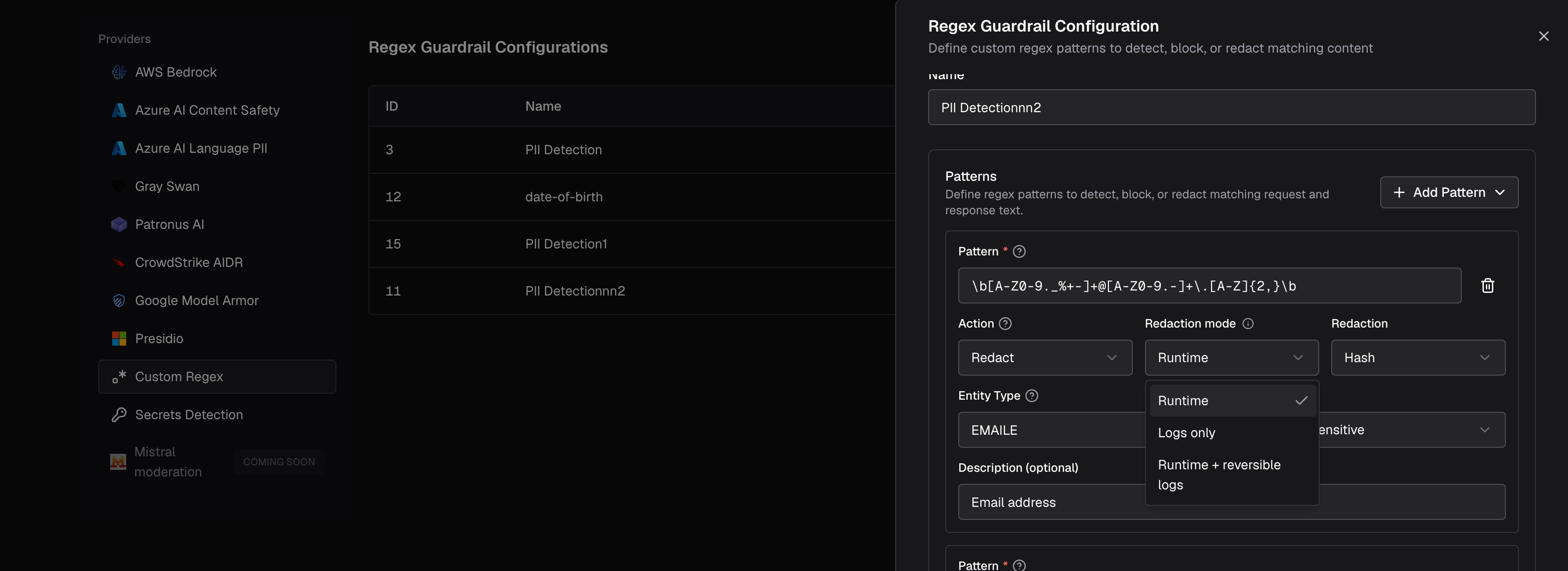 | Mode | API value | Runtime request/response | Bifrost logs | Trace/export connectors | Reveal supported |
| ------------------------- | -------------------- | ------------------------------------------ | ------------------------------------- | ----------------------- | -------------------------- |
| Runtime | `runtime` | Redacted with `replace`, `mask`, or `hash` | Redacted the same way | Redacted content only | No |
| Logs only | `logs_only` | Left raw | Redacted with reversible placeholders | Placeholderized content | Yes, for Bifrost logs only |
| Runtime + reversible logs | `runtime_reversible` | Redacted with reversible placeholders | Redacted with reversible placeholders | Placeholderized content | Yes, for Bifrost logs only |
### Runtime (`runtime`)
Use `runtime` when sensitive text should not reach the model provider or the caller. Bifrost rewrites detected text in the live request or response and stores the already-redacted value in Bifrost logs.
Example with `redaction_strategy: "replace"`:
```text theme={null}
Contact alex@example.com
```
becomes:
```text theme={null}
Contact [EMAIL]
```
### Logs only (`logs_only`)
Use `logs_only` when the model should receive the original text, but Bifrost logs and trace exports should not store raw sensitive values.
Runtime content stays unchanged. Bifrost logs and trace-export connectors receive placeholders:
```text theme={null}
Contact [EMAIL-1]
```
The placeholder mapping is stored with the Bifrost log row for reveal. It is not sent to connectors.
### Runtime + reversible logs (`runtime_reversible`)
Use `runtime_reversible` when runtime content should be redacted, but authorized users still need a controlled way to view the original values in Bifrost logs.
Runtime content, Bifrost logs, and trace-export connectors use the same placeholder style:
```text theme={null}
Contact [EMAIL-1]
```
## Reveal
Reveal is Enterprise-only and applies only to Bifrost logs.
Users need the `Logs:Reveal` permission to reveal original values for a log that has reversible redaction data. When the caller has that permission, the log detail response can include the placeholder mapping for that log, for example:
```json theme={null}
{
"redaction_mapping": {
"input": {
"EMAIL-1": "alex@example.com"
},
"output": {
"PHONE_NUMBER-1": "+1 555 0100"
}
}
}
```
Important details:
* Reveal is scoped to Bifrost logs, not external destinations.
* The mapping is stored with the log row and is deleted when the log row is deleted.
* When an encryption key is configured, the mapping is encrypted before storage.
* The reveal response is marked `Cache-Control: no-store`.
* Data Access Control still applies when fetching or revealing a log.
If content logging is disabled, Bifrost does not persist request/response content or redaction reveal data for that log. In that setup, there is nothing to reveal later.
## Connector Exports
For trace-export connectors, Bifrost applies raw-to-placeholder replacements before the completed trace is exported.
This keeps exported span content aligned with Bifrost log redaction for reversible modes, while keeping the reversible mapping inside Bifrost.
| Destination type | Behavior |
| ------------------------------------------------------------------------------------ | ----------------------------------------------------------------------------------- |
| Trace-export connectors such as OpenTelemetry, Datadog, Kafka, Pub/Sub, and BigQuery | Receive redacted or placeholderized content. The reveal mapping is not exported. |
| Prometheus metrics | No request/response content is exported, so there is no redaction payload to apply. |
| Bifrost logs | Store redacted content and, for reversible modes, the reveal mapping. |
This section describes Bifrost's completed-trace export path. Integrations that do not consume completed Bifrost traces should not be assumed to receive the same connector redaction behavior.
## Provider Defaults
| Provider | Default action | Default strategy | Default mode |
| --------------------- | -------------- | ---------------- | ------------ |
| Custom Regex | `block` | `replace` | `runtime` |
| Secrets Detection | `block` | `replace` | `runtime` |
| Microsoft Presidio | `detect_only` | `replace` | `runtime` |
| Azure AI Language PII | `detect_only` | `replace` | `runtime` |
For redaction, set `action: "redact"` explicitly. Relying on defaults is usually the wrong move here, especially for Presidio and Azure AI Language PII.
## Edge Cases
* Redaction is text-based. It does not inspect image pixels, audio, or arbitrary binary content.
* Custom Regex uses Go's RE2-compatible regexp engine.
* Overlapping findings are resolved into a non-overlapping set before replacement.
* Bifrost-managed redaction cannot be combined with provider-managed transformed output for the same request or response phase.
* Input redaction cannot safely run together with raw-body passthrough transformations; Bifrost fails closed rather than forwarding an inconsistent payload.
* If a request uses both input and output redaction, Bifrost carries replacements forward so raw log fields and exported trace content are redacted consistently.
| Mode | API value | Runtime request/response | Bifrost logs | Trace/export connectors | Reveal supported |
| ------------------------- | -------------------- | ------------------------------------------ | ------------------------------------- | ----------------------- | -------------------------- |
| Runtime | `runtime` | Redacted with `replace`, `mask`, or `hash` | Redacted the same way | Redacted content only | No |
| Logs only | `logs_only` | Left raw | Redacted with reversible placeholders | Placeholderized content | Yes, for Bifrost logs only |
| Runtime + reversible logs | `runtime_reversible` | Redacted with reversible placeholders | Redacted with reversible placeholders | Placeholderized content | Yes, for Bifrost logs only |
### Runtime (`runtime`)
Use `runtime` when sensitive text should not reach the model provider or the caller. Bifrost rewrites detected text in the live request or response and stores the already-redacted value in Bifrost logs.
Example with `redaction_strategy: "replace"`:
```text theme={null}
Contact alex@example.com
```
becomes:
```text theme={null}
Contact [EMAIL]
```
### Logs only (`logs_only`)
Use `logs_only` when the model should receive the original text, but Bifrost logs and trace exports should not store raw sensitive values.
Runtime content stays unchanged. Bifrost logs and trace-export connectors receive placeholders:
```text theme={null}
Contact [EMAIL-1]
```
The placeholder mapping is stored with the Bifrost log row for reveal. It is not sent to connectors.
### Runtime + reversible logs (`runtime_reversible`)
Use `runtime_reversible` when runtime content should be redacted, but authorized users still need a controlled way to view the original values in Bifrost logs.
Runtime content, Bifrost logs, and trace-export connectors use the same placeholder style:
```text theme={null}
Contact [EMAIL-1]
```
## Reveal
Reveal is Enterprise-only and applies only to Bifrost logs.
Users need the `Logs:Reveal` permission to reveal original values for a log that has reversible redaction data. When the caller has that permission, the log detail response can include the placeholder mapping for that log, for example:
```json theme={null}
{
"redaction_mapping": {
"input": {
"EMAIL-1": "alex@example.com"
},
"output": {
"PHONE_NUMBER-1": "+1 555 0100"
}
}
}
```
Important details:
* Reveal is scoped to Bifrost logs, not external destinations.
* The mapping is stored with the log row and is deleted when the log row is deleted.
* When an encryption key is configured, the mapping is encrypted before storage.
* The reveal response is marked `Cache-Control: no-store`.
* Data Access Control still applies when fetching or revealing a log.
If content logging is disabled, Bifrost does not persist request/response content or redaction reveal data for that log. In that setup, there is nothing to reveal later.
## Connector Exports
For trace-export connectors, Bifrost applies raw-to-placeholder replacements before the completed trace is exported.
This keeps exported span content aligned with Bifrost log redaction for reversible modes, while keeping the reversible mapping inside Bifrost.
| Destination type | Behavior |
| ------------------------------------------------------------------------------------ | ----------------------------------------------------------------------------------- |
| Trace-export connectors such as OpenTelemetry, Datadog, Kafka, Pub/Sub, and BigQuery | Receive redacted or placeholderized content. The reveal mapping is not exported. |
| Prometheus metrics | No request/response content is exported, so there is no redaction payload to apply. |
| Bifrost logs | Store redacted content and, for reversible modes, the reveal mapping. |
This section describes Bifrost's completed-trace export path. Integrations that do not consume completed Bifrost traces should not be assumed to receive the same connector redaction behavior.
## Provider Defaults
| Provider | Default action | Default strategy | Default mode |
| --------------------- | -------------- | ---------------- | ------------ |
| Custom Regex | `block` | `replace` | `runtime` |
| Secrets Detection | `block` | `replace` | `runtime` |
| Microsoft Presidio | `detect_only` | `replace` | `runtime` |
| Azure AI Language PII | `detect_only` | `replace` | `runtime` |
For redaction, set `action: "redact"` explicitly. Relying on defaults is usually the wrong move here, especially for Presidio and Azure AI Language PII.
## Edge Cases
* Redaction is text-based. It does not inspect image pixels, audio, or arbitrary binary content.
* Custom Regex uses Go's RE2-compatible regexp engine.
* Overlapping findings are resolved into a non-overlapping set before replacement.
* Bifrost-managed redaction cannot be combined with provider-managed transformed output for the same request or response phase.
* Input redaction cannot safely run together with raw-body passthrough transformations; Bifrost fails closed rather than forwarding an inconsistent payload.
* If a request uses both input and output redaction, Bifrost carries replacements forward so raw log fields and exported trace content are redacted consistently.